Professional haircuts for men are not one particular cut. They are any cut where the sides sit off the ears, the neckline is tidy, and the shape still looks deliberate three weeks after you paid for it. A short back and sides, a low taper, a French crop and a scissor cut with a side part all clear that bar. What gets a man noticed at work for the wrong reason is rarely the length on top. It is the edges.
Professional Haircuts for Men: Office Guide
Which professional haircuts suit men who work in an office, how long each one holds its shape, and the words to use in the chair to get it right.
6 min readGolden Scissors, Maida Vale, London
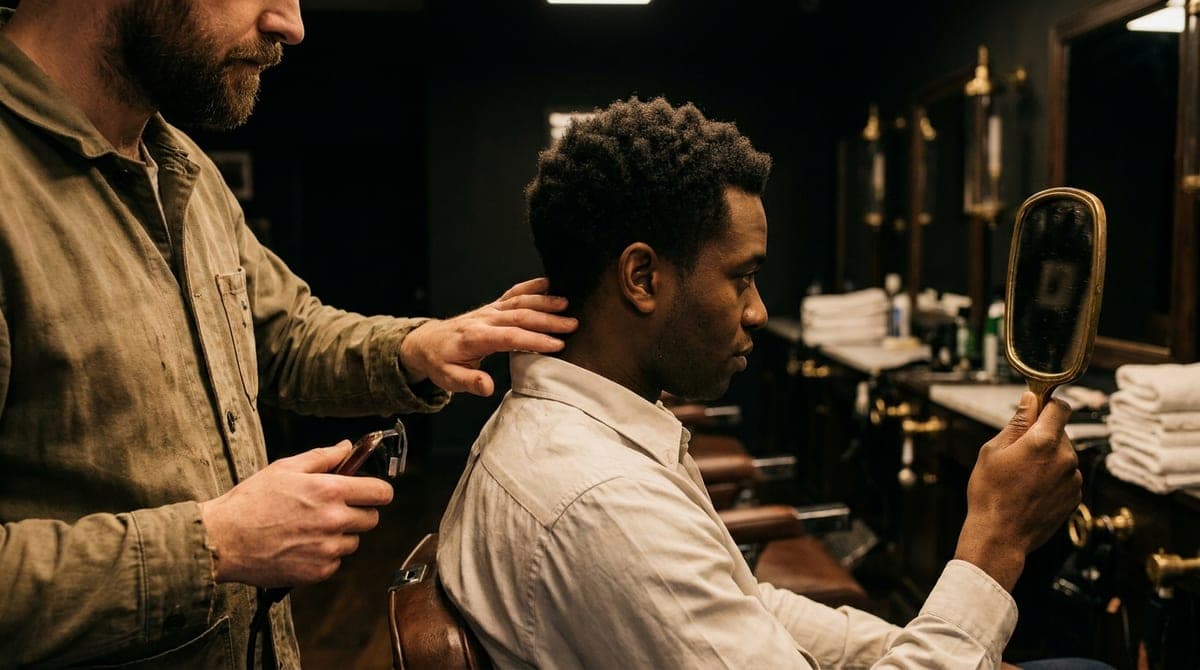
What makes a cut read as professional
Short does not automatically mean smart. We cut men who carry four inches on top and look completely at home in a boardroom, and we have watched a number two all over make a man look like he lost a bet.
Three things do the actual work.
The perimeter. Hair off the ears, hair off the collar. That is most of the job. A cut can hold real length on top and still look tidy if the outline around it is clean.
The neckline. You never see the back of your own head, so this is the part men leave to the barber and then live with for a month. A square neckline is the sharpest on the day. It also grows a shelf, and by week three there is a line of hair sitting below the line somebody cut. A tapered neckline is softer on day one and it vanishes as it grows out. If you are not back in the chair every fortnight, take the tapered one.
The contrast. How big the jump is between the sides and the top. A high fade with length above it is a strong shape and it reads as fashion. Bring the contrast down and the same haircut reads as grooming instead. Neither is wrong. But if you want your hair to be the least interesting thing in the room, keep that gap moderate.
Five professional haircuts that work in an office
Short back and sides. The default, and the one we cut most before nine in the morning. A grade two or three on the sides, scissors on top, blended rather than stepped. £14 in a 20 minute slot. It suits almost every hair type, and it is the safest thing to ask for in a shop you have never sat in before.
Low taper fade. The fade that behaves itself. The blend starts low, just above the ear, so from the front you barely register it and from behind it looks finished. £17, 40 minutes. It also grows out better than any other fade, which matters more than it sounds on the day.
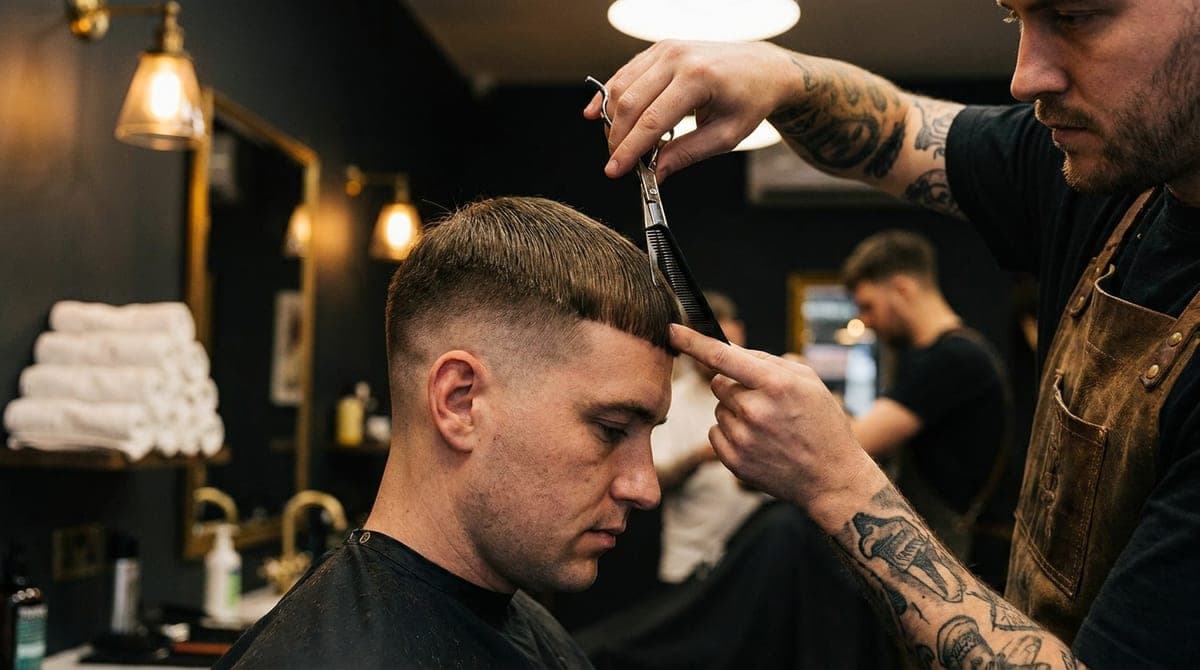
French crop. Short textured top pushed forward into a blunt fringe, tight sides. It is what we suggest most often to men whose hairline has started to move, because the fringe covers the corners and nobody reads it as a comb-forward. There is a fuller breakdown in our guide to the French crop.
Scissor cut with a side part. No clippers at all if you would rather not. Length kept through the sides, weight taken out underneath, parted where your hair already wants to part. £15 in 30 minutes. Ask for this one if your workplace is on the traditional side, or if you are in your forties and a fade would look like you were trying something.
Crew cut. Short and graduated, a little longer at the front than at the crown. £10, 20 minutes, and nothing to do with it in the morning. The catch is rhythm. It looks its best for about three weeks and you have to keep to that.
The details that get an office haircut wrong
A hard line at the temple. Squaring off the front corner with a razor looks excellent for roughly five days. Then the shaved skin fills back in and you are wearing a visible ridge across your forehead. Ask for it left natural if you cannot get back quickly.
A skin fade you cannot keep up with. Bare skin is stubble again in three or four days, and once there is stubble underneath, the contrast closes up. The look is fine. The calendar is the problem.
A fringe fighting your glasses. If you wear glasses all day, say so before we start. A fringe cut to sit just above the frame stays where it is put. A centimetre longer and you will be pushing it off the lens every hour for a month.
Too much texturising. Thinning shears take weight out, and on fine hair they take out too much. The top sits flat by lunchtime and fluffs up by four o'clock. If your hair is fine, ask for the weight removed with point cutting instead.
How often each one needs doing
This is the part that decides whether a haircut works for you, not the photo you brought in.
- Crew cut: three weeks. One guard all over grows out evenly, so it fails politely rather than badly
- Short back and sides: four weeks, and the one to put in the calendar if you only keep one appointment in it
- Low taper fade: sharp at three weeks, tidy at four
- French crop: four to five weeks, because a slightly longer fringe does not break the shape
- Scissor cut with length: five to six weeks
- Skin fade: a fortnight, and at its best for the first ten days
If your diary is the constraint, pick the cut that matches it. Choosing the one you like most and then missing the appointments leaves you looking worse than the cut you did not want. Booking the next one on your way out of the shop is the only thing we have seen work reliably. The full timetable, cut by cut, is in our guide to how often men should get a haircut.
What to say in the chair
One sentence gets you a good office haircut in any shop in the country: "Grade two on the sides, blended, scissors on top, take about an inch off, and leave the neckline tapered."
Then four details worth adding, because each one changes how the cut looks for the next month:
- Neckline. Tapered or square. Say which.
- Temple. "Line the corner up" or "leave it natural."
- Fringe. Give a length you can point to. "So it sits above my eyebrows" beats "not too long."
- Top. Inches or finger widths, not "a trim." A trim means four different things to four barbers.
Avoid "just tidy it up." It is the single most common thing men say to us and it tells us nothing, so we end up guessing at your idea of tidy. If you are not sure of the words, our guide on asking for a haircut has the phrases written out.
Before an interview or a first day
Get it cut three or four days ahead rather than the night before. A haircut settles. The neckline softens by a shade, the top stops standing to attention, and you arrive looking like a man who has always had this haircut instead of one who booked it for the occasion.
And if you want to change something about your hair, do it in a quiet month, not the week you start somewhere new.
We are open from 9:00am and the last weekday chair goes at 7:30pm, so before work and after it both work, with Sunday running 10:00am to 6:30pm. Six chairs run at once, so a walk-in usually gets seen. Book a chair or come in, and tell us what you do for a living before we pick anything up. It changes what we cut.
Common questions
- What is the most professional haircut for a man?
- There is no single one. A short back and sides is the safest thing to ask for anywhere, but a low taper, a French crop and a scissor cut with a side part all look right in an office. What matters more is that the hair is off your ears and collar and the neckline is tidy.
- Is a skin fade unprofessional?
- Not any more, in most workplaces. The reason we steer office workers away from it is upkeep rather than image. A skin fade looks its best for about ten days, so unless you are back every fortnight it will spend most of the month looking half grown out.
- How short should the sides be for work?
- A grade two or three suits most men. Shorter than a one and you are into high contrast territory, which reads as a statement rather than as grooming. Blended rather than stepped is the part that matters.
- How long before an interview should I get my hair cut?
- Three or four days. A haircut needs a few days to settle, and cutting it the night before is how you turn up looking like you got it done for the occasion.
- How much is a smart office haircut at Golden Scissors?
- A short back and sides is £14 in 20 minutes and the standard haircut is £15 in 30. A low taper fade is £17 in 40 minutes. Adding a beard trim to any cut takes £2 off the beard, so a haircut and a beard together is £24 in a 45 minute slot.
Read next
Barbershop FAQ
How to Ask for a Haircut: What to Say
How to ask for a haircut in words a barber can cut to: the four decisions, what a photo is actually for, and the one sentence that saves ten minutes.
7 min
Barbershop FAQ
How Often Should Men Get a Haircut?
How often should men get a haircut? Every two to six weeks depending on the cut. The honest timetable we give customers on Harrow Road, cut by cut.
5 min
Style Guide
What Is a French Crop Haircut?
What a French crop haircut is, whose hairline it rescues, what to ask for in the chair, and how long it holds before it needs doing again.
6 min