Dandruff vs dry scalp comes down to oil. Dandruff flakes are big, yellowish or grey, faintly greasy, and they cling to the scalp and to the hair near the root. Dry scalp flakes are small, white and powdery, and they let go on their own. One sits on a scalp making too much oil. The other sits on skin that has had its oil stripped out of it. Work out which you have got before you buy anything, because the two want opposite treatment. If your scalp itches and you cannot find a flake anywhere, it is probably neither, and the itchy scalp causes that leave no flakes are a separate list.
Dandruff vs Dry Scalp: How to Tell
Dandruff vs dry scalp: what the flakes look like in each case, the wash test that separates them, what helps for each, and when to see a pharmacist.
6 min readGolden Scissors, Maida Vale, London
What the flakes are telling you
Get a comb, part your hair at the crown under a decent light, and look at the skin rather than at your shoulders.
The oily kind. Flakes the size of a grain of rice or bigger, off-white going yellow, and they feel slightly tacky between your fingers. They do not fall off. You have to lift them, and often a little sheet comes away with hair caught in it. The skin underneath looks pink and a bit shiny. It concentrates in patches: the crown, behind the ears, the back of the hairline. Check your eyebrows, the creases at the sides of your nose and, if you have one, the skin under your beard. Flaking in those places alongside the scalp points the same way, because those are oily bits of skin and simple dryness tends not to pick them out.
The dry kind. Small, white, dust-like. It is on your collar by lunchtime because it does not stick to anything. The scalp itself feels tight after a wash, matte rather than shiny, and the flaking is spread fairly evenly rather than sitting in patches. Nine times out of ten the man with a dry scalp also has dry shins and dry knuckles, and it all arrived in the same fortnight.
Both get worse from October onwards, which is exactly why men mix them up. Cold outside, radiators inside, hat on for four months. The dry scalp is caused by that. The oily kind just happens to flare at the same time of year.
The wash test that settles dandruff vs dry scalp
If the comb has not settled it, this will.
Wash with a plain mild shampoo, nothing medicated, no product afterwards, and leave it alone for two days.
A dry scalp improves almost immediately and then creeps back over a week. The tightness goes first, the flaking follows. The oily kind is unchanged, or back within about forty-eight hours, and the itch comes back with it. That difference in timing is the most reliable test you can run at home, and it costs nothing.
One more check, because it catches a lot of people out. Scrape a flake off and rub it. If it feels waxy rather than dry and crumbly, that is not your scalp at all. It is product. Clay and dry shampoo that has never been properly rinsed out builds up at the roots and comes off in sheets that look exactly like the real thing until you touch them. A single clarifying wash clears it, and the greasy hair advice we wrote in July covers the habits that cause it.
What we see from behind the chair
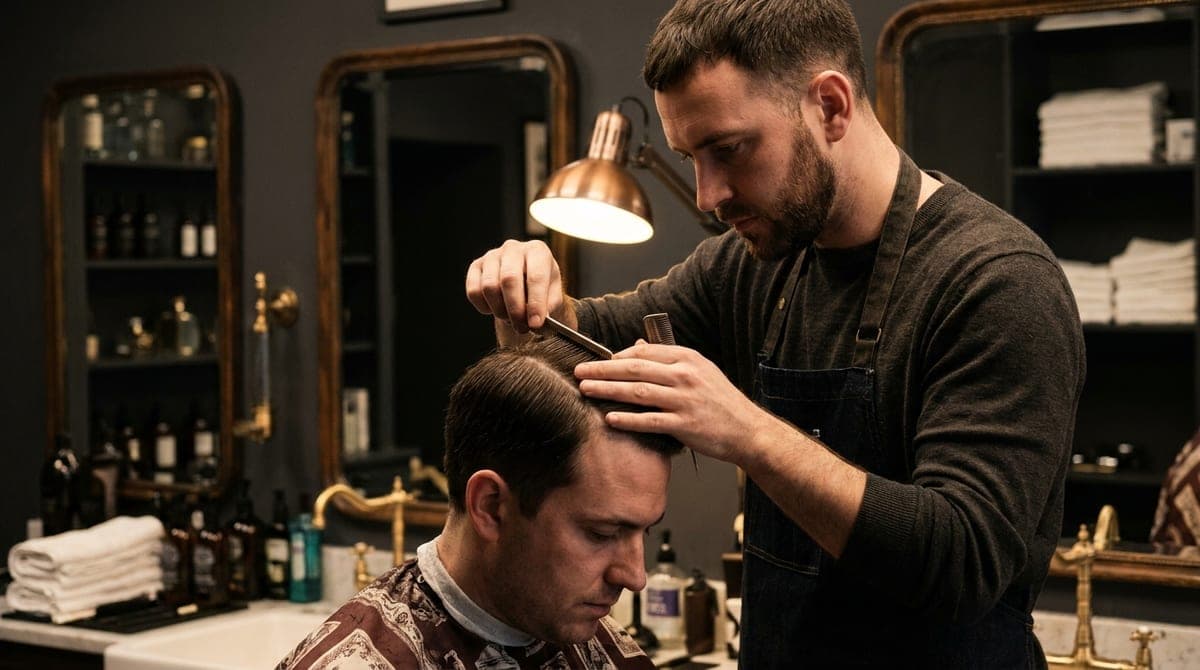
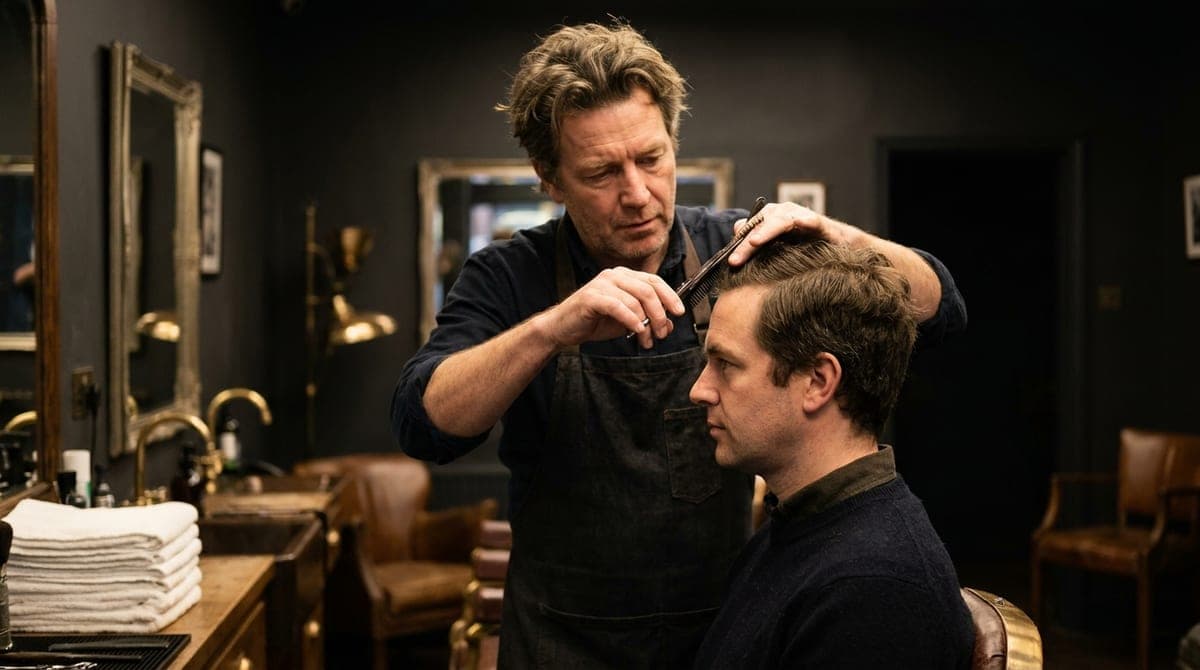
Under the shop lights, with the hair combed into a parting, you can usually see which one it is in about ten seconds. That is not a clever trick, it is just that we are looking at scalps all day and you are looking at yours in a bathroom mirror from the front.
Three things come through this shop far more often than actual dandruff.
The first is build-up, as above. The second is the man who has been going at it with the strongest medicated shampoo on the shelf, daily, for a month, and has now got a stripped scalp on top of whatever he started with. Those shampoos are not daily shampoos and the label says so. The third is a sore, scratched hairline. Scratching turns a manageable itch into broken skin along the back of the neck, and broken skin is the one thing that genuinely changes what a barber can do with a razor.
Beards are worth a mention while we are here. The skin under a beard flakes for the same reasons the scalp does, and if you trim your own you are probably never getting near it. A beard trim is £11 in a fifteen minute slot and part of that is combing the hair up and off the skin so someone can actually see what is going on underneath.
A wash and cut is £18 in a forty minute slot, and the basin shampoo is a good look at your scalp rather than a cure for anything. We will tell you what we can see. We will not sell you a bottle of something, because we do not stock one.
If it is the dry kind
Turn the water down. Hot water is the single biggest cause of a tight scalp in winter, and lukewarm rinses just as well.
Wash less often, and gently, with your fingertips instead of your nails. Rinse for longer than feels necessary, because leftover conditioner dries into something that flakes on its own.
Get some moisture back in. Any conditioner worked into the scalp rather than only through the lengths will do, or a light oil the night before a wash if it is bad. Once the heating goes on, that is the week to start, not December.
And leave the dry shampoo alone. It is designed to absorb oil, which is the opposite of what your scalp needs.
If it is the oily kind
Use a proper anti-dandruff shampoo, and use it correctly, because almost nobody does. On, worked in, then left there for two or three minutes before rinsing. Most men apply it and rinse within ten seconds, decide it does not work, and buy a different bottle to do the same thing with.
Expect to manage it rather than cure it. It settles with regular use and it comes back when you stop, so twice a week indefinitely beats a furious fortnight followed by nothing.
Ask a pharmacist which one to buy. There are several different types on that shelf, they do not work the same way, and thirty seconds at the counter beats guessing at three bottles. If your scalp flares mainly on training days, the timing rather than the shampoo may be the problem, and what happens to a scalp after the gym is a separate thing worth ruling out first.
Stop scratching it. Easy to say. But the itch is doing far less damage than your fingernails are.
Where we stop being useful
Redness spreading past the hairline onto the forehead or the neck, patches with a clear defined edge, anything weeping or crusting, spots, hair coming away with the flakes, or itching that wakes you up. That is a pharmacist or a GP. We are barbers, so we can tell you what your scalp looks like and how it compares to the ones we see in this chair every day on Harrow Road, and that is where our expertise stops.
One practical thing if you are booking a cut while you are dealing with this. Do not scrub it clean the morning of your appointment. Come in with it as it actually is, and say something when you sit down. It takes a second and it changes how we work: clippers kept off anything sore, the neckline done with scissors instead of the razor if the skin is broken, and no aftershave splash at the end.
Common questions
- What is the main difference between dandruff and dry scalp?
- Oil. Dandruff flakes are larger, yellowish and slightly greasy, and they stick to the scalp. Dry scalp flakes are small, white and powdery, and they fall away on their own.
- Can you have dandruff and dry scalp at the same time?
- Yes, and it is common in men who have been using a strong anti-dandruff shampoo every day for weeks. The original problem is still there and the skin is now stripped as well.
- Does washing your hair less help with flakes?
- It helps a dry scalp and makes the oily kind worse. That is why getting the diagnosis the right way round matters before you change anything.
- Is a flaky scalp a reason not to get a haircut?
- No. Tell your barber when you sit down so he can keep the clippers off any sore patches and skip the aftershave on the neckline. Broken skin is the only thing that changes what we do.
- When should I see a pharmacist or a GP about it?
- If the redness spreads past the hairline, the patches have a clear edge, there are spots, or the itching keeps you awake. We can describe what your scalp looks like. We cannot tell you what it is.
Read next
Hair Health
Dealing with a Sweaty Scalp After the Gym
How to deal with a sweaty scalp after the gym: whether to rinse or shampoo, what stops the itch, and the cuts that cope with daily training.
5 min
Hair Health
Stop Your Hair Going Greasy in Hot Weather
Why hair turns greasy in summer, what to change about washing and product, and the haircuts that hide it best. Straight advice from a Maida Vale barbershop.
5 min
Trend
Autumn Hair Trends for Men in 2026
The autumn hair trends men are asking us for: length coming back on top, tapers over skin fades, and how to grow it out without the bad six weeks.
6 min