The best haircuts for thick hair are the ones where weight comes out before length does. Thick hair does not sit down because there is simply too much of it, so a cut that only goes shorter makes things worse: you end up with a dense block that lifts at the sides and sits like a lid on top. What works is a shape that removes bulk from underneath and leaves the surface long enough to fall.
Haircuts for Thick Hair That Actually Work
The haircuts for thick hair that hold their shape: why dense hair grows out sideways, the five cuts we recommend, and what each one costs in the chair.
6 min readGolden Scissors, Maida Vale, London
Density and coarseness are not the same problem
Two different heads of hair get called thick, and they want different things done to them.
Density is how many hairs you have. Coarseness is how wide each individual hair is. You can have fine hair packed so tight that no scalp shows anywhere, or a moderate amount of hair where every strand is basically wire. Both men sit down and say the same sentence, and if we cut them the same way one of them leaves unhappy.
Dense hair pushes outward. It has nowhere else to go, so by the third week the sides have grown sideways rather than down and your head reads wider than it did. That is the complaint we hear most.
Coarse hair does something different. It stands up. It resists the parting, it ignores product, and it will hold whatever direction it grew in regardless of what you did to it in the mirror this morning. Length is the fix there, because weight is what eventually pulls a coarse hair down.
Say which one you have when you sit down. If you are not sure, we can tell in about ten seconds with a comb.
The haircuts for thick hair we cut most
Taper fade with the top thinned, £17, 40 minutes. If you take one thing from this page, take this one. The taper clears the bulk at the bottom without dropping all the way to skin, so the grow-out stays tidy rather than going blurry, and thinning the top kills the lid effect. It is the cut we push most thick-haired customers towards.
Skin fade, £17, 30 minutes. Sharper, and dense hair takes it well because a fade needs something solid to blend into. Fine hair shows every bump on the head at a 0; thick hair does not. The trade-off is upkeep. Dense hair refills a fade quicker than fine hair does, so you get a week and a half of it looking the way it did walking out, and after that it softens.
Haircut with a crop on top, £15, 30 minutes. The top done with scissors, the fringe kept short and square across the front. Of everything on this list it is the cut that depends most on bulk being removed first, because a crop left heavy on thick hair turns into a solid shell that stands away from the forehead instead of resting on it. Done properly it is the best cut here for hair that grows forward.
Short back and sides, £14, 20 minutes. The honest note on this one: 20 minutes is a tight slot for a genuinely dense head. It is the right cut if you want clippers through the sides and a tidy neckline, but if you also want weight taken out of the top, book the £15 haircut and give us the extra ten minutes rather than expecting both.
Crew cut, £10, 20 minutes. Thick hair buzzes better than anything else, because dense coverage means no scalp showing through and the grade sits true. Worth saying: ask for the top to be gone over twice against the grain, or a thick head will read a fraction longer than the guard you asked for.
Taking the weight out is the actual job
Length is the easy part. What separates a cut that works on thick hair from one that does not is how the bulk gets removed, and there are three ways to do it.
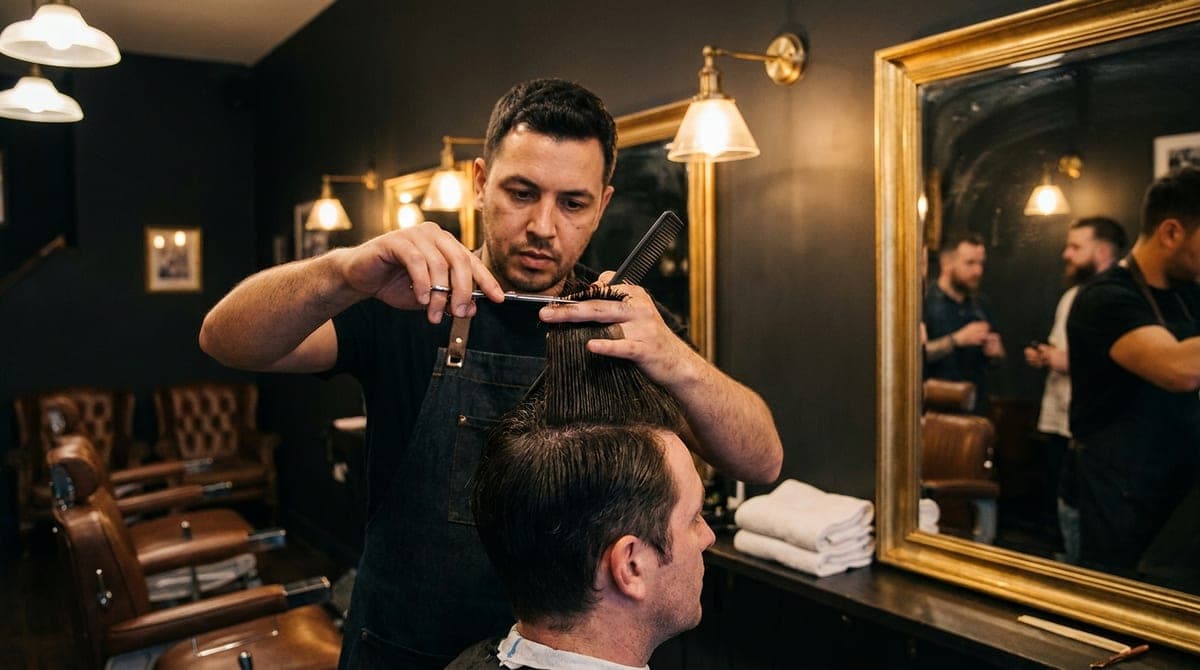
Point cutting. Scissors held into the ends rather than across them, so the hair breaks up into separate pieces instead of finishing as one blunt edge. This is what we use most. It is slower and it is the reason a thick head takes the full 30 or 40 minutes.
Thinning shears. Faster, and useful deep underneath where nobody sees the ends. We are careful with them and we keep them away from your hairline and your parting. Shears leave short cut ends that grow back standing upright, and on a dense head that means a couple of weeks of fluff sitting proud at the front. Any barber who reaches straight for the thinners on your fringe is saving himself time.
Clipper-over-comb. For the bulk in the corners at the back, where the head changes shape and a guard cannot follow it. Nothing else gets that area clean on thick hair.
There is also what we will not do. If an area is already sparse, nothing comes out of it. Plenty of men are dense on top and going thin at the temples, and those are two different areas of one head that have to be treated differently.
What to say so the weight comes out
The sentence that gets you what you want is "take the weight out but keep the length". Most men say "make it shorter" when what they actually mean is "make it less". Those get you two completely different haircuts, and only one of them solves the problem.
After that, three specifics help: how short at the sides in guard numbers, how much off the length on top in inches or fingers, and whether the fringe stays. For the rest of the vocabulary there is a separate guide to asking for a haircut that goes through what each trade term actually means.
Mention your cowlick if you have one. On a dense head it sets the ceiling on how much can come off the top, because a cowlick with that weight of hair behind it will not lie back down once it is cut short. It stands up, and it stays there.
How often to come back
Two weeks for a fade. Three to four for scissor work on top, and at the longer end of that if the weight came out properly, because a thinned cut loses its shape slowly instead of thickening back into a block.
The tell is the sides. When your hair starts going wide instead of long, the weight has grown back in and it is time, whatever the calendar says.
A warning to finish on, because on thick hair this is the one that comes through the door most. Thinning scissors are cheap online and men with thick hair buy them more than anyone. Used dry, at the wrong angle, through the top layer instead of from underneath, they leave holes that take months to grow out, and the only repair is cutting everything else down to meet them.
If the bulk gets to you between appointments and you do not want to lose the length on top, there is a sides-only skin fade at £16 in a 30 minute slot. It clears all the weight below and leaves the top exactly where it is. Cheaper than a mistake you have to wear for the next three months, and it is on the full price list with everything else.
Common questions
- What is the best haircut for thick hair?
- There isn't one answer, but the cuts that work all take bulk out from underneath rather than just going shorter. A taper fade with weight removed from the top is the safest bet, and a crop is the best of them if your hair grows forward.
- Should I get my thick hair thinned out?
- Usually yes, but ask for it to be point cut rather than done with thinning shears near the hairline. Shears leave short ends that grow back standing up, and on a dense head that is a fortnight of your hair looking fluffy at the front.
- Why does my hair stick out at the sides?
- Because there is too much of it to lie flat, so it pushes outward instead of down. It is the standard sign that the weight was never taken out, and it usually shows up around week three.
- Does thick hair suit a skin fade?
- It suits it better than fine hair does, because dense hair gives the blend something solid to fade into. The catch is that thick hair fills a fade back in fast, so you are looking at a week and a half before it softens.
- Is a wash and cut worth it on thick hair?
- It helps. Thick hair cut dry hides its own bulk, so washing it first lets us see where the weight actually sits. It is £18 in a 40 minute slot against £15 for the standard haircut.
Read next
Style Guide
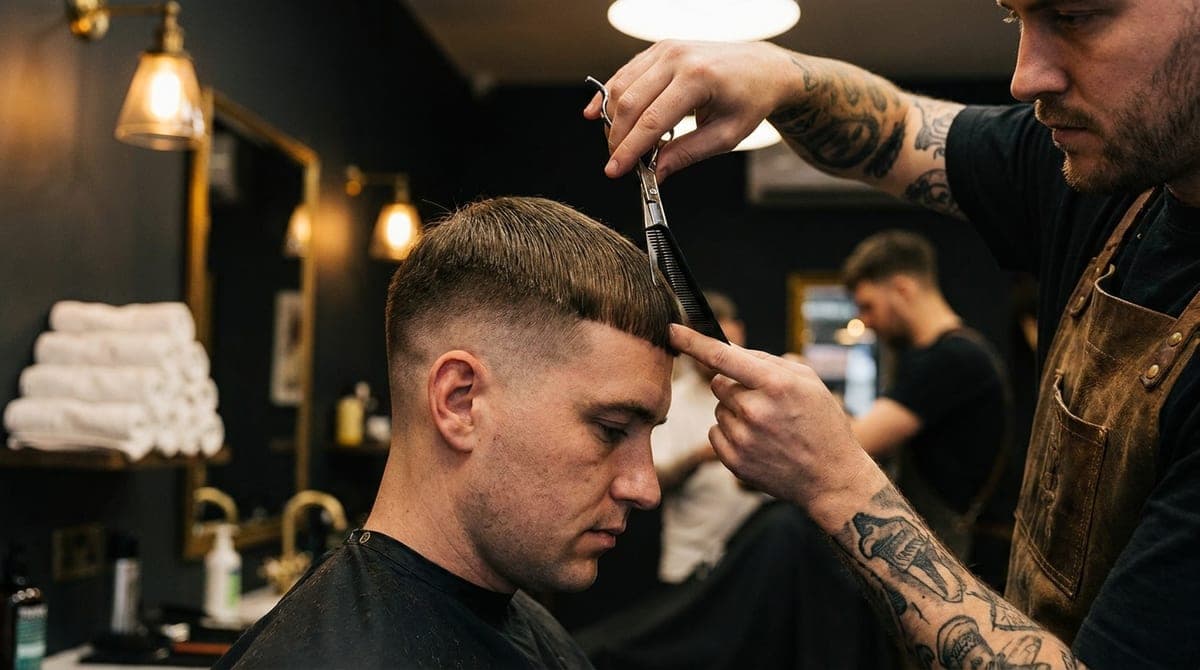
What Is a French Crop Haircut?
What a French crop haircut is, whose hairline it rescues, what to ask for in the chair, and how long it holds before it needs doing again.
6 min
Barbershop FAQ
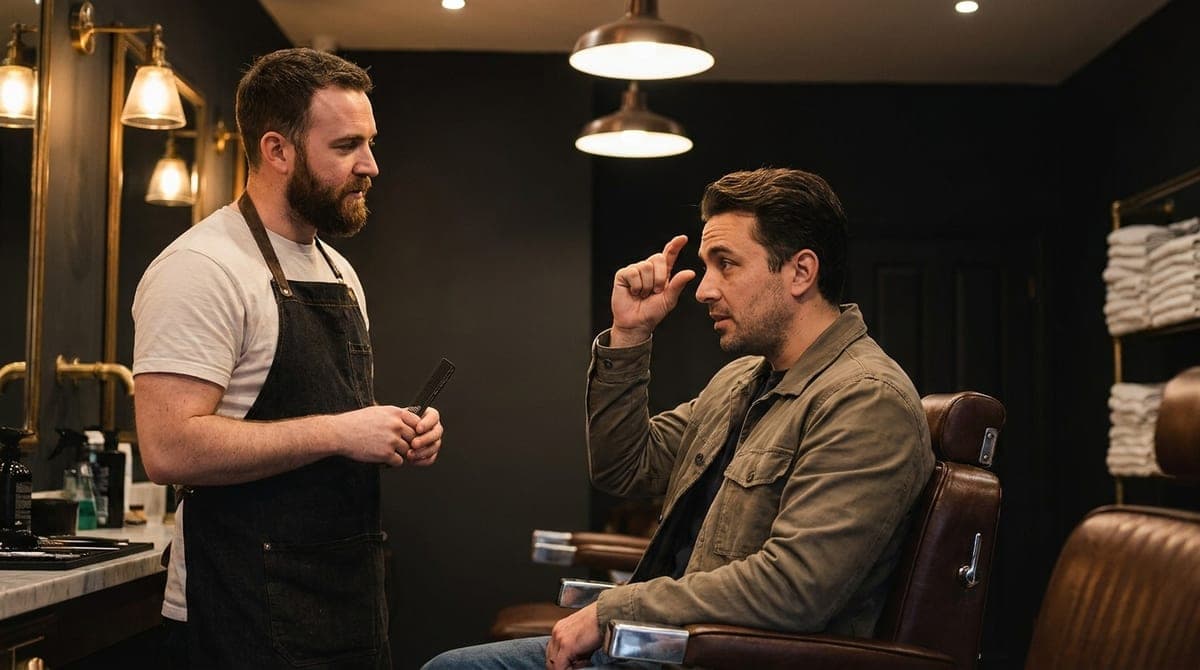
How to Ask for a Haircut: What to Say
How to ask for a haircut in words a barber can cut to: the four decisions, what a photo is actually for, and the one sentence that saves ten minutes.
7 min
Barbershop FAQ
Clipper Guard Lengths in mm, From 0.5 to 8
Every clipper guard from 0.5 to 8 in mm and inches, the 1.5 included, plus what each one looks like on your sides and how to ask for it in the chair.
6 min