Clipper guard lengths run in eighths of an inch. A number 1 leaves about 3mm of hair, a 2 leaves 6mm, a 3 about 9.5mm and a 4 roughly 13mm, which is half an inch. That is the whole system. The confusion starts with the next part, because on most heads the number describes the sides of the cut, not all of it. Say "a 2" in the chair and you are choosing the shortest point of your haircut. Everything above it gets blended to match.
Clipper Guard Lengths: 1 to 4 Explained
Clipper guard lengths in plain millimetres: what a number 1, 2, 3 or 4 actually leaves, which one your sides want, and how to ask for it.
5 min readGolden Scissors, Maida Vale, London
Clipper guard lengths, number by number
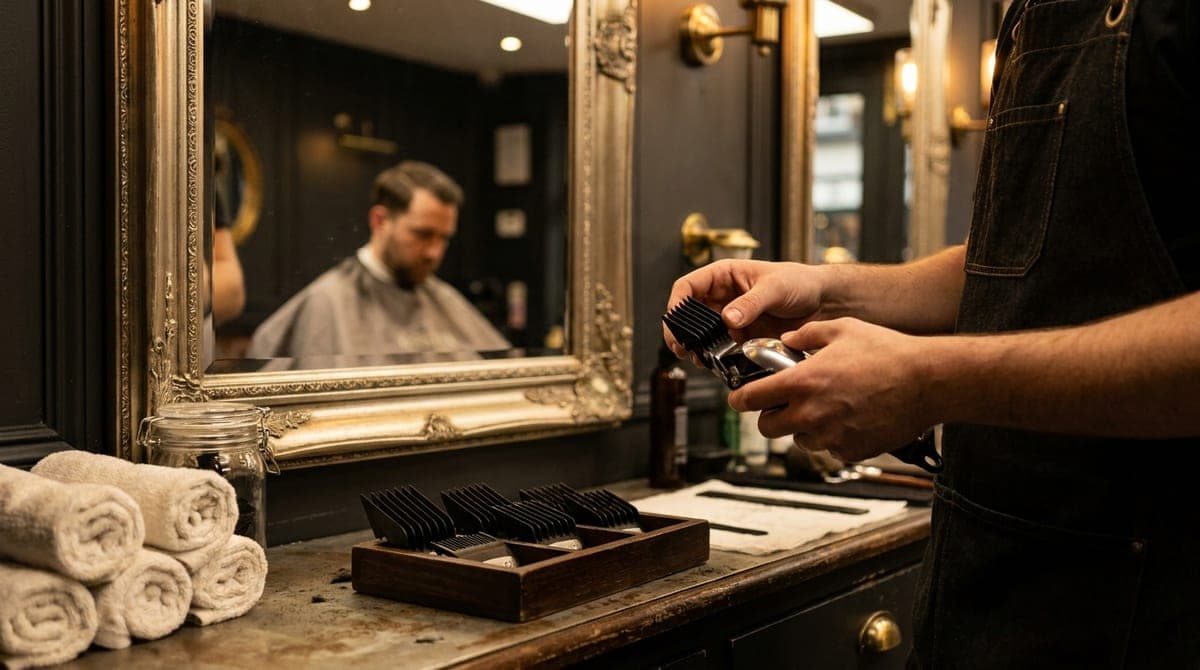
The guard is the plastic comb that clips over the blade and holds it a fixed distance off your skin. The number tells you how many eighths of an inch that distance is, so a number 8 leaves a full inch behind.
| Guard | Leaves behind | In old money |
|---|---|---|
| 1 | about 3mm | an eighth of an inch |
| 2 | about 6mm | a quarter of an inch |
| 3 | about 9.5mm | three eighths |
| 4 | about 13mm | half an inch |
Below a 1 sit the 0.5, which leaves heavy stubble, and the bare blade, which leaves next to nothing. Above a 4 the numbers keep going up to an 8, but somewhere past the 4 hair stops standing up and starts flopping over, and scissors usually take over from there.
Two warnings about that table. Different makes of clipper disagree by up to half a millimetre on the same number, so the 2 you got in one shop is not always the 2 you get in another. And the steps are not equal in effect. Going from a 2 to a 1 removes half the hair on your sides. Going from a 4 to a 3 is barely visible across a room.
A number on the sides is not a number all over
The sentence we hear most across our six chairs is some version of "a 2 on the sides, scissors on top". That is a guard number doing its proper job: setting the sides and back of an ordinary haircut while the top stays long enough to cut by hand, which is where scissors take over from clippers. Our Short Back & Sides is exactly that cut, £14 and twenty minutes.
The same number over the whole head is a different haircut and a bigger decision. A 2 everywhere is a buzz cut. It shows every bump on your crown and it changes how your face reads, which is why we covered every buzz length, grade by grade on its own. If that is where you are heading, start there.
As a rough guide for sides only: a 1 is sharp and wants redoing inside a fortnight, a 2 is the standard most men settle on, a 3 reads soft and suits thick hair that springs away from the head, and a 4 barely looks clipped at all, which on some heads is exactly the point.
Half guards and the lever
The 0.5 and 1.5 guards exist because the bottom of the scale is where the steps feel biggest. From a 1 to a 2, the hair on your sides doubles. Nobody notices a 5 against a 6, but everybody notices a 1 against a 2, so the half sizes fill the gaps where precision actually matters.
Then there is the lever on the side of the clippers, the tool most men do not know exists. Flicking it open moves the blades apart and adds roughly half a grade to whatever guard is on. When we say "a one and a half", we might reach for the 1.5 guard or run the 1 with the lever open, and the result on your head is the same. The lever is also how the blend between two numbers gets made, a fraction of a millimetre at a time, which is most of the skill in a fade.
What number a fade actually is
A fade is not one number. It is a run of them climbing the side of your head, and the number you give us sets the bottom of the run, the shortest point just above your ear or neckline. A skin fade starts below the numbers entirely, at bare skin, while a taper fade usually bottoms out around a 0.5 or a 1.
So a fade request carries two decisions, not one: how short the bottom goes, and where on the head the fade sits. Low, mid and high describe the position. The number describes the length. "Low skin fade" and "high fade to a 2" are both complete instructions. "A fade" on its own means we will be asking you questions for a minute or two first, which is fine, that is what the chat in the mirror at the start is for.
The same numbers work on your beard
Guards go over beard hair the same way, and the numbers mean the same lengths. Most tidy short beards sit between a 1 and a 3. Beard hair is coarser than head hair and grows in more directions, so the same guard reads slightly longer on a jaw than on a scalp.
If you know your beard number, a beard trim here is £11 and fifteen minutes, and "take it through with a 2, sharpen the cheek lines" will get you exactly that. If you do not know it, tell us how long since it was last trimmed and we will work backwards.
Walking in with your number
Say the number for the sides, then what happens on top, then the neckline if you have a preference. "A 2 on the sides, trim the top, square the neckline" covers everything a barber needs.
If you do not know your number, do not guess short. A guess that is one grade too long is fixed in ninety seconds. One grade too short takes three weeks to grow back. Tell us what annoyed you about the last cut, or how long ago it was, and we will find the number in one pass. Guards click on and off in a second and there is a full set at every chair, so asking to see the 2 next to the 3 before we start costs nothing. Book a chair and bring your number, or come without one and leave with it settled for every haircut after.
Common questions
- What is a number 2 haircut?
- A cut where the sides are done with the number 2 guard, leaving about 6mm. Most men who ask for it mean a 2 on the sides with scissor work on top. A 2 over the whole head is a buzz cut, which is a different decision.
- How many millimetres is each clipper guard?
- Guards run in eighths of an inch. A 1 leaves about 3mm, a 2 about 6mm, a 3 about 9.5mm and a 4 about 13mm. The exact figure is moulded into the plastic of the guard itself.
- Are guard numbers the same on every brand of clipper?
- Close but not identical. Most makes follow the eighth-of-an-inch system, but two brands can disagree by up to half a millimetre on the same number, which is one reason the same 2 can feel different between shops.
- What guard do barbers use for a fade?
- A run of them, not one. A skin fade starts at bare skin and climbs up through the grades; a taper fade usually bottoms out at a 0.5 or a 1. The number you give sets where the fade finishes, not the whole cut.
- Can clipper guards be used on a beard?
- Yes, and the numbers mean the same lengths. Most short beards sit between a 1 and a 3. Beard hair is coarser than head hair, so the same guard reads slightly longer on a jaw.
Read next
Style Guide
Buzz Cut Lengths: Every Grade Explained
What each clipper grade actually leaves on your head, which buzz cut lengths suit which hair, and what to ask for. From the barbers on Harrow Road.
6 min
Style Guide
Skin Fade vs Taper Fade: The Difference
A skin fade goes to bare skin, a taper fade keeps a little length. Which one suits your hair, your head shape and how often you can get back to the chair.
5 min
Barbershop FAQ
How Often Should Men Get a Haircut?
How often should men get a haircut? Every two to six weeks depending on the cut. The honest timetable we give customers on Harrow Road, cut by cut.
5 min