
Damp hair, four to six sprays for most tops, fingers, then dry it while it moves. That is how to use sea salt spray, and nearly everything that goes wrong with it is one of three mistakes: hair too dry when you spray, twice as much product as the hair needed, or leaving it to air-dry untouched so the salt sets stiff. Towel-dry first, spray from a hand span away, rake it through, and use half of what you think you need.
How to Use Sea Salt Spray, and How Much
How to use sea salt spray from a barber: how many sprays for your length and hair type, in one table, plus how damp to go and why it turns crunchy.
Updated 7 min readGolden Scissors, Maida Vale, London
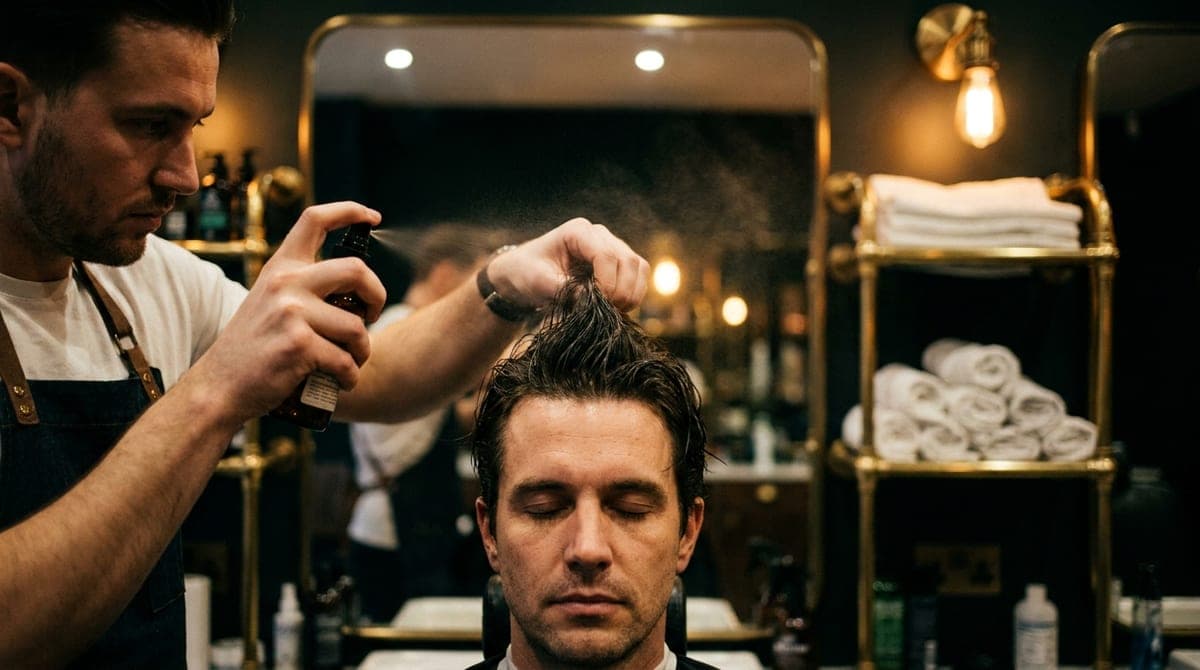
What the spray actually does
Sea salt spray is bottled beach hair. Salt roughens the outside of each strand, so hairs grip each other instead of sliding flat, and the hair holds a shape on its own without anything sticky in it. What you get is matte texture and a bit of lift, the way your hair looks after a swim in the sea and an hour in the wind.
What you do not get is hold. It is not glue, and asking it to keep a style pinned in place all day will only tempt you into using more, which is where the crunch starts. If you need holding rather than roughening, you want a clay, or the layering trick from our humidity guide: spray first, dry it in, then a small amount of clay over the top.
How to use sea salt spray, step by step
- Start damp. After a wash, towel the hair until it has stopped dripping and feels cool rather than wet. On dry hair the spray sits on the surface and dries crisp exactly where it landed. Soaking wet, and you are diluting it into nothing.
- Spray from a hand span away. Move around the head rather than soaking one patch, and use the count in the table below. If you want lift, tip your head forward and put a couple of those sprays in at the roots.
- Fingers, not a comb. Rake it through so every part of the top gets some. A comb flattens the texture you have just paid for.
- Dry it moving. This is the step most men skip, and it is the whole trick. Scrunch and push the hair about with your hands while it dries, or do the same under a dryer on medium. Hair that dries while it is being moved comes out tousled and soft. Hair that air-dries untouched comes out in stiff strands.
- Then leave it alone. Every pass of your fingers afterwards pulls the texture apart and moves oil from your hands into it.
How many sprays of sea salt spray to use
Count the sprays by how much hair is on top, then adjust for how thick it is. These are starting points from the chair, for damp hair:
| Length on top | Fine or straight hair | Thick or wavy hair |
|---|---|---|
| Under 3 cm | Skip it, there is nothing to grip | Skip it |
| 3 to 5 cm, a short crop | 2 to 3 sprays | 3 to 4 sprays |
| 5 to 8 cm, a textured crop or quiff | 4 sprays | 5 to 6 sprays |
| 8 cm and over, towards the ears | 5 to 6 sprays | 6 to 8 sprays |
Start at the low end of your row for the first week. You can add one more spray before you dry, but you cannot take one out. And if a bottle tells you ten, it is counting for hair longer than most men who come through our door wear it.
Why it turns crunchy
Too much product is the usual reason. Salt spray is deceptive because it goes on like water, so it never feels like product, and eight sprays feels the same as four right up until it dries. If your hair feels like a crisp packet by mid-morning, halve the dose before you change anything else.
Spraying dry hair is the second. With no water to carry it, the salt cannot spread down the strand, so it dries in patches and every patch is stiff.
Build-up is the slow one. Salt stays in the hair until it is properly washed out, and a splash of water the next morning does not count. Two or three days of spray with no shampoo leaves hair that feels rough before you have added anything. If you use it daily, wash it out at night and condition after, because salt takes moisture with it when it goes.
You will also find recipes for mixing your own from kitchen salt and warm water. It works the way the actual sea works: texture for an hour, straw by the evening. A bought spray has conditioning agents in it to soften that trade-off. Salt water on its own is all trade-off.
If it has gone crunchy by lunchtime, wet your fingers and scrunch for thirty seconds. That revives it. More product does not.
Who it suits, and who should skip it
Fine, straight hair that will not hold a style is where salt spray earns its keep. It is the difference between a top that has flopped by ten o'clock and one with some movement left in it at five.
On straight hair, though, the drying does more than the spray. Use the dryer rather than air-drying, head tipped forward, scrunching handfuls up towards the scalp on medium heat, and twist a few pieces at the front between two fingers as they finish. Leave straight hair to dry on its own and it simply goes back to straight, with salt in it.
Wavy hair might be the best match of all. The salt brings out a wave that was always there but too heavy to show.
Nothing under about three centimetres, though. Shorter than that and there is not enough hair for texture to read, so the spray mostly dries on your scalp. If you are growing out a buzz cut, that is around week eight.
Curly hair should mostly leave it alone. Curls hold their shape with moisture, salt pulls moisture out, and what comes back is frizz with crunch on top. A light cream does for curls what salt spray does for straight hair. The same goes for hair that is already dry, bleached or damaged: it does not need help being rough.
It is also a warm-weather product. Once the heating goes on in October and the indoor air dries out, daily salt spray on fine hair is how you get straw by November. Swap to a cream or a matte clay for the cold months and pick the spray back up in spring.
The cut does half the work
No spray can put texture into a cut that has none. If the top is cut blunt to one length, salt spray will make it rougher but not more interesting, because every hair is the same length pushing in the same direction. What the spray wants is a top with layers or point-cutting in it, so there are different lengths to work against each other. A textured crop is the obvious partner, and that built-in texture is most of why the cut looks effortless on the men who wear it well.
So tell whoever cuts you that you finish with salt spray. It genuinely changes the cut: we will take weight out of the top and put movement in, instead of cutting a clean shape that wants a comb and something with shine. A haircut here is £15 and takes half an hour, and saying "point-cut the top, I style with salt spray" in the first minute is worth more than anything you can buy in a bottle afterwards. Book a chair and say exactly that.
From there, adjust one thing at a time. Dose first, then how damp the hair is, then how long your hands stay in it while it dries. And if your hair drinks the spray and still will not stand up, the answer is in the cut rather than the bottle, and that is a conversation for the chair, not the shower.
Common questions
- Do you put sea salt spray on wet or dry hair?
- Damp is best. Towel-dry until it stops dripping, then spray. On dry hair one or two light sprays from further away will rough up a top that has dried flat, but any more than that dries crisp where it lands.
- Why does sea salt spray make my hair crunchy?
- Too much of it, or letting the hair air-dry untouched. Halve the dose and keep the hair moving with your fingers while it dries and the crunch goes.
- Is sea salt spray bad for your hair?
- Used most days without washing it out, it dries hair the way the sea does. Shampoo it out at night, condition after, and give it a rest over winter when indoor heating is already drying your hair out.
- Can I use sea salt spray with clay?
- Yes, and it is the best of both. Spray on damp hair, dry it in, then a small amount of matte clay over the top for hold.
- Does sea salt spray work on short hair?
- It needs about three centimetres to have anything to grip. Below that it dries on your scalp rather than in your hair.
Read next

Products
The Best Men's Hair Products for Humidity
The best hair products for humid weather, the ones that fail by lunchtime, and what to leave on the shelf. Honest advice from our Harrow Road chairs.
6 min
How To
How to Style a Textured Crop
How to style a textured crop in under two minutes each morning, using the product and finger-work our barbers on Harrow Road actually recommend.
5 min
How To
The Stages of Growing Out a Buzz Cut
Every stage of growing out a buzz cut in one table: the weeks, the length on top, what it looks like, and the cut to book so month three never looks wrong.
7 min