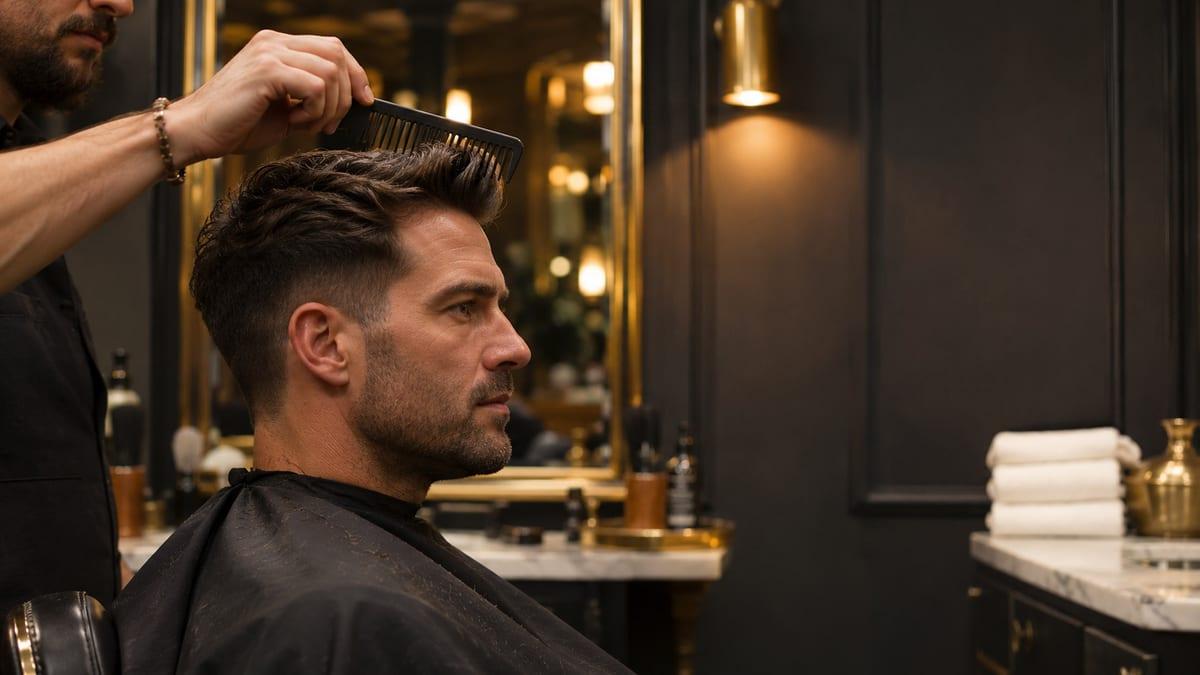
A quiff hairstyle stays up when the cut is built for it: the front left longest, the length stepping down shorter towards the crown, and the sides tapered tight so the top has something to stand above. Then it gets dried upwards for a minute before any product goes near it. Get those two right and a quiff holds all day. Get the cut wrong and no amount of clay will save it, because you are propping up a top that was cut to lie flat.
How to Get a Quiff Hairstyle That Stays Up
A quiff hairstyle stands or falls on the cut: front length in cm for three sizes, how the top is graded back to the crown, and why it drops by noon.
7 min readGolden Scissors, Maida Vale, London
What is a quiff hairstyle?
A quiff is short sides with the hair at the front lifted up and a little forward, tallest at the hairline and dropping lower towards the crown. It can be neat or broken up and textured. If the whole top is combed back smooth into one curve, it has become a pompadour, which needs more length and a lot more patience.
The difference matters more than it sounds. We have written up what a pompadour actually takes, and the short version is that most men who ask for one would be happier in a quiff. A quiff forgives a stray section. A pompadour shows it.
Pick the size before you pick the photo
Most quiff photos online are the big version, styled for the camera ten minutes earlier. The size that works for you depends on your hair and how much time you will give it at 7.30 on a Tuesday, so decide that first.
| Quiff | Front length | At the crown | Sides | Morning time |
|---|---|---|---|---|
| Short textured | 4 to 6 cm | 2 to 3 cm | Taper or low fade | 2 minutes, a quick dry and fingers |
| Classic | 7 to 9 cm | 3 to 4 cm | Taper, grade 1 to 2 at the bottom | 5 minutes with a dryer |
| Big | 9 to 10 cm | 4 to 5 cm | Mid fade or tight taper | 5 to 10 minutes, dryer and brush |
Past about 10 cm at the front you are into pompadour territory, and the hair is heavy enough that it wants to fall forward the moment it gets warm.
If you have never worn one, start short. The short textured quiff is the one men keep. It looks right on a wet morning, it needs a minute with the dryer rather than five, and when it drops it still reads as a haircut. You can always leave the front longer next time. The top gains roughly a centimetre every month, which makes short to classic about two months of waiting, and you can wear every stage of it.
The part of the cut nobody photographs
Every guide says leave length on top. What they skip is how that length is laid out, and that is where most quiffs fail.
The top of a quiff is graded. Longest at the hairline, then a little shorter every few centimetres back, until the crown is maybe half the length of the front. That gradient is what gives a quiff its shape from the side. Cut the whole top to one length and the back of the top sits as tall as the front, so the quiff has nothing to rise out of. It just looks like a lot of hair.
The other thing is weight. Thick, straight hair cut blunt on top sits like a lid and will not stay lifted, so we point cut into it to break the ends up and take some bulk out of the middle. Fine hair is the opposite. Thin it out and you lose the density that was holding it up, so on fine hair we leave the ends almost blunt and keep the whole thing shorter.
The sides do half the work too. A quiff over long, puffy sides looks wide rather than tall. A taper or a fade takes the width away, and the top reads taller without being any longer. On most heads we would take a taper over a skin fade here. It holds for four weeks instead of ten days, so the sides stay tidy for as long as the top does.
Who should not go big
A receding hairline at the temples. A tall, narrow quiff pulls the hair up and away from the corners and puts them on show. Keep it short and broad, push it a touch to one side, and the recession reads as part of the shape. There is more on this in our guide to cuts for a receding hairline.
Fine hair. It will stand up at 5 cm. At 9 cm the root cannot hold the weight, and it is flat by mid morning.
A long face. Height on top adds length, and tight sides take width away. Put a big quiff on a long face and both make it longer. A short one is fine.
A strong cowlick at the front. This one is not a no, it is a direction. We comb the front down damp and watch which way it wants to go, then build the quiff leaning that way rather than straight up. Fight a cowlick and it wins by lunchtime.
How it changes over five weeks
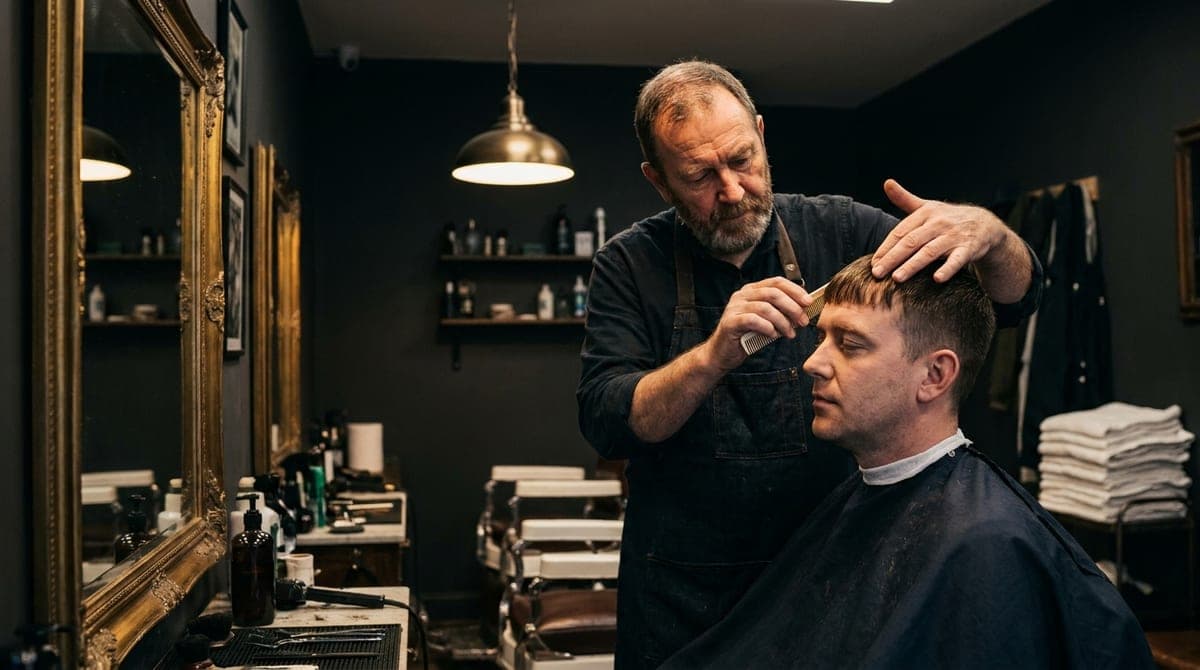
Week one. Sharp sides, the gradient on top doing its job. This is the cut in the photo.
Weeks two and three. The sides soften and the front gets a little heavier. It still stands, but you might need ten more seconds with the dryer.
Week four. The crown has grown out of its gradient, so the back of the top is catching up with the front. The quiff starts to look flatter from the side even though the front has barely changed. This is when most men say it "won't go up any more", and it is the cut, not them.
Week five on. The front is long enough to fall forward into a fringe when it is warm or damp. Book before this, not after it.
So a quiff wants doing every three to four weeks. You do not need to take much off the front each time. Most of the visit is the sides and putting the gradient back into the top.
Keeping it standing through a London day
The lift comes from the dryer, not the product. Dry the roots up and back from the hairline, finish on cold, then add product. We have set out the drying method for volume step by step, and a quiff needs nothing different from it.
For product, a matte clay suits a short textured quiff. A classic or big quiff on thick hair can take a firmer paste, but apply it at the back first and bring what is left on your fingers to the front. A full dose on the front is the fastest way to drop the whole shape.
Weather is what usually finishes it. A hood flattens it, rain undoes the set, and a December gust on the towpath by Little Venice will move it over to one side whether you like it or not. Accept that a big quiff is a dry day style. On a wet day the short one survives and the big one does not, which is another reason to start short.
Words that get you the right quiff
Do not just say "a quiff". Say the size, and say how it should step down. Something like: "A short textured quiff, about 5 cm at the front and shorter towards the crown, taper on the sides, and point cut the top because it is thick." That one sentence tells us more than a photo, because a photo cannot tell us your hair type or how long you will spend on it in the morning.
Bring a side-on photo if you have one. The front view hides the gradient, which is the part we need to see. And ask us to dry it before you go, so you can watch which way the air goes. A haircut here is £15 in 30 minutes, or £17 in 40 if you want a proper taper on the sides. You can pick a time or walk in.
One more thing for the first week: do not judge it on the first morning. The first time you dry it yourself it will come out lower than it did in the chair. By the third morning your hands have learnt it.
Read next
Style Guide
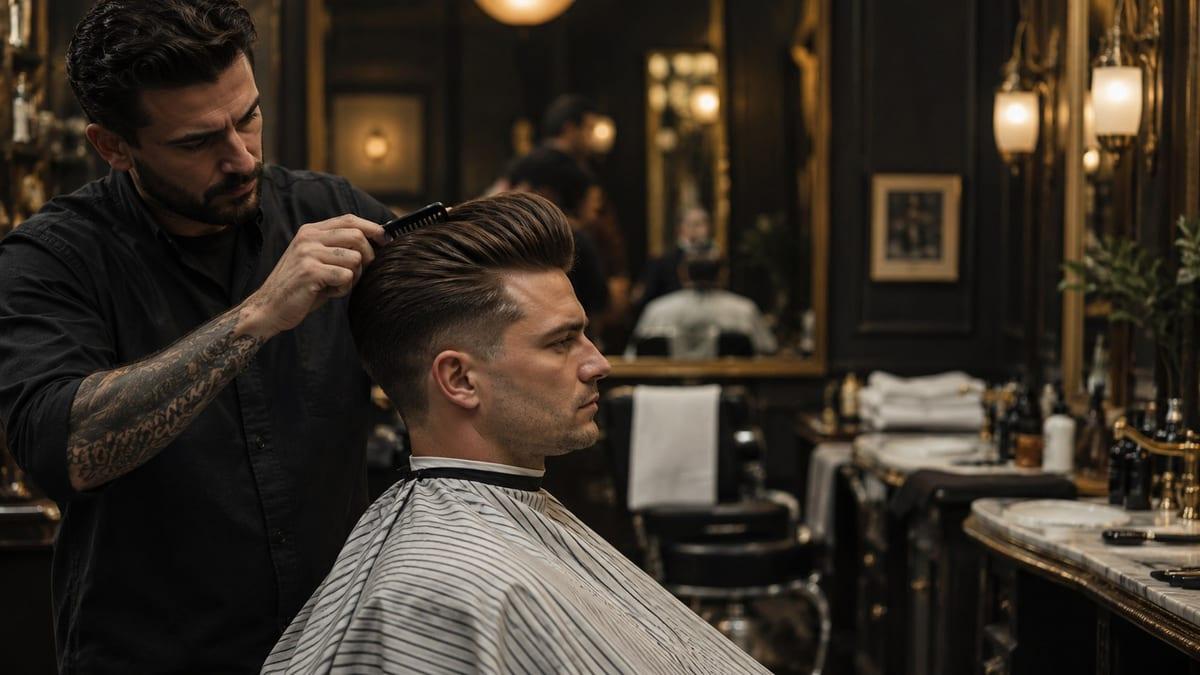
Pompadour Haircut: What It Takes
A pompadour haircut needs four inches at the front, short sides and a hairdryer every morning. What to ask for, who it suits and how to keep it standing.
6 min
How To
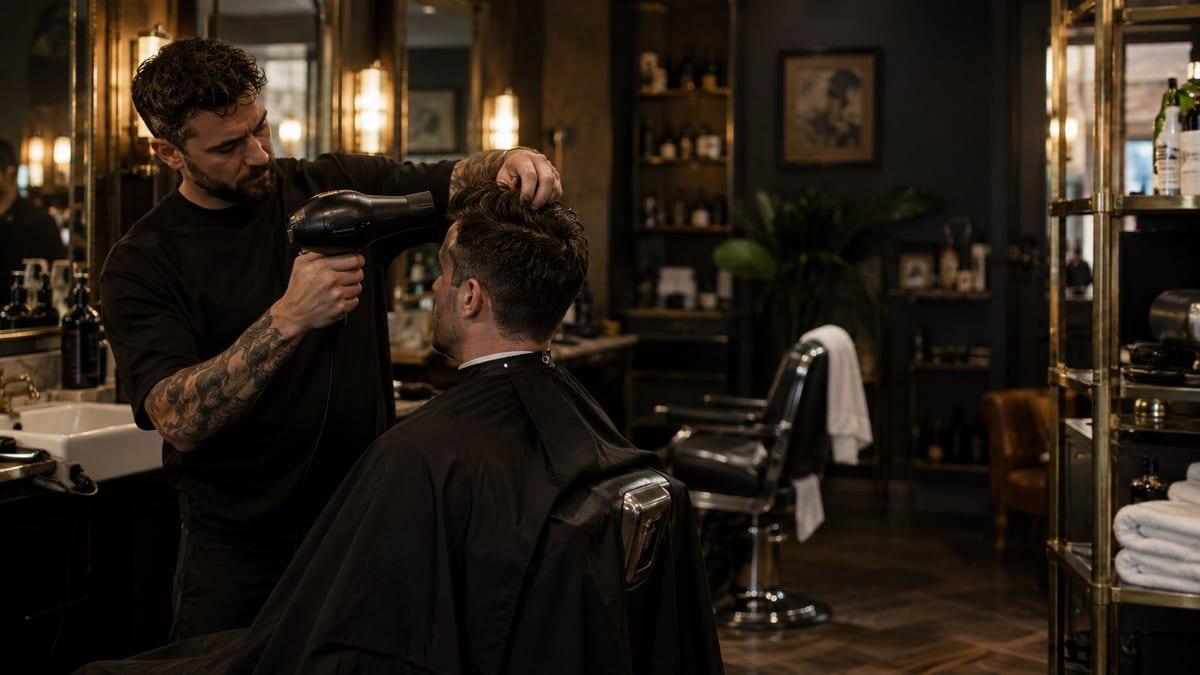
How to Get Volume in Mens Hair
Flat hair is usually the dry and the weight, not the product. A barber's guide to how to get volume in mens hair, and the cuts that hold it.
7 min
Hair Health
Best Haircuts to Hide a Receding Hairline
The best haircuts for a receding hairline, matched to where yours is going. A barber's table of what to ask for, what each costs and four cuts to avoid.
7 min