Flat hair is almost always the dry and the weight, not the product. How to get volume in mens hair comes down to three things in order: take length off the top so the roots carry less, dry it at the roots against the way it grows, and put your product in while the hair is damp rather than after it has already fallen. Most men do none of those and then blame the wax.
How to Get Volume in Mens Hair
Flat hair is usually the dry and the weight, not the product. A barber's guide to how to get volume in mens hair, and the cuts that hold it.
7 min readGolden Scissors, Maida Vale, London
Why it goes flat in the first place
Hair stands up or lies down depending on what the root was doing when it dried. That is the whole mechanism. Hair sets as it cools and holds that shape until it gets wet again.
So the man who towel-dries, combs it flat and leaves the house has set his hair flat. There is nothing a clay can do about that at half eight in the morning. He is trying to lift hair that has already made up its mind.
Weight is the other half. Every extra inch on top is more for the root to hold up, and fine hair gives up sooner than thick does. It is why men tell us their hair used to have body, when what has actually happened is nine weeks since the last cut.
Then there is product used badly. A pomade or a heavy wax pressed onto dry hair is a weight sitting on top of the very roots you want standing. It is a finisher. It is not a lifter, and it never was.
How to get volume in mens hair with a hairdryer
This is the bit that does most of the work, and it takes about ninety seconds.
Start with hair that is damp, not wet. Towel it until it has stopped dripping. Soaking hair takes longer and you will lose patience halfway and comb it down.
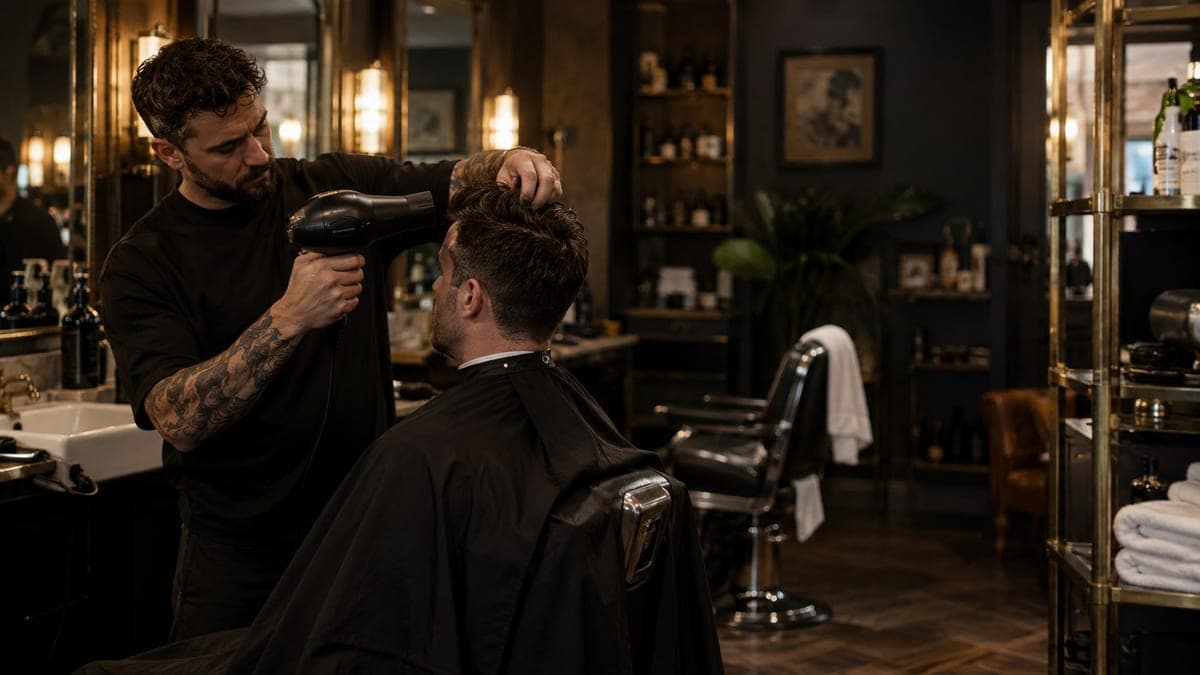
Dry the roots first, against the grain. Find the direction your hair naturally falls, then push it the other way with your fingers and put the dryer on the roots, not the ends. If it falls forward, dry it back. If it falls to the left, dry it right. You are not styling yet. You are just making the roots dry standing up instead of lying down.
Use your fingers, not a brush. Claw your hand into the roots and shake it about while the air is on. A brush on short hair drags the lot into one smooth direction, and smooth is flat.
Medium heat, and keep the dryer moving. Hot air held in one spot dries the outside of the hair while the root is still wet, and then it collapses twenty minutes later when the rest of the moisture comes out.
Finish on cold. Every dryer has a cold button and almost nobody uses it. Hair holds the shape it is in as it cools, so ten seconds of cold air at the end is what makes the difference between hair that stays up until six and hair that has gone by eleven.
Then, and only then, put it where you want it. If the style needs a different direction altogether, a parting or a slick back, we have set out which way to point the dryer for each shape.
If you have a cowlick or a crown that sits up on its own, work with it rather than flattening it. That is free volume. Men spend years fighting the one part of their head that is already doing what they want.
Put the product in damp, not dry
There are two stages and most men only use one of them.
A pre-styler goes in when the hair is damp and dries into the hair, holding the root up from the inside. A finisher goes in at the end on dry hair and changes the look and the separation. If you want volume you need the first one. If you only own the second one, that is your problem.
What works damp:
- Sea salt spray, four to six sprays at the roots with your head tipped forward. We have a whole guide on getting salt spray right without the crunch, because too much of it is the usual mistake
- Mousse, which went out of fashion with men and should not have. A golf ball of it on fine hair, worked into the roots, then dried, is the cheapest volume there is
- Volume powder, sprinkled at the roots on dry hair. This one is the exception to the damp rule and it is the closest thing to a trick in this whole post. A little goes a very long way and too much feels like sand
What to be careful with: clay is the best of the dry-stage products here because it is matte and light, but it is still weight. Our comparison of clay, pomade and wax covers which is which. If you are going for lift, halve whatever amount you normally use, and apply it at the back first so the front gets whatever is left on your fingers rather than the full dose.
One more thing on washing. Conditioner belongs on the mid-lengths and ends, not the roots. On short hair that often means it barely belongs anywhere. Conditioner at the root is softness where you want grip.
The cut is doing more than you think
Technique gets you maybe a third of the way. The rest is decided before you leave the chair.
Take length off before you take weight out. Every inch that comes off is weight the root no longer has to hold, and on fine hair that is where the lift actually comes from. Taking weight out is a different job, and it only pays on hair with weight to give: break the ends up on thick hair and the top stops sitting like a lid. Fine hair has nothing to remove, so thinning it out leaves you looking at scalp instead of shadow, and a blunt end reads denser anyway because every hair finishes on the same line. The textured crop is what we reach for most often here, and on fine hair we barely point cut it at all.
Shorter sides make the top read taller. Nothing up top has changed, the contrast just does the work for you. It is why a man with a fade looks like he has more hair than the same man grown out all over.
Come back sooner. Three to four weeks rather than seven. Body is the first thing a cut loses as it grows, long before it starts looking untidy, so most men put up with flat hair for a fortnight before it occurs to them to book.
The request we talk men out of most often is growing the top to get more body. That works on thick hair and backfires on fine, because you are loading weight onto a root that is already losing. Past about three inches, fine hair generally stops standing up.
For this particular problem the wash and cut is worth the extra: £18 in a 40 minute slot, and we dry it in front of you so you can watch where the dryer actually goes. Seeing it done once beats reading four sections about it. A haircut on its own is £15 in 30 minutes if you would rather turn up dry.
Where volume stops being the answer
If you are seeing more scalp at the crown than you used to, or the hairline has moved, that is not flatness and no drying technique will change it. The two get confused constantly because they look alike in a bathroom mirror at seven in the morning.
The test: flat hair still covers the scalp when you push it about with your fingers. Thinning hair does not. If the scalp shows through whatever you do with it, what you want is a cut that suits less density, not a volume spray. Plenty of the advice above still helps, it is just doing a different job.
If it has changed quickly, or it is coming out in handfuls, see a GP or a dermatologist. We cut hair. We are not going to sell you a treatment for that.
What to ask for
Say the word flat out loud when you sit down. Tell us it goes flat by lunchtime, tell us whether it is fine or just heavy, and say which way it falls when you do nothing to it. That last one decides which way we cut the top and which way you should be drying it.
Then ask us to dry it before you leave. Six chairs run here and nobody minds spending two minutes on it. If you want to book a slot rather than take your chances on a Saturday, the wash and cut is the one to pick for this.
Common questions
- Does washing your hair less give it more volume?
- The opposite. Oil at the roots is weight, and weight is what pulls hair flat. Men who go four days between washes usually have their flattest hair on day three.
- Is short hair better for volume?
- Up to a point. Taking length off lets the roots stand up, but go too short and there is nothing left to stand. On fine hair the sweet spot on top is usually two to three inches.
- Do volume sprays and thickening products actually work?
- The ones you put in damp do. Sprays, mousses and powders coat the hair and add grip so it holds a shape. Anything you rub between your palms and press on dry hair is adding weight, not lift.
- Why does my hair go flat by lunchtime?
- Usually because it was dried in the direction it grows, so nothing was holding the roots up in the first place. It can also be too much product, or touching it all morning.
- Is flat hair the same as thinning hair?
- No, though they look alike in a mirror. Flat hair lies down but the strands are all still there. Thinning is fewer strands, and you will see more scalp at the crown or a hairline moving back.
Read next
Trend
Textured Crop Styles and What to Ask For
Every textured crop, low fade to French crop, in one table with the price and the words to say, plus how the texture is cut and which hair it suits.
7 min
Products
How to Use Sea Salt Spray, and How Much
How to use sea salt spray from a barber: how many sprays for your length and hair type, in one table, plus how damp to go and why it turns crunchy.
7 min
Products
Clay vs Pomade vs Wax: Which Do You Need?
Clay vs pomade vs wax explained by barbers who see the results three weeks later: what each one does, which suits your cut, and how to wash it out.
6 min