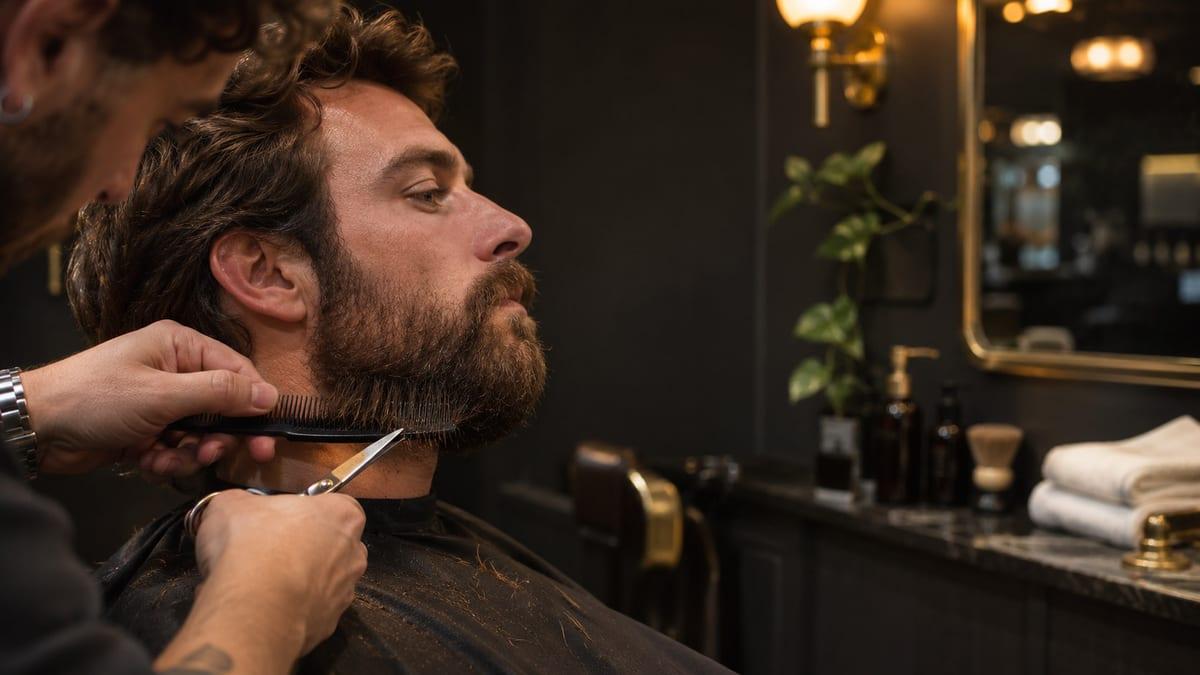
To trim a beard with scissors only, comb a section out away from your face, hold the comb still at the length you want to keep, and cut just the hair that pokes through past the teeth. The comb is your guard. Work in small sections from the sideburns down to the chin, check both sides in a mirror after each one, and leave the neckline alone, because scissors cannot cut a clean line on skin.
How to Trim a Beard With Scissors Only
How to trim a beard with scissors and a comb: the length it needs first, how the comb angle sets your length, and the one edge scissors cannot do.
6 min readGolden Scissors, Maida Vale, London
That is the whole method. The rest of this is the part the step-by-step guides leave out: when scissors are the right tool, how to stop the comb drifting, and what a scissor-cut beard looks like compared with a clippered one.
When scissors are the right tool, and when they are not
Scissors only work once there is enough beard to get a comb into. Under about a centimetre, roughly where a grade 4 guard would leave you, the comb lies flat on your skin and there is nothing between its teeth to cut. If that is your length, a trimmer is the right tool and our guide to keeping a short beard tidy with a trimmer is the one to read.
Over that, scissors start to win. A trimmer guard cuts every hair to exactly the same length from your skin, which on a longer beard is the problem: the cheeks and the chin end up identical, and a beard looks better with more length under the chin than on the cheek. Scissors let you leave length where you want it. They also cut the end off a hair rather than mowing across it, so the finished beard looks softer and less like it has just been done.
The other honest reason men ask us about scissors is that the trimmer is dead, lost, or at home and they are not. That is fine too. A beard can go a long way on a comb and a sharp pair of scissors.
The kit
Short scissors with sharp blades, ideally around five or six inches long. Long hairdressing scissors are hard to control this close to your own face, and the tips of very short ones never reach across a section.
A comb with fine teeth at one end and wide teeth at the other. The wide end detangles, the fine end holds the hair while you cut.
A mirror you can stand square to, plus a hand mirror if you have one, for checking under the jaw. Do it over a sink or a towel, because a scissor trim drops a lot more loose hair than you expect.
How to trim a beard with scissors, step by step
- Comb it all out first. Wide teeth, downwards, then out from the jaw. You are looking for its real length and any knots, not cutting yet.
- Decide what length the chin keeps. This is the longest point and everything else is cut relative to it. If you are not sure how much chin your face wants, our piece on beard length by face shape goes through it.
- Start on one cheek, at the sideburn. Slide the fine end of the comb into the beard against the growth, lift it out from your face to the length you want, and stop.
- Cut only what sticks out past the teeth. Close the scissor tips across the hair just beyond the comb. Keep the scissors parallel to the comb, not angled into it.
- Move down a comb's width and repeat, overlapping the last section slightly so you can see the length you just left and match it.
- Do the same section on the other cheek before you go any further down. Working side to side, section by section, is what keeps it even. Doing a whole side and then trying to match the other one is how men take too much off.
- Work down to the jaw and under it. Tip your head back and use the hand mirror. Let the comb come out a little further from your face as you get to the chin, so the length builds towards it.
- Moustache last. Comb it straight down and trim only the hairs that hang over the top lip, a few at a time with the scissor tips.
- Comb the whole thing out again and look. Any long hairs that stand proud of the outline, snip them singly. Then put the scissors down.
The comb angle is the length
This is where a scissor trim usually goes wrong, and most guides skip it.
On a trimmer the guard decides your length. With scissors the comb does, and the comb is in your hand, so it moves. Hold it slightly further from your face on one section and slightly closer on the next and you have two different lengths a centimetre apart. Tilt it, so the teeth point up towards your eye instead of straight out, and you cut a slope into the beard without noticing.
Two habits fix most of it. Rest the knuckle of the hand holding the comb lightly against your face, so it has a reference point and comes out the same distance each time. And look at the comb, not at the beard, when you cut. Your eye wants to follow the hair. It should follow the teeth.
Point cutting the ends
Once the shape is right, a scissor-cut beard can look a bit square at the edges, especially on thick, straight hair. The fix is point cutting: hold the scissors upright, pointing into the ends of the beard, and make small snips into the tips rather than straight across them. It breaks up the hard line so the beard looks grown rather than cut.
Go lightly. A few snips per section is plenty, and you are only cutting the last few millimetres. If the beard starts looking thinner, stop.
The one edge scissors cannot do
The neckline. Scissors cut hair that is lifted on a comb. They cannot cut down to skin in a clean line, and trying to do it with the tips is how men nick the soft skin under the jaw. If you have no trimmer or razor, leave the neck to grow and get it lined. Where it belongs, and why home necklines creep up the jaw, is in our home trimming guide already.
The cheek line is the same story. Scissors can tidy the odd stray hair high on the cheek, one at a time, but they cannot set a line.
On a longer beard, this is how we split it in the chair too: comb and scissors for the length and the shape, razor for the edges. When you come in, tell us you have been keeping it with scissors and roughly how much chin you have been leaving. We can work from your shape rather than starting over, and booking a slot means one of our six chairs is free for it when you arrive.
The first time, take off half of what you planned
Scissors are slower than a trimmer and that is in your favour. You see every cut as it happens. The mistake on a first scissor trim is not a slip, it is a man deciding the beard needs to lose two centimetres and taking all two in the first pass. Take one, comb it out, look at it in daylight, and live with it until tomorrow. If it still looks long the next morning, the second centimetre will still be there.
Common questions
- Can I use kitchen scissors or nail scissors on my beard?
- Kitchen scissors are too blunt and too long, so they fold the hair over before they cut it and you get a chewed edge. Nail scissors are sharp but the blades are so short you end up making fifty tiny cuts that never line up. A cheap pair of proper barber's or beard scissors is better than either.
- How short can I go with scissors only?
- About as short as the comb lets you, which in practice is around a centimetre. Below that the comb cannot get under the hair and you are cutting freehand against your skin. If you want stubble or a short boxed beard, that is a trimmer job.
- Should I cut my beard wet with scissors?
- Damp at most, and only to get it combing straight. Hair that has just come out of the shower lies longer than it will by lunchtime, so whatever you cut wet ends up shorter than you saw in the mirror.
Read next
Beard & Shave
How to Trim Your Own Beard Between Cuts
How to trim your own beard between barber visits: the kit that matters, the order to work in, the guard to start on, and the two lines to leave well alone.
6 min
Beard & Shave
Beard Length by Face Shape, in Guard Numbers
The right beard length for your face shape, split into cheeks, jaw and chin with the guard number for each, and how to find your shape with a beard on.
5 min
Products
Beard Oil vs Beard Balm: The Difference
Beard oil vs beard balm explained by the barbers on Harrow Road: what each one actually does, and which one your beard needs right now.
4 min