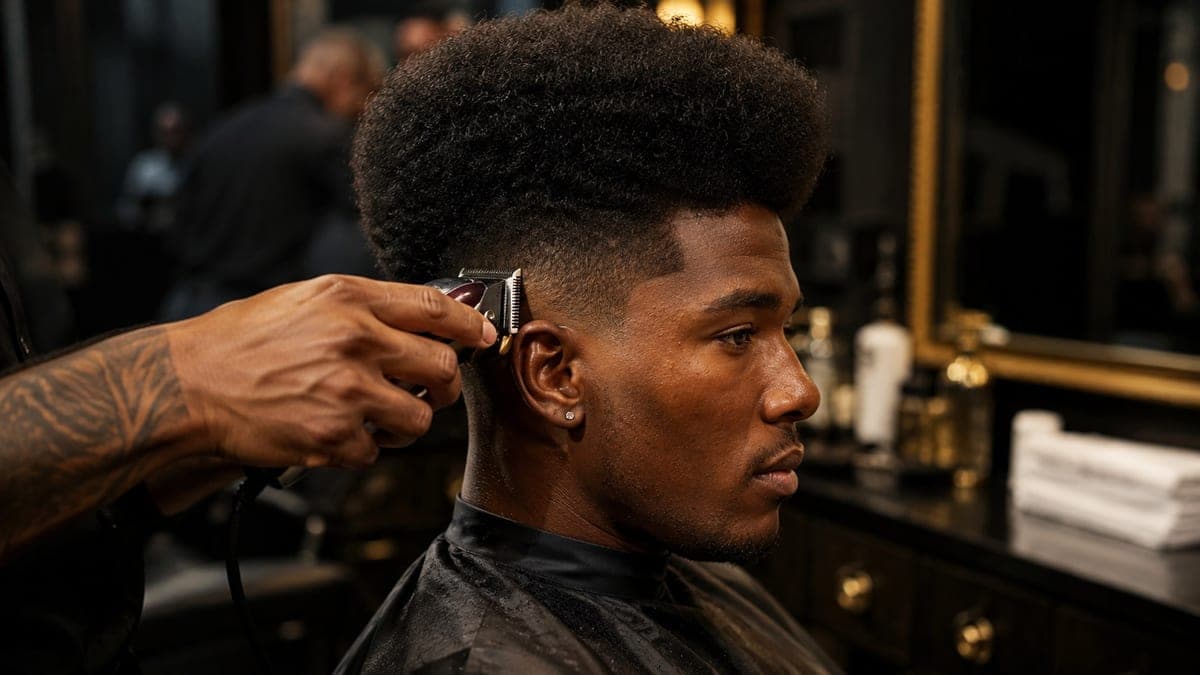
An afro taper fade keeps the full height of your afro on top and shortens the hair gradually around the edges, at the temples, over the ears and down the nape, stopping at a guard rather than at bare skin. That is the part that matters. A taper always leaves a shadow of hair at the bottom, so there is no hard line where the clippers finished and your own density begins.
Afro Taper Fade Types and What to Ask For
Every afro taper fade side by side, temple to burst, what a soft taper and a round afro mean, and the exact words to use so you leave with the right one.
Updated 8 min readGolden Scissors, Maida Vale, London
Why an afro taper fade beats a skin fade
We cut plenty of skin fades on afro hair and some of them are the best-looking cuts that leave this shop. On a dense, well-shaped top, bare scalp underneath is a contrast nothing else touches, and how the two finishes age is a fair comparison. So this is not a rule, it is a default.
The case for the taper is not that a skin fade looks wrong on coily hair. It is mostly about what happens after you leave.
Bare scalp shows regrowth within days on any head, so a skin fade is at its crispest for about ten days and wants redoing at two to three weeks. A taper does not run on that clock, because the bottom of a taper is already a shadow. Growth arrives as slightly more of what was already there.
The last reason is the nape. Coily hair does not come out of the scalp in a straight line, it comes out in a curve, and hair cut flush to the skin can catch on the way back out and turn into the skin rather than clearing it. That is why the back of the neck is where men with coily hair get bumps, and it is why we take the nape of a taper down to a guard and leave it there. If you already get them, start with a pharmacist and see a GP if they do not clear up, because that is past what a barber should be advising on.
The four places to put a taper
"Taper" on its own is not an instruction. It describes how the hair gets shorter, not where, and those are separate decisions that men run together in the chair every week.
| Version | Where the short hair goes | What is left alone | Ask for it when |
|---|---|---|---|
| Temple taper | The corners, from the front of the hairline back to about the top of the ear | Everything behind the ear | You want the afro untouched from the side but sharp from the front |
| Nape taper | The back, from the ears down | The temples and sides | A growing afro is starting to sit on your collar |
| Burst taper | A semicircle round the ear, dropping behind it | The back of the head | Your afro is widest just above the ears and you want that width gone |
| All the way round | The whole outline, temples to nape | The top | You want the standard version |
The burst is the one men overlook. It takes the width out at exactly the point where an afro gets widest, and the same arc, in skin or taper, is the base under a frohawk, which our burst fade guide covers.
All the way round is what you get if you ask for an afro taper and say nothing else.
What to actually say
Barbers work in guard numbers and directions, so give us those.
A workable ask for the full outline: "Take the edges down to a one, blend it up to a three by the time you get to the top of my ear, leave the length on top alone, and follow my hairline rather than squaring it."
Two details are worth naming. The first is the height of the taper, meaning how far up your head the short hair travels before it meets your length. Low keeps almost all your width. Higher gives you shape and takes weight out of a top that has got heavy. The second is whether the taper is scissor-blended into the top or clippered up to it, and on a genuine afro you want scissors doing that join, because clipper work up into dense coils leaves a shelf.
If you are only in for the edges, say the words "do not touch the top". It sounds obvious. It gets forgotten on a busy Saturday, and once the length is gone it is gone.
Pick it out before anyone judges the shape
An afro is not the size it looks. Coily hair compresses against itself, and hair that measures four inches when it is stretched can be sitting at an inch and a half on your head. That gap is exactly where a taper goes wrong.
So the top gets picked out first, from the roots and all the way round, before anyone decides where the taper stops. An afro flattened by a hood or slept on has a different silhouette to the same hair picked out, and a taper height set against the flattened version leaves the line in the wrong place once it springs back up.
It also changes what looks balanced: the fuller the top, the higher the taper can travel without your head reading narrow at the bottom. How the top itself gets cut is a longer subject, and our guide to fades on curly hair covers it. The picking out belongs to the taper, because it sets where the line lands.
Soft taper, round afro
Two words get added to "afro taper" a lot, and they describe different halves of the cut.
Soft is about the sides. A soft taper is the gentlest version of the blend: the bottom stays on a longer guard, the shortening is spread over more of your head, and there is no point where you can see a line. "Keep it soft, nothing below a two" is a clear way to ask. It is also the sensible first taper if you have never had one, because a soft taper can be taken shorter next time and a short one cannot be put back.
Round is about the top. A round afro is shaped into one even curve from every side, so the silhouette reads as a circle rather than as height on top and bulk at the sides. That is scissor work on picked-out hair, following the curve, and the taper underneath has to stay low so the curve can run down into the sides without a corner. Put a high taper under a round top and it cuts the circle off halfway.
The two go together. A soft, low taper under a round top is the easiest version to keep while you are growing, because it holds the shape you are working towards and takes almost nothing off the length.
The edge up is where hairlines get lost
Afro hairlines are rarely symmetrical. One corner usually sits deeper than the other, there is often a shallow dip above the middle of the forehead, and the growth at the temples tends to be finer than the growth an inch behind it. Trimmers flatten all of that into one straight line in about ninety seconds, and for a week afterwards it looks superb.
What it costs is the hair that had to come off to make the line straight, and then that same hair again a fortnight later, because a drawn edge only stays sharp while you keep cutting back to it. Hold a hard line for a couple of years and it is no longer sitting where it started. The temples go first.
There is a middle setting, and it is what you get here unless you say otherwise. We clean the hairline you already have, take the stragglers off below it, and leave the shape itself alone. It reads as tidy rather than drawn, and it takes nothing off you that will not grow back. If you do want the sharp version, ask each visit, because it is not what we default to. Line ups, and what one involves goes through the technique properly.
How long it holds, and what it costs
Three to four weeks. That is the honest interval for a taper, against about two for a skin fade on the same head, and it is the practical argument for the taper more than anything about how it looks. A taper in week four is a slightly softer taper. A skin fade in week four is a haircut you are apologising for.
A taper fade is £17 here and holds a chair for 40 minutes, which is the time it takes to pick the top out, set the height and blend the join by hand. If you want the beard done in the same sitting it is £9 added to the cut rather than £11 on its own, so the two together come to £26. With six chairs going, the time on your booking is the time you sit down. Reserve a slot, or take your chances as a walk-in.
The mistake worth heading off has nothing to do with technique. In ordinary use "fade" has drifted to mean skin fade, so a man who wants a taper asks for a fade, is given precisely what he asked for, and spends the next three weeks looking at a line he never wanted. Use the word taper. Say how high you want it to travel. If you are unsure of the rest, "not down to the skin" is enough to keep you out of trouble.
Common questions
- What is the difference between an afro taper fade and a skin fade?
- A taper stops at a guard, so there is always a shadow of hair at the bottom. A skin fade goes to the blade and leaves bare scalp. On coily hair that shadow also spares the nape, where hair cut flush to the skin is the most likely to grow back in as bumps.
- How often does an afro taper fade need redoing?
- Three to four weeks for most men, and it still looks deliberate in week four. A skin fade on the same head wants doing at two, because bare scalp shows regrowth the moment it starts.
- Can I get a taper while I am growing my afro out?
- That is the main reason men ask for one. The taper tidies the outline and leaves every bit of length on top, so the shape stays sharp through the months where an afro is otherwise just getting wider.
- Does getting the edges done push your hairline back?
- The clippers do not, but the habit can. Squaring off a naturally uneven hairline means cutting into hair that was already there, and repeating that every fortnight for a year moves the line. Ask your barber to follow your hairline rather than redraw it.
- How much is an afro taper fade at Golden Scissors?
- A taper fade is £17 and holds the chair for 40 minutes. Adding a beard trim to it takes the beard to £9 instead of £11, so the pair comes to £26.
Read next
Curly & Afro
Which Curly Hair Fade Suits Your Curl Type?
The best curly hair fade for loose waves, tight coils and a thinning crown in one table, why the top must be cut dry, and the £16 visit that keeps it sharp.
7 min
Style Guide
Skin Fade vs Taper Fade: The Difference
A skin fade goes to bare skin, a taper fade keeps a little length. Which one suits your hair, your head shape and how often you can get back to the chair.
5 min
Style Guide
What Is a Line Up Haircut? Edges Explained
What a line up haircut is, how it differs from an edge up or a shape up, who it suits and what to ask for. From the barbers on Harrow Road.
6 min