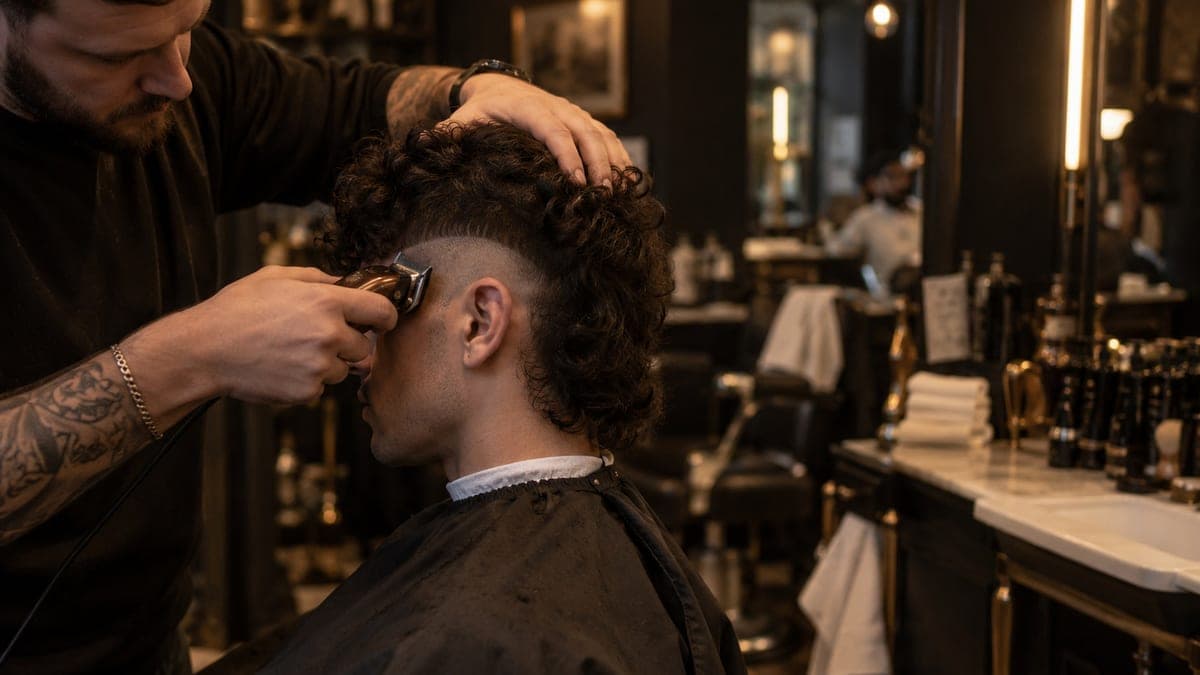
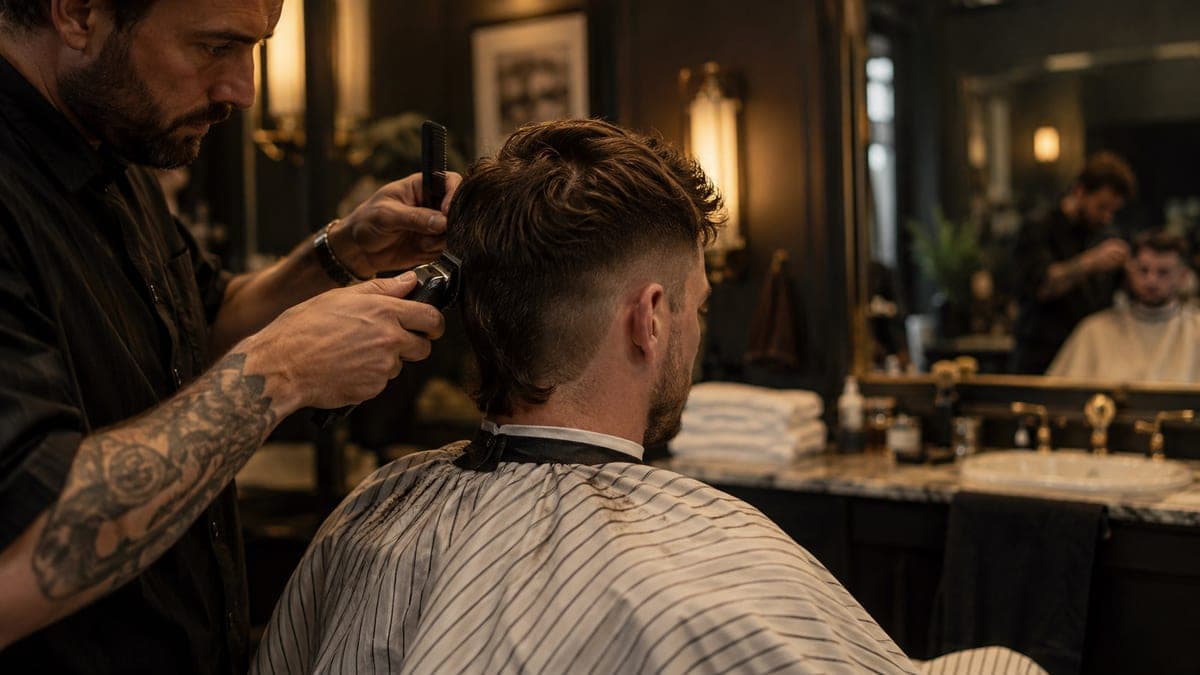
A burst fade is a fade cut in a half circle round the ear. It starts in front of the ear near the temple, goes shortest just above it, and curves back up behind it, so the fade looks like it is radiating out from the ear. Everything outside that arc keeps its length, the back of the head included. That length down the back is why the burst fade is the usual base under a modern mohawk or faux hawk.
Burst Fade: The Cut Behind the Modern Mohawk
A burst fade curves round the ear and leaves the back long, which is why it sits under the modern mohawk. Who it suits and how to book one.
6 min readGolden Scissors, Maida Vale, London
Where the fade stops
Most fades go all the way round your head. A low fade, a mid fade or a high fade each draws one line at a set height and carries it from one temple, round the back, to the other. The drop fade bends that line down behind the ear, but it still goes all the way round.
A burst fade doesn't. The clipper work stays in a curve round each ear and then stops. If you stand behind someone with a burst fade, the middle of the back of the head is just hair at whatever length is on top, or one guard shorter, tapered slightly into the neck. Nothing is faded there.
The shortest point is directly above the ear, at the middle of the arc. That can be skin, foiled clean, or a taper that stops at stubble. The rest of the arc blends out from there in every direction at once: up towards the temple, forward towards the sideburn, back and up behind the ear. That is the skill in it. A straight fade blends in one direction. A burst has to blend outwards from a single point, so a mistake on one side shows up as a lopsided ring rather than a slightly uneven line.
Why a mohawk needs one
A real mohawk shaves the sides off completely and leaves a single strip running front to back. That is a lot to commit to on a Tuesday morning. A burst fade gets you most of the shape while leaving more hair on your head.
The fade takes the bulk off round the ears, which is where the head is widest. What is left is a band of length over the top and down the back, getting narrower as it reaches the nape. Style the top up into a ridge and it reads as a mohawk from the front. Comb it flat and it reads as an ordinary short cut with interesting sides. You are not committed to the mohawk every day, and that is most of the appeal.
How wide the band ends up depends on how far behind the ear the arc finishes. Stop it close behind the ear and the strip down the back is broad and soft, more faux hawk than anything else. Take the arc further round and the strip narrows, which gets closer to the real thing. At the neck you can leave it squared off, round it, or bring it to a point. The point is the version people tend to mean when they say burst fade mohawk.
What hair it works on
Curly and afro hair suit it best. Curl holds the shape on top by itself without product, and the arc trims the sides right where an afro would otherwise push out furthest. On an afro the burst sits under a frohawk, and on looser curls the top can just be left to do what it does. Our afro taper fade guide has the burst taper as one of its four placements if you want the softer version of this.
Thick straight hair needs a bit of help. It will stand up through the middle if it is cut short enough on top to support itself, roughly finger length, and you put some clay or paste through it in the morning. Leave it longer than that and it flops sideways over the arc and hides the fade you paid for.
Fine or thinning hair is where we'd steer you away from the skin version. A bare ring round each ear makes the hair above it look thinner by contrast, and fine hair won't hold a ridge up in the middle anyway. A taper finish keeps the curve with less scalp on show.
One more thing to know: the arc frames the ear. That is the point of the cut, but if you would rather your ears were not the first thing people see, a burst fade is the wrong cut for you. A plain taper hides them better.
The back is the part to plan
The burst decides what happens round the ears. The back is a separate choice, and you need to make it before you sit down, not halfway through the cut.
You have three options. Keep the back tight to the head, a guard or two longer than the burst, and the cut stays short and tidy. Leave it the same length as the top and you have something close to a short mullet, which is a different look with its own grow-out timetable, covered in our piece on the modern mullet. Or narrow it to a strip that follows the mohawk down to the neck, which needs the most upkeep because a strip that blurs at the edges stops looking like a strip.
All three get called a burst fade. They look nothing alike from behind, and behind is the one angle you never check in the mirror.
How it grows out
The arc goes first. Two weeks in, the shortest point above the ear has grown back enough that the ring starts to soften, and at three weeks the curve has lost its shape. If the fade went to skin, that happens a little sooner. A taper holds a few days longer because there was less contrast to lose.
The top and the back grow out more slowly because there is more length there. You can come back every fortnight for the sides and only have the top touched every second visit. If you do that, a Skin Fade, Sides Only at £16 covers the arc without paying for the top.
Booking one here
There is no line on our price list called burst fade. Book a Skin Fade if you want the arc going to bare skin, or a Taper Fade if you want it to stop at stubble. Both are £17 and take 40 minutes, and the Skin Fade is the most-booked chair we have, so a burst is ordinary work for whoever cuts you. You can book either one online and tell us about the shape when you sit down.
When you do, bring a photo taken from the side and one from behind, not the front. A burst fade is almost invisible from the front, so a straight-on picture tells us nothing about how far the arc runs or what you want at the neck. If you only have the front view, tell us the back option you want in plain words: tight, long, or a strip.
Common questions
- Is a burst fade the same as a drop fade?
- No. A drop fade dips behind the ear and then carries on round the back of the head. A burst fade curves round the ear and stops, so the back is never faded at all and keeps its length.
- Do I need a mohawk to get a burst fade?
- No. The burst only decides what happens round the ears. You can wear it under curls, a textured crop or a short mullet. A mohawk is just the style that shows it off most, because the length left at the back gives you a strip running down to the neck.
- Does a burst fade work on straight hair?
- It does if the hair is thick enough to stand up through the middle. Fine, straight hair tends to lie flat in the strip, and then the cut reads as a mullet that has not decided yet. A taper finish round the ear is kinder to it than skin.
- How much is a burst fade at Golden Scissors?
- It is booked as a Skin Fade or a Taper Fade, both £17 for 40 minutes. Tell us in the chair you want the burst shape and where you want the back to finish.
- How often does a burst fade need redoing?
- Every two to three weeks for the arc round the ear, which is the first part to lose its shape. The back and the top can go much longer between cuts.
Read next
Style Guide
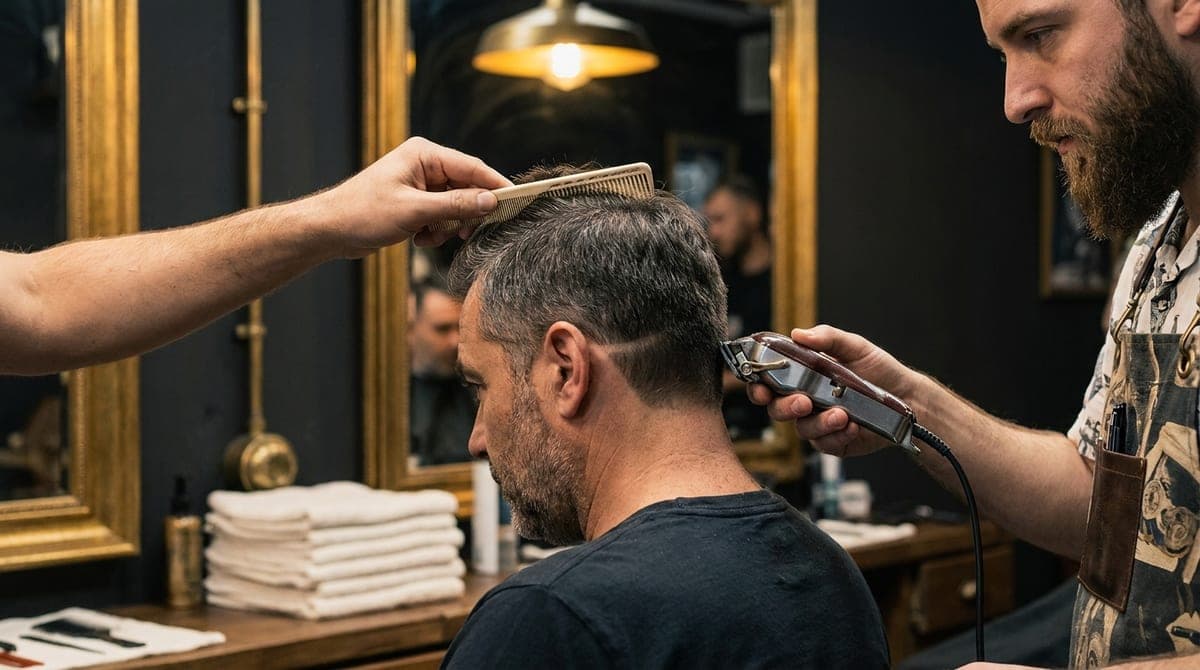
Drop Fade: 15 Styles to Show Your Barber
A drop fade curves down behind the ear instead of running level, which head shapes it flatters, and how it pairs with a beard or curls.
5 min
Curly & Afro
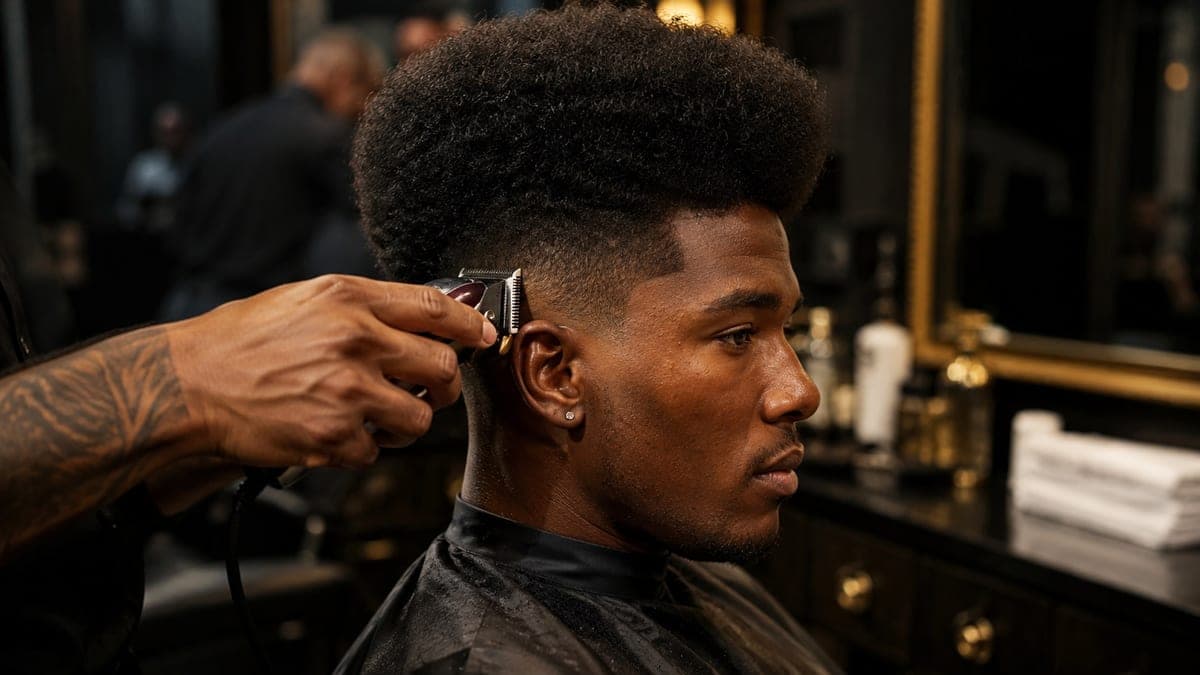
Afro Taper Fade: The Complete Guide
What an afro taper fade is, why it grows out better than a skin fade on coily hair, where to put the taper and what to ask for in the chair.
7 min
Trend
Modern Mullet: What It Looks Like in 2026
A modern mullet in 2026 tapers the sides instead of growing them out flat. What we actually cut, who it suits and what to say in the chair.
5 min