Most beard trim styles come down to three decisions rather than a name off a chart: how short the length goes, where the cheek line sits, and how low the neckline drops. Get those three right and the beard suits your face whether it is a week old or a year old. Get the neckline wrong and nothing else you do rescues it. Here is how we work through all three in the chair.
Beard Trim Styles: Shape, Length, Neckline
The beard trim styles we cut most on Harrow Road, what guard number to ask for, where a neckline actually belongs and when to leave the cheek line alone.
6 min readGolden Scissors, Maida Vale, London
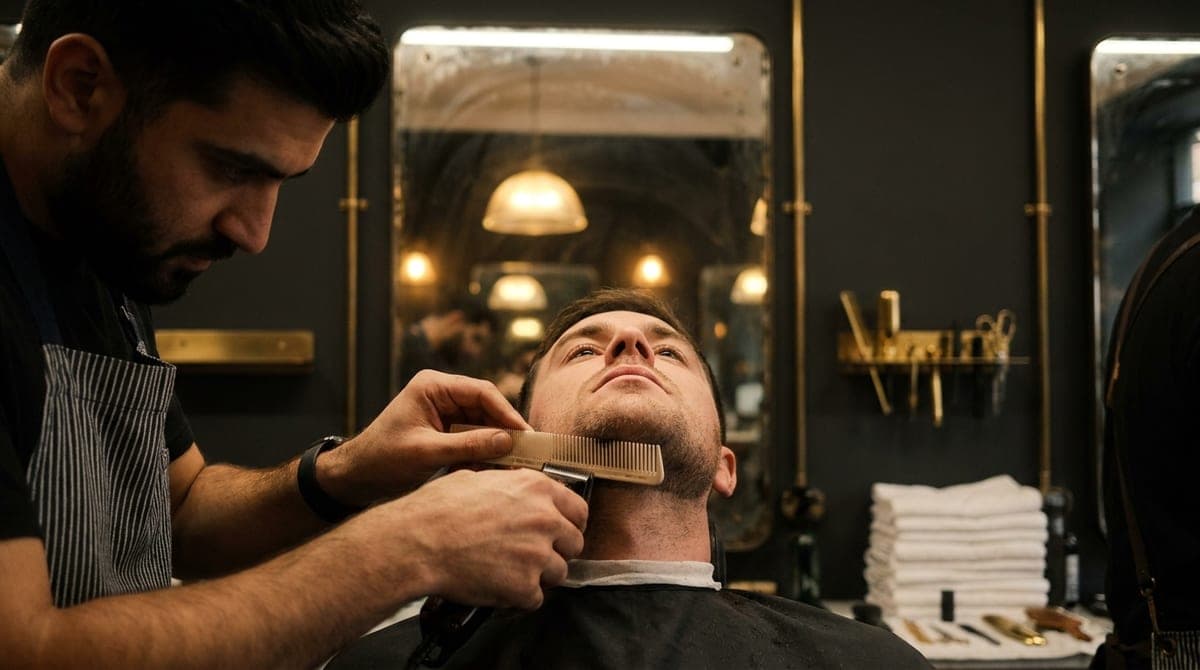
The beard trim styles we cut most
Beard names travel badly. What one shop calls a short boxed beard another calls a stubble trim, and half the names men bring us come off a photo grid rather than out of a barber's mouth. So we describe a beard by what it does instead.
Shaped stubble. One short length all over, a 1 or under, with the cheek line and neckline cut in properly. It is the lowest-maintenance beard there is, and it flatters more faces than men expect, because at that length the hair reads as shadow, and shadow is very good at squaring a jaw.
The short boxed beard. A 2 or a 3 through the cheeks, a little longer at the chin, edges cut hard. This is the one most men mean when they say they want the beard tidy. It works for office life, it survives a fortnight, and it needs no product.
The tapered beard. Short at the sideburn, growing longer as it comes down and forward to the chin, with no hard line at the top of the cheek. It is the kindest shape on a round or heavy face because all the weight ends up at the bottom, where it lengthens instead of widening.
The full beard, shaped. Length kept, but the outline cut on purpose: cheeks cleaned above the natural line, neck taken back, the whole thing evened out so it grows as one mass rather than at five different speeds. Most of that is scissor work, not clippers.
There are others and we will happily cut them. A goatee, a chinstrap, a moustache on its own at £5. Those are a look you have chosen rather than a shape that follows your face, which is fine, as long as you know which of the two you are asking for.
Length is a number, not an adjective
"Short" means nothing across a mirror. Give us a guard number and the trim is settled in one pass.
The guards that go on your head go on your beard and the numbers mean the same lengths, with one caveat: beard hair is coarser and grows in more directions, so a 2 on your jaw reads slightly longer than a 2 on your sides. Most tidy short beards live between a 1 and a 3.
Here is the part worth knowing. A beard cut at one number all over is a length. A beard cut at two numbers, shorter through the cheeks and longer at the chin, is a shape. That one extra step is the difference between a trim that looks done and a trim that looks like you ran the clippers over it yourself in the kitchen. It costs about ninety seconds of chair time.
If you are patchy across the cheeks, and plenty of men are, go shorter rather than longer. Patches show at length and vanish at a 1. Growing a thin cheek out in the hope it fills in mostly buys you four weeks of looking like you are waiting for something.
Your neckline is too high
We straighten out more necklines than we cut from scratch, and nearly all of them were shaved at home.
The line lives about two fingers above your Adam's apple, and it curves. It does not run flat across from ear to ear along the jaw, which is where most men put it, because in the mirror the jaw looks like the obvious edge. Cut it there and you have a chinstrap. The beard stops where your face stops, and the whole thing looks stuck on rather than grown.
So: lower than you think. Then let it climb towards the back corner of the jaw on each side instead of holding a level line.
The other half of it is what to do between visits, and the answer is nothing. Necklines drift down as the beard grows and the urge to reset one with the trimmer at seven in the morning is strong. The trouble is that the line you shave in the bathroom sits higher than the one you shaved last month, and higher again the month after, and by the third go we are all waiting three weeks for your neck to catch up. Leave the neck alone and let someone who can see it put it back.
The cheek line: how high, and how hard
Two choices, and it is a genuine decision rather than a technicality.
Natural. We take the strays off above the natural top of your growth and leave the line where your face put it. Softer, grows out invisibly, and on uneven or patchy growth it is almost always the right call.
Cut. A defined line angled from the sideburn down towards the corner of the mouth, finished with the razor. Sharp, obvious, and it wants seeing to every two or three weeks before the growth above it blurs the edge.
Be honest with yourself about how often you will get back. A cut cheek line on a man who comes in every six weeks looks worse at week five than a natural one ever does at any point. There is no shame in the natural line. Most of the beards you would look at in the street and call well kept are wearing one.
What to say when you sit down
Length, then shape, then the neck. "Take it through with a 2, leave the chin a bit longer, natural cheeks, and set the neckline properly" is a complete instruction and it takes about six seconds to say.
Worth adding if it applies: whether you are growing it out. A beard being grown towards a length gets trimmed differently from one being held where it is, and both men sit down and ask for a tidy up. Tidy and shape are different jobs, and asking for the wrong one is how men leave shorter than they meant to.
A beard trim is £11 and holds a chair for 15 minutes: shaped, evened out, lines put back with the razor. Add it to any haircut when you book and the trim drops £2, so a cut and a beard together bills £24 in one sitting. Every two to three weeks holds the edges. The length can wait as long as you like. Where those fifteen minutes go, and when it is fair for a trim to run longer, is in what a beard trim should cost.
If nobody has ever set your neckline for you, start there rather than with the length. Fifteen minutes and £11, and it does more for a beard you already own than any change of number will. Grab a slot or put your head round the door: six chairs run at once, so there is usually one going.
Common questions
- How often should I get my beard trimmed?
- Every two to three weeks if you want the edges sharp. The length can go a lot longer than that, but a cheek line and a neckline start drifting inside a fortnight.
- What guard number should I ask for on my beard?
- Most tidy short beards sit between a 1 and a 3. Beard hair is coarser than head hair and grows in more directions, so the same guard reads a little longer on a jaw than on your sides. If you do not know your number, tell us how long it has been since the last trim and we will work back to it.
- Where should a beard neckline sit?
- About two fingers above the Adam's apple, curving up towards the back corner of the jaw on each side. Not along the jawline itself. A line cut on the jaw gives you a chinstrap.
- Should I have a hard cheek line or leave it natural?
- Natural if your growth is patchy, or if you cannot reliably get back every two or three weeks. A cut line looks sharp for a fortnight and then the growth above it turns it into a smudge.
- How much is a beard trim at Golden Scissors?
- £11 in a 15 minute slot. Added to any haircut it drops by £2, so a haircut and a beard together bills £24. A moustache trim on its own is £5, and a clean shave with a straight edge and hot towels is £11.
Read next
Beard & Shave
Beard Care in Summer: 7 Rules to Live By
Summer beard care from the barbers on Harrow Road: how to wash, oil and trim a beard through London heat, and when to take it shorter instead.
5 min
Barbershop FAQ
Clipper Guard Lengths in mm, From 0.5 to 8
Every clipper guard from 0.5 to 8 in mm and inches, the 1.5 included, plus what each one looks like on your sides and how to ask for it in the chair.
6 min
Products
Best Aftershave Balms to Stop Razor Burn
The best aftershave balm for razor burn is an alcohol-free one: what we tell men to buy, what to leave on the shelf and why the shave matters more.
7 min