A patchy beard is not a growing problem, it is a matching problem. Nothing in a bottle starts a follicle that was never there, so the honest answer is to stop chasing the beard you had in mind and wear the one your face will actually carry. Almost every man who sits down unhappy with his patches is wearing his beard two or three times longer than his growth can support, and the length is doing more damage than the gaps are.
Patchy Beard: How to Make It Work
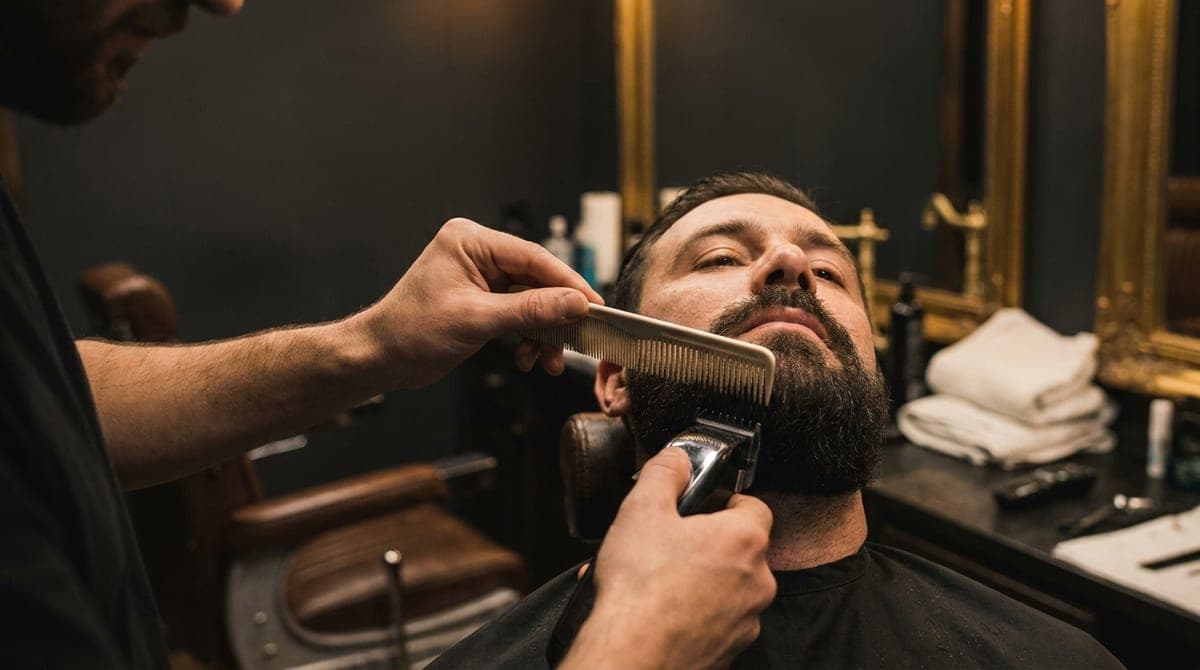
You cannot grow hair where there is no follicle, but you can wear a beard that fits the growth you have. How we read a patchy beard in the chair.
6 min readGolden Scissors, Maida Vale, London
Work out which kind of patchy you are
Men use one word for about five different things, and they do not all have the same answer.
Thin cheeks. The common one by a long way. The jaw and chin come in solid, then the cheek thins out or stops in a ragged line halfway up. Usually symmetrical, usually there from the start.
The corner under the ear. A bare stretch where the jaw meets the sideburn, so the beard looks like it has come loose from your hair instead of running into it.
The moustache gap. Chin and moustache refuse to meet at the corners of the mouth. Very common, and the one men worry about most while other people notice it least.
Sparse chin sides. Strong growth dead centre, thin on the slopes either side. This one is often not a gap at all, which brings us to the thing worth checking before you write any of it off.
A clean round patch. Smooth, coin-sized, in a beard that used to be full. That is not a growth pattern, that is a change, and it is the one thing on this list that belongs with a GP rather than with us.
Here is the check. Wet the area and push the hair against the grain with your thumb. On a genuine gap there is nothing to push. What you will often find instead is hair that is perfectly present but growing flat and sideways, lying down across the skin and letting the light through. That is a direction problem, not a density one, and it is fixable in a way that a real gap is not: a shorter cut stands it up, and blowing it dry against the grain for ten seconds holds it there. Colour plays the same trick. A fair or red beard lets skin show through at short lengths and can look thinner than it is, which is one reason a short beard often looks a different shade from the hair on your head.
Age does more for it than anything on a shelf
Facial hair is the last thing to turn up and it arrives slowly. Density generally carries on building through the twenties and settles somewhere in the early thirties, so a cheek that looks hopeless at twenty-one is genuinely not a verdict. Plenty of men who cannot hold a full beard at nineteen can hold one comfortably by their late twenties.
That is not a promise, because nobody can look at a thin patch and tell you whether it is late or permanent. It is a reason not to make an expensive decision about it in your early twenties. Give any new growth the first eight weeks before you judge the shape of it, then judge what is there rather than what you were expecting.
Why a patchy beard looks thinner as it gets longer
This is the part that catches most men out, because the instinct is exactly backwards. When you spot a thin area, growing it longer feels like the fix. It is the opposite.
Short hair stands up. At three to six millimetres the hairs are stiff enough to hold their own angle and they lean on their neighbours, so what you see is a surface with a shadow under it, and your eye reads that as density. The skin barely gets a look in.
Past a centimetre the weight starts winning. Hair lies down, falls into strands and separates, and every strand that drops away from a thin patch opens a window straight to the skin. A gap that was invisible at a grade two is a hole at an inch. The beard is not thinner, it is just no longer hiding anything.
So the lever is the guard, and it is the only one that works the same day. Run the whole beard on one setting, a three or a four for most men, and the thin areas stop announcing themselves because there is no longer a long, full area sitting next to them for contrast. Uniform reads as deliberate. Uneven length reads as a beard that has gone wrong.
The beard to ask for, pattern by pattern
Thin cheeks. Drop the cheek line. Most men try to carry it high because that is what they see in photographs, and it means the sparse top of the cheek is the first thing on show. Bring the line down to where the growth is genuinely solid, cut it clean with the razor, and everything above it is skin on purpose rather than a failure. Short overall, and let the jawline do the work.
The corner under the ear. Keep the beard short enough that the gap is stubble rather than a break, and connect it visually through the sideburn instead of trying to fill it. If it is a wide bare stretch, a deliberate disconnect looks far better than a bridge that is not there.
The moustache gap. Either let it be, because at short lengths it disappears, or stop fighting it and go to a horseshoe, where the gap is the design. A moustache that is trimmed properly on its own is £5 and ten minutes, and it takes the pressure off the rest.
Sparse chin sides. Run everything to one guard, then take the corners of the chin in slightly so the eye follows the outline rather than the surface. Where the cheek line and neckline sit does more for the shape than length ever will, and we go through both in our guide to beard shapes and lines.
Strong chin, weak everywhere else. This is what a goatee is for. It is a proper style with a century of history behind it, not a consolation prize, and on the right growth map it looks considered in a way that a struggling full beard never does.
Oils, supplements and what is worth your money
Beard oil is worth buying. It softens the hair, it stops the skin underneath flaking, and it makes a short beard sit better. It does not create follicles, and any bottle sold on a growth claim is selling you something it cannot deliver. The same goes for brushes, rollers and most supplements: fine for condition, useless for coverage.
Minoxidil comes up often enough to be worth a straight answer. It is a real medicine with real research behind it, but using it on the face is off-label in the UK, it is not something the NHS prescribes for beards, and it is not a barber's call. If you are seriously considering it, take it to a doctor rather than to us. The same goes for any patch that has appeared rather than always been there.
Three sentences that get you the right beard
Tell us, in this order: how long you have been growing it, which areas you are unhappy with, and whether you would rather keep the length or lose the gaps. You cannot have both, and knowing which way you lean saves us guessing.
Then let us put a guard through it before you decide anything permanent. Most men who come in convinced they need to shave it off walk out with the same beard two grades shorter, and the patch they came in about is not visible from the other side of the room. That is £11 and a quarter of an hour, or £24 with a haircut. Book a chair, and the first thing we do is read the growth you have rather than the beard you asked for.
Common questions
- Will my patchy beard fill in as I get older?
- It might. Facial hair is the last thing to finish arriving, and density generally keeps building into the late twenties and early thirties, so a thin cheek at twenty-one is not a final answer. Nobody can tell you which gaps are late and which are permanent, which is why we cut the beard you have today rather than the one you are hoping for.
- Does beard oil make a patchy beard fill in?
- No. Oil conditions the hair you already have and softens the skin underneath, which is worth doing, but it cannot start a follicle that was never there. Anything sold as a beard growth serum is making a claim it cannot keep.
- Why does my beard look patchier the longer I grow it?
- Because long hair separates. At a few millimetres the hairs stand up and lean on each other, so the eye reads a surface. Past a centimetre or so they fall into strands, and every strand that falls away from a thin area opens a window to the skin.
- I have a smooth round bald spot in my beard. Is that the same thing?
- No, and it is worth getting looked at. Never having grown much on the cheeks is a pattern. A clean circle appearing in a beard that used to be full is a change, and that belongs with a GP or a dermatologist rather than a barber.
- What does it cost to get a patchy beard shaped?
- A beard trim is £11 and takes 15 minutes. Booked alongside a haircut the two together come to £24, because we take £2 off the beard whenever it goes with a cut.
Read next
Beard & Shave
How to Grow a Beard: The First Eight Weeks
How to grow a beard without giving up in week three: what happens week by week, the only thing to trim while you wait, and when to let us shape it.
6 min
Beard & Shave
Beard Trim Styles: Shape, Length, Neckline
The beard trim styles we cut most on Harrow Road, what guard number to ask for, where a neckline actually belongs and when to leave the cheek line alone.
6 min
Beard & Shave
How to Trim Your Own Beard Between Cuts
How to trim your own beard between barber visits: the kit that matters, the order to work in, the guard to start on, and the two lines to leave well alone.
6 min