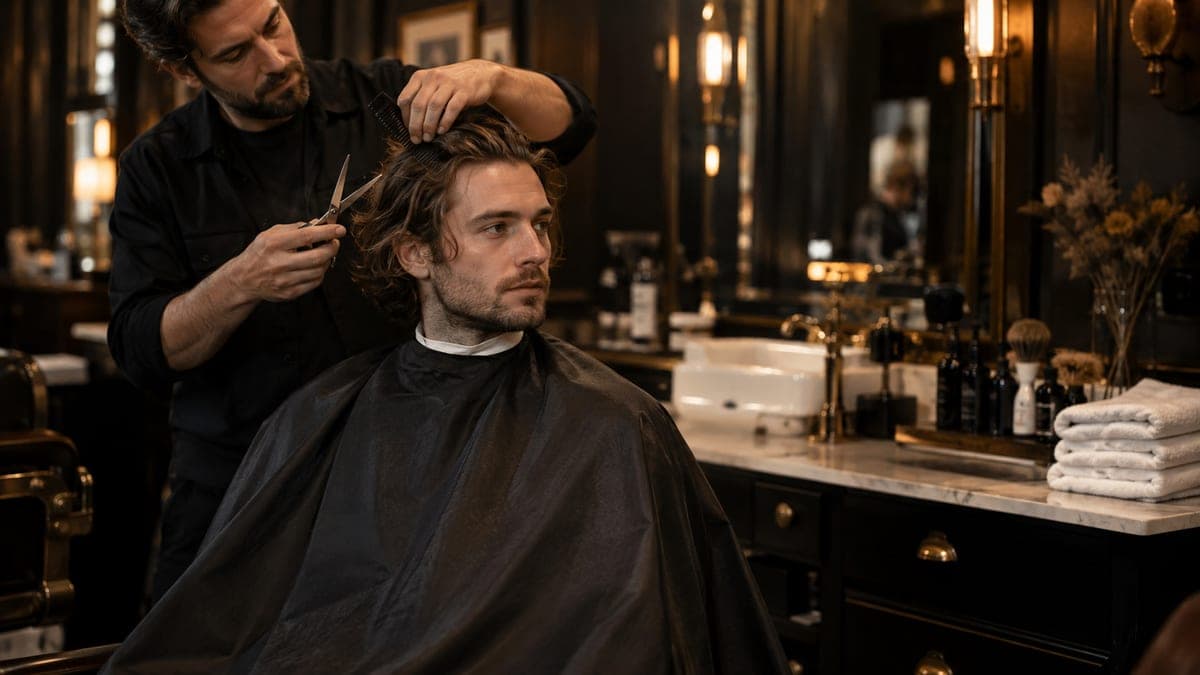
A flow haircut for men is hair grown long enough all over to fall back off the face under its own weight: roughly 10 to 15 centimetres on top, sides long enough to tuck behind the ears, and the back resting on the collar. It is cut with scissors only, in long layers, so it moves when you push a hand through it and settles back without product. From a short back and sides, expect eight months to a year. The top is rarely the hold-up. The sides are.
The Flow Haircut for Men and How to Get It
What a flow haircut for men measures at the top, sides and back, the hair it fails on, the stage nobody warns you about, and the one line to say in the chair.
6 min readGolden Scissors, Maida Vale, London
What a flow haircut measures, area by area
The photos online all show the finished thing from the front. Here is the same cut from the chair, area by area, because each part has a different job.
| Area | Length when it is working | What the barber does to it |
|---|---|---|
| Top | 10 to 15cm, reaches the bridge of your nose when combed forward | Long layers, ends point cut so they fall instead of sitting blunt |
| Front | Long enough to push back past the hairline and stay there | Left longest, never thinned at the root |
| Sides | 8 to 10cm, sits behind the ear | Weight taken out from underneath, length barely touched |
| Back | Rests on the collar, may flick out at the ends | Nape cleaned up, edge left soft rather than squared |
The thing that makes it a flow rather than just long hair is the layering. Cut everything to one length and it hangs straight down in a curtain. Layer it so the top is a touch shorter than the hair underneath it and each section rests on the one below, which is what pushes it back and gives it the swing.
It sits at the opposite end from a wolf cut, which uses layers to break the hair up into choppy, piecey shapes. A flow uses them to make the hair travel as one piece.
The hair a flow suits, and the hair it fights
Wavy hair is the best head for it, by a distance. A slight wave lifts the hair at the root, bends it back by itself and hides any unevenness at the ends. Plenty of the flows you see in pictures are wavy hair doing most of the work.
Thick straight hair works well once it is long enough to have weight, and it needs that weight taken out at the sides more than anyone. Left alone it pushes outward over the ears and the whole shape goes triangular.
Fine straight hair is where we will be honest with you. At collar length it tends to go flat at the crown, separate into strands and show scalp under a bright light, and the ends cling to your forehead instead of sweeping away from it. It can be done, with a blow dry every morning and a salt spray for grip. If you would rather not sign up to that, a shorter cut built for fine hair will look fuller every day of the week.
Tight curls do not flow back, they grow up and out, so the same length gives you volume rather than movement. That can look excellent. It is a different cut and we would shape it differently.
A strong cowlick at the front matters too. If your hair at the hairline grows forward or swirls, pushing it back fights the growth every morning, and it will win by lunchtime. We can usually see this in the first minute in the chair.
Getting there from short hair
If you are starting from a buzz, the early months are covered in the stages of growing out a buzz cut, and the advice there holds: let the top go and keep the sides tidy. A flow changes one thing about that plan, and it is where flows usually stall. At some point the sides have to be allowed to grow as well, and the sooner you pick that point the sooner you arrive.
- Have one last clipper cut on the sides, and then stop. From a short back and sides, that can be your next appointment. From a buzz, it is about three months in, once the top is near 4cm. After this, nothing goes near the sides but scissors. Say it out loud every visit. Clippers on the sides are a reflex in any barbershop, ours included, and one pass of habit undoes a month.
- Get through the ears. At around 4 to 5cm the side hair lands on top of your ears and pushes out like a pair of wings. This is the second awkward stage, and it is the one nobody warns you about. Do not cut the length. Book in and ask for the weight to come out from underneath, so what is left lies flatter against your head.
- Tuck it. Somewhere around 7 or 8cm the side hair reaches behind your ear and stays there. That is the moment it starts to look like a flow rather than a haircut that got away from you.
- Leave the back to meet the collar. It gets there at about the same time as the sides, because it started short too. Ask for the nape to be cleaned but the edge left soft. A squared neckline under a flow looks like two different haircuts.
- First real flow cut. Layers in, ends point cut, and now it moves.
The arithmetic is simple and not negotiable. At roughly a centimetre of growth every month, side hair that started at a 10mm guard needs around seven months to tuck behind the ear. From a short back and sides the top usually gets to 10cm before that, which is why the sides set the pace. From a buzz, the top and sides land at roughly the same time, about ten months after the clippers, provided you stopped cutting the sides at month three.
Keeping it once it is there
In terms of visits, a flow is one of the easiest cuts to keep. There is no fade line to keep sharp, so every eight to ten weeks is enough: a little off the ends so they do not go thin and wispy, and the weight taken back out of the sides before they start pushing out again.
For hair this long we would point you at the Wash & Cut, £18 and 40 minutes, rather than the standard £15 haircut. Long layers are easier to cut accurately damp, and the extra ten minutes is how long it takes to dry it back and check how it actually falls.
At home, push it back with your fingers while it is damp, not a comb, and let it dry where you put it. If it drops forward by mid-morning, it needs drying back with the dryer pointed from the front towards the crown, which takes three or four minutes and is covered properly in our blow drying guide. Keep the product light. A flow that looks wet or stuck down has stopped flowing.
The line to say in the chair
"I'm growing it into a flow. Don't take length off the sides or the back, take the weight out so the sides sit behind my ear, and point cut the ends on top." That covers every stage from step two onwards, and anyone here will know exactly what it means.
The one thing to resist is having the sides "just tidied" when the wings arrive, three or four months after the last clipper cut. It feels like nothing. It is a month or two of growth gone, on the part of your head that was already holding everything up.
Common questions
- Can I have a fade with a flow?
- Not a real one. A flow is defined by length on the sides that tucks behind the ear, and a fade takes exactly that away. What you can have is the nape cleaned up and tapered very slightly so the back sits neat on the collar.
- Does a flow work with a receding hairline?
- It shows it. Everything is pushed back off the face, so the temples are on display. If the corners bother you, a flow worn with a loose middle or side parting covers more than one swept straight back.
- How short can a flow be?
- About ten centimetres on top, with the sides past the tops of the ears. Shorter than that and the hair cannot fall back on its own weight, so it either stands up or needs product to stay put, and then it is a swept-back cut rather than a flow.
Read next
How To
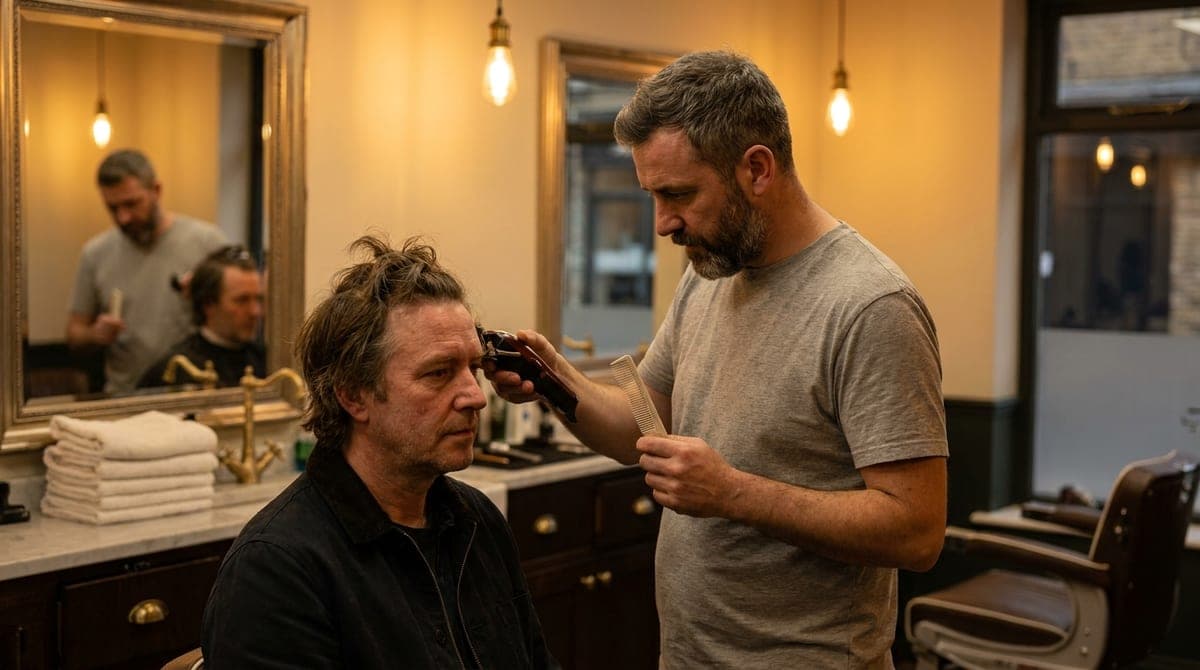
The Stages of Growing Out a Buzz Cut
Every stage of growing out a buzz cut in one table: the weeks, the length on top, what it looks like, and the cut to book so month three never looks wrong.
7 min
Trend
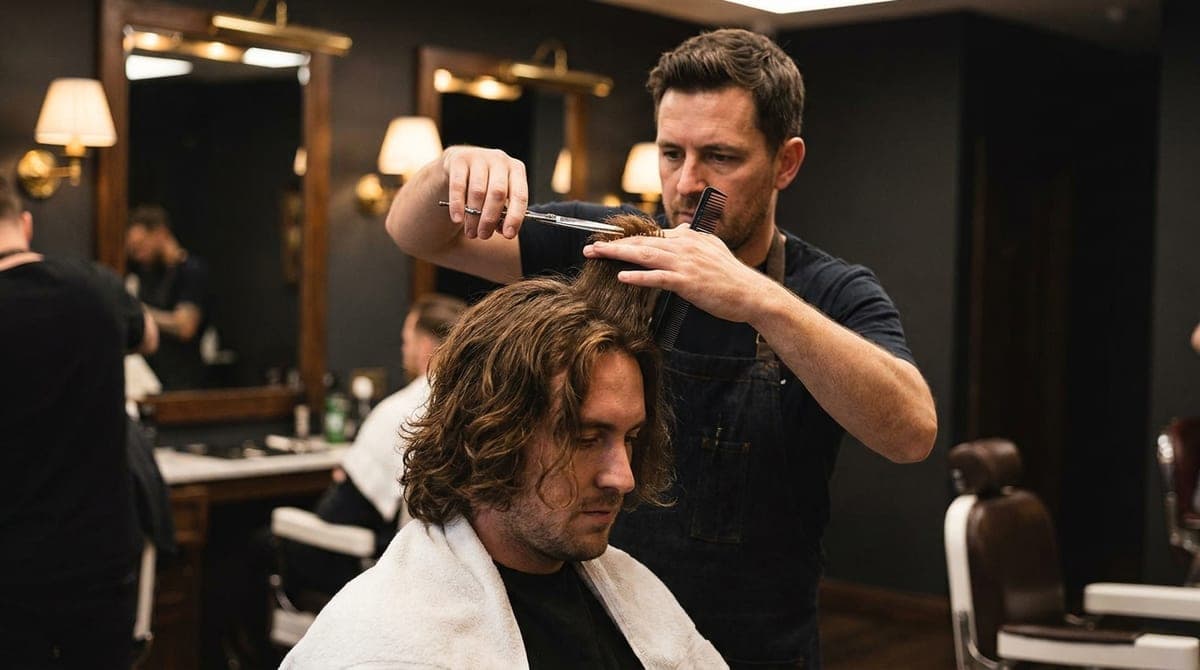
Wolf Cut for Men: Is It Still In for 2026?
The wolf cut men ask for in 2026 is softer than the 2021 one: what it is, who it suits, what to ask for and how long you need to grow first.
7 min
How To
How to Blow Dry Men's Hair, Style by Style
How to blow dry mens hair for a side parting, slick back, quiff, crop or curls: which way to point the air, which tool to hold, and when to skip the dryer.
7 min