The haircuts for thin hair men get the most out of are short, even and textured: a crop with about an inch on top, scissors rather than clippers through it, and sides tapered to a 1 or 2 so the top is not standing alone against bare skin. Long hair on a thin head separates into strands and the scalp shows between them. Short hair stands up and covers. That one fact decides almost everything below.
Haircuts for Thin Hair Men Should Ask For
Fine hair and thinning hair need different cuts. Which haircuts hide scalp, which ones show it, and how short to go on top, from a Harrow Road barber.
6 min readGolden Scissors, Maida Vale, London
Fine and thinning are two different heads
Men tell us they have thin hair and mean one of two things.
Fine hair is about the size of each strand. You might have a perfectly normal number of hairs, but each one is narrow, soft and light, so it lies flat, takes a dent from a hat and gives up on styling by lunchtime. Nothing is being lost. It is simply the hair you were born with.
Thinning hair is about the count. There are fewer hairs than there used to be, usually at the crown or across the top, and you can see more scalp under a bright light than you could five years ago.
Plenty of men have both, and the cut for both is the same in shape. What changes is how short we are willing to go. Fine hair with a full count can carry two or three inches on top if it is dried properly, and the guide to getting volume into flat hair covers that side of it. Thinning hair usually cannot. Once there are gaps, every extra half inch is another half inch of hair parting itself and pointing at them.
The haircuts for thin hair men ask us for most
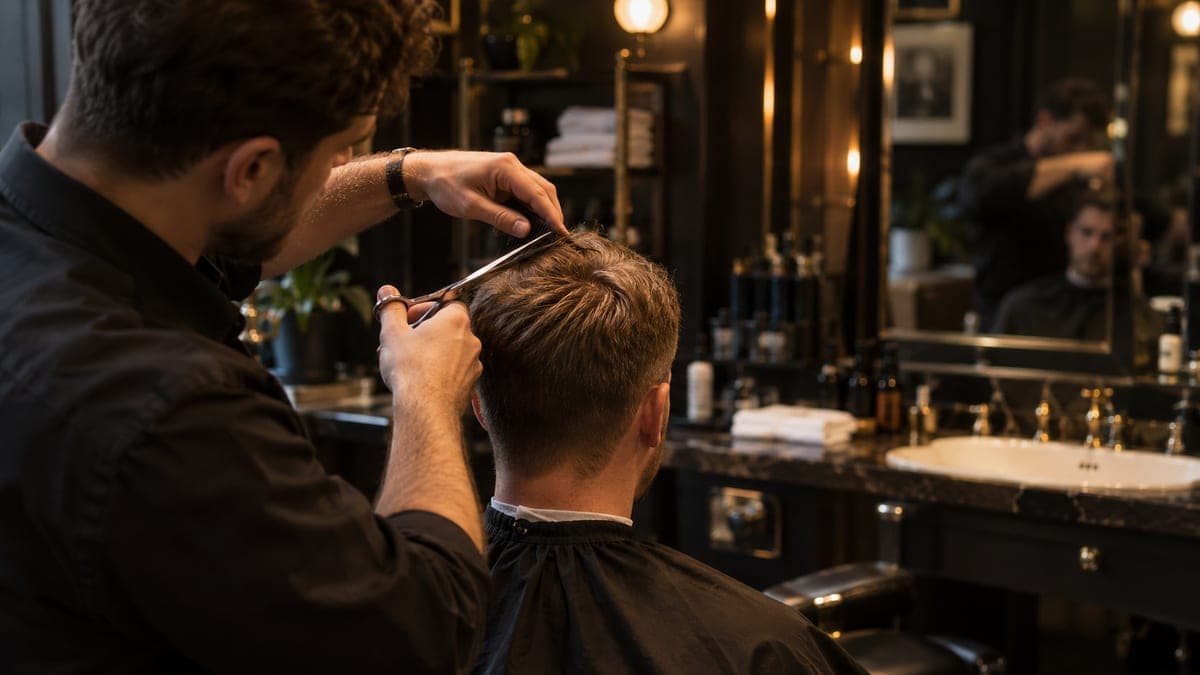
Textured crop, £15, 30 minutes. Booked as an ordinary haircut. The top is cut with scissors to around an inch, the ends chipped into so they sit in small separate pieces, and the fringe brought forward rather than combed back. Pieces of hair pointing in slightly different directions hide scalp far better than a smooth sheet pointing one way. Not sure which cut you want? Start with this one.
Low taper fade, £17, 40 minutes. For men who want the sides sharper than a crop gives them. The point is that it stays low and never goes to skin above the ears. Those 40 minutes are mostly the blend, which on fine hair has to be soft, because a hard step in the grades shows on fine hair in a way it does not on dense hair.
Short back and sides with the top scissor cut short, £14, 20 minutes. Clippers on the sides, a tidy neckline, and the top kept short and even. It is the plainest cut on the price list and on a thinning head it often looks better than anything fancier, because there is nothing on top long enough to separate.
Crew cut, £10, 20 minutes. One guard all over, or a guard on the sides and a slightly longer one on top. When the crown and the front are both going, this is often the honest answer, and nobody looking at it thinks you are hiding anything. Do not take it too close on top. Below about a 3 on a thinning head, the scalp starts showing through the stubble and you have swapped one problem for another.
Head shave, £18, 30 minutes. We will not push anyone into it. But there is a point where the most flattering thing left is to take it all off, and if you have reached it, you will hear that from us instead of another cut around the gaps.
For customers past 60, the Over-60s haircut is £10 for 30 minutes, and any of the shorter shapes above can be done in that slot.
Where cuts go wrong on a thin head
Thinning scissors. Fine hair has no bulk to remove. Thinning shears cut a share of the hairs off short, and on a thin top those short ends stand up as fuzz while the long ones lie down and part. The head looks sparser after than before. If anyone reaches for the thinners on a fine top, ask them to stop. We go the other way and keep the ends fairly blunt, because a blunt end looks thicker than a tapered one.
A skin fade taken high. Next to bare skin, any top looks thinner than it is. Fades work fine on fine hair if they stay low, but the higher the skin line goes, the more the top is set against it. The front corners suffer the same way, which the piece on cuts for a receding hairline goes into properly.
Growing the top long to cover the crown. This is the most common one. Length on top gets combed back over a thin crown, and for a few weeks it works. Then the hair gets heavy, it splits along the whorl, and the gap at the crown is framed by a parting of its own making. Shorter at the crown, not longer, is what hides it.
Wet-look products. Gels and high-shine pomades clump fine strands together into thin cords with scalp between each one. A pea of matte paste or clay, worked in with fingertips and not palms, keeps the hairs separate and lets them cover more ground.
The crown is its own problem
Most thinning starts at the front corners or the crown, and the crown is harder because you cannot see it. You find out from a photo someone took behind you, or from the mirror we hold up at the end.
Hair at the crown grows out of a whorl, spiralling away from a centre point. Even on a full head there is a little scalp at the middle of it. As hair thins, that centre opens out, and the longer the hair around it, the more it splays away and shows it.
So on a thinning crown we cut the top in a way that brings the length down towards the back: an inch or less through the crown, slightly longer towards the front if you want something to style. Leave it longer at the back than the front and the whorl gets wider every week.
Mention the crown when you sit down, even if you have never noticed a problem with it. We look at it before we start, and we would rather plan around it than find it halfway through.
Before you book
Bring a photo of the cut you want, and be ready for us to say it was taken on a thicker head than yours. Plenty of them are. We can point out what in it your hair can do and what it cannot, and suggest the nearest thing that will.
Come back every three to four weeks. Short cuts on thin hair look good for about that long, and after that the top grows long enough to start separating again. Stretching it to six weeks saves a haircut, and thin hair is the type where that shows soonest.
If the thinning is new, fast, or arriving in patches rather than gradually, that is worth raising with a GP or a pharmacist, and the post on hair loss in your twenties sets out what is ordinary and what is not. A haircut changes how much scalp shows. It does nothing for what is happening under it.
When you are ready, book a textured crop or a low taper and tell us which of the two kinds of thin you think you have. We will check it under the light before the gown goes on.
Common questions
- What is the best haircut for thin hair on men?
- For most men it is a short textured crop: scissors on top at around an inch, sides tapered to a 1 or 2. It keeps the top and sides close in length, so there is no contrast to show the scalp through.
- Is a skin fade a bad idea with thin hair?
- Taken high, usually yes. Bare skin at the sides makes a sparse top look sparser next to it. A low taper, or sides at a 1 or 2, does the same tidying job without the contrast.
- Should fine hair be thinned out?
- No. Fine hair has no bulk to lose, and thinning scissors leave short broken ends that make the top look sparser. If anything we cut it blunter so the ends look fuller.
- Will a shorter haircut make my thin hair look thicker?
- Up to a point. Short hair stands up instead of separating and lying flat, which hides scalp. Go too close on top, though, and the scalp shows through the stubble, so there is a floor.
Read next
Hair Health
Best Haircuts for Receding Hairline
The haircuts that hide a receding hairline without exposing more scalp, and the ones that make it worse. Straight advice from a Maida Vale barbershop.
5 min
How To
How to Get Volume in Mens Hair
Flat hair is usually the dry and the weight, not the product. A barber's guide to how to get volume in mens hair, and the cuts that hold it.
7 min
Hair Health
Hair Loss at 25: Normal or Not?
What's ordinary hairline change for young men in their twenties, what points to something more, and when it's worth talking to someone about it.
5 min