Yes, the wolf cut is still in for 2026, but not the version that filled everyone's feed a few years ago. The wolf cut men ask us for now is softer: long layers, some shag through the top, and none of the hard disconnection that made the early ones look like a mullet somebody regretted halfway through. It is a scissor cut built on length, and the length is the part most men underestimate before they sit down.
Wolf Cut for Men: Is It Still In for 2026?
The wolf cut men ask for in 2026 is softer than the 2021 one: what it is, who it suits, what to ask for and how long you need to grow first.
7 min readGolden Scissors, Maida Vale, London
What a wolf cut actually is
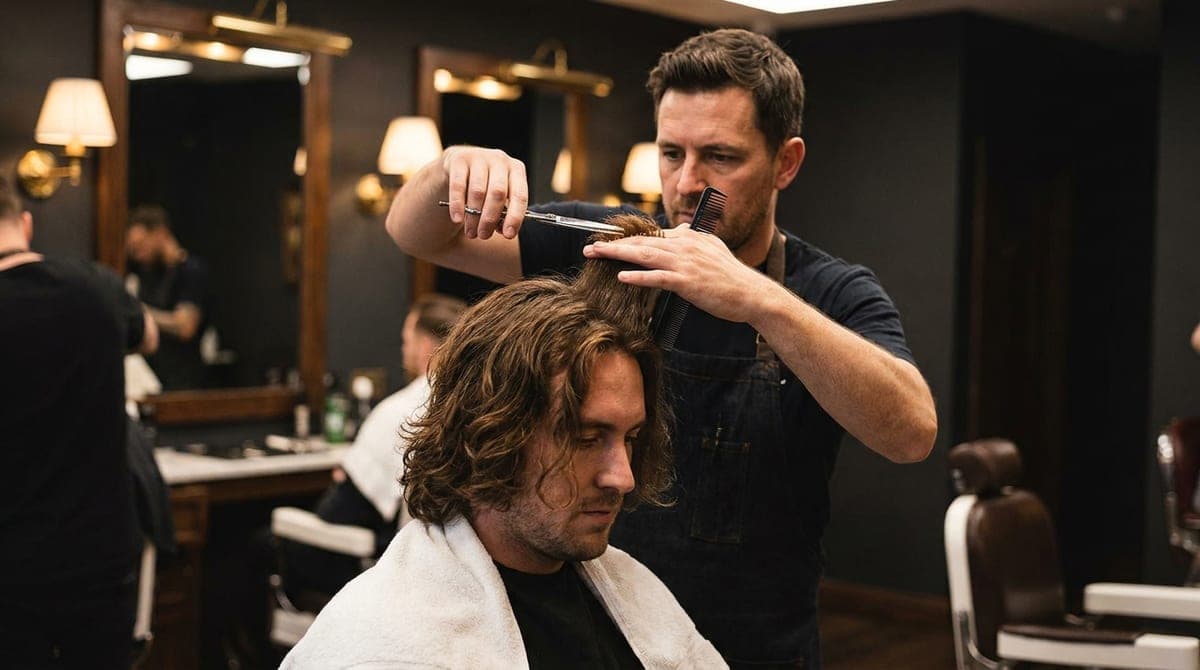
It is a layered cut, and that is the whole of it. Short layers through the crown to get height, longer layers falling through the back and sides, and the ends broken up with the points of the scissors rather than cut level. The shape is meant to look like it arrived on its own.
It sits between two older cuts. A shag is layered evenly all over with a wide fringe. A mullet is short at the front and long at the back with a hard step between them. The wolf borrows the layering from one and a bit of the back length from the other, and the good versions lean much further towards the shag.
There are no clippers in it. A wolf cut is cut wet, with scissors and a comb, and the texture comes from how the ends are finished rather than from product. That is worth knowing before you book, because it is a slower thing to do properly than a cut with a guard number in it.
The length is the real barrier. You want somewhere around four inches on top before there is enough to layer, and more than that at the back. Coming from a short back and sides, that is seven or eight months rather than the six most men guess: hair moves about a centimetre a month, four inches is ten of them, and a short back and sides only starts you two or three centimetres in. The sides are what decide whether those months are bearable: hair above the ear grows outwards rather than down, so if nobody touches it you go wide before you go long. We have written up the way to get from short to real length without the month where your head looks like a box.
The wolf cut men ask for now is softer
We are not going to pretend we have search data on this, and anyone quoting you a percentage about a haircut is making it up. What we can tell you is what walks through the door and what a photo looks like when it gets held up.
What has changed is the extremes. The early wolf cut had a lot of disconnection in it, meaning the top was cut to one length and the back left to another with very little blending between the two. It photographed well and it aged badly, because the moment it grew a few weeks that step turned into a shelf. The version being asked for now keeps the layers talking to each other. Same idea, less of a cliff. If what you actually want is the length without the choppiness, hair that sweeps back in one piece, that is a flow rather than a wolf cut.
This is one of the few cuts men do name out loud, because it came with a name attached rather than being a shape barbers always cut. That cuts both ways. It means we know roughly what you mean. It also means the picture in your head might be four or five years old, and the cut in that picture is more extreme than the one you actually want. Bring the photo anyway, then let us tell you which parts of it we would soften.
Who it suits and who it argues with
Thick straight hair and wavy hair are what this cut was built for. There is enough weight for the layers to fall properly and enough movement that the broken ends read as texture instead of damage.
Fine hair is the harder one. Layers remove weight, and fine hair does not have much to give away, so heavy layering leaves you with thin, stringy ends and nothing at the bottom of the cut. It can still be done. It wants fewer layers, kept longer, and the ends left much closer to blunt than a barber's instinct suggests.
Curly hair works, and people are often surprised by that. The catch is that the layers do a different job. On straight hair they exist to create lift at the crown. Curl already has the lift, so cutting it the same way pushes the volume sideways and you end up wide at the ears with a flat top. The layers have to go in higher and the weight has to come out of the sides instead.
On face shape, the honest version: the height at the crown lengthens a round face, which is usually flattering, and the length hanging either side of a long narrow face drags it longer still. If yours is the second one, ask for the sides kept shorter and tucked behind the ear rather than left to hang.
And a trade-off, because this cut gets sold as the easy option. It looks undone. It is not low effort. A fade needs you back in the chair; a wolf cut needs ten minutes from you every morning instead. Pick which of those you would rather do.
What to ask for in the chair
Four things, and you can say them in about fifteen seconds.
Where the front should fall: cheekbone, jaw, or past it. Where the back should sit: collar, or below. How much lift you want at the crown, which is the layers question. And whether you want it tucked behind your ears or falling in front of them.
Then one thing to rule out, and it is the request we most often talk men out of on this cut. Every edge in a wolf cut is soft on purpose. No weight line, no neckline worth the name, nothing anywhere you could hold a ruler against. Put clipper work at the bottom of it and you have handed the eye the one hard reference the cut was built to avoid, and everything above that line starts reading as untidy instead of as texture. Keep the scissors in it the whole way down.
On price it is a haircut at £15 for 30 minutes, with nothing added for the layering. The upgrade worth paying for is the wash and cut at £18, and not for the comfort of it: layers are cut wet, and hair off the basin is evenly wet from root to end in a way a spray bottle over a dry head never quite manages. Wet it unevenly and the layers land unevenly. You find that out when it dries, which is too late to do much about.
Living with it
Come back every eight to ten weeks. There is no line to keep sharp, which is why it stretches further than a fade, but the ends thicken and the shape sinks if you leave it past about three months.
Styling is salt spray on damp hair, scrunched with your hands, then left alone. Not a hairdryer on full, and not a heavy pomade, which pulls the texture into separated strands and makes clean hair look like day-four hair. If you have not used one before, how to get salt spray to actually do something covers the amount, which is always less than people use.
If you are seven or eight months of growing away from this, the thing worth doing today is finding out whether your hair will carry it at all. Fine hair is the case that goes wrong, and it goes wrong late. You notice somewhere around month four, with nothing to show for month one to three. So bring the photo in while your hair is still short and let us tell you what those layers will do on your head, which is the few minutes we spend on that before anything gets cut. If the answer is that yours will not hold them, there is a version of this shape that it will hold, and that is worth hearing now rather than at the end of six months of growing.
Common questions
- Is the wolf cut still in style in 2026?
- Yes, but the softened version. The heavily disconnected one from a few years ago has mostly gone and what men ask for now is a long layered cut with broken-up ends. If you bring in a 2021 photo you will get a more extreme cut than you probably want.
- How long does my hair need to be for a wolf cut?
- Roughly four inches on top and more at the back before there is anything worth layering. Hair moves about a centimetre a month and four inches is ten of them, so from a short back and sides that is seven or eight months, not the six most men assume. The sides need cutting the whole way through or it grows outwards instead of down.
- Is a wolf cut the same as a mullet?
- No. A mullet is short at the front and long at the back with a hard line between the two. A wolf cut is layered all over, so the length changes gradually and there is no line. The early versions borrowed more from the mullet, which is where the confusion started.
- Does a wolf cut work on curly hair?
- It works well, but the layers go in differently. Curl already gives you the lift the layers are there to create on straight hair, so cutting it the same way makes the shape go wide at the sides rather than tall at the crown.
- How often does a wolf cut need cutting?
- Every eight to ten weeks. There is no fade line to protect, so it grows out slowly, but the ends need taking back or the whole thing goes shapeless and heavy at the bottom.
Read next
Trend
Autumn Hair Trends for Men in 2026
The autumn hair trends men are asking us for: length coming back on top, tapers over skin fades, and how to grow it out without the bad six weeks.
7 min
How To
The Stages of Growing Out a Buzz Cut
Every stage of growing out a buzz cut in one table: the weeks, the length on top, what it looks like, and the cut to book so month three never looks wrong.
7 min
Trend
The Mod Cut Hairstyle Making a Comeback
What a mod cut hairstyle actually is, how it differs from curtains, what to ask for in the chair and who it suits. From the barbers on Harrow Road.
5 min