Rain undoes your hair because water breaks the temporary bonds holding it in the shape you dried it into this morning, and your hair starts heading back to whatever it does naturally. The water does not go in evenly, so the strand bends at different angles along its length rather than simply dropping. Frizzy hair in rain hits men with wavy, curly or sun-worn hair hardest, and if yours is fine and straight it tends to go flat instead of fuzzy. Either way the fix is mostly about how you dry it afterwards, not what you put on it.
Frizzy Hair in Rain? The 4-Step Fix for Men
Why rain turns your hair to frizz, why a drizzle is worse than a downpour, and four steps to get the style back once you are indoors. From our barbers.
Updated 7 min readGolden Scissors, Maida Vale, London
Why you get frizzy hair in rain
Your hair holds a style because of temporary bonds that form as it dries. Water competes for those bonds and breaks them. That is what lets a dryer put your hair where it would never go on its own, and it is equally why the weather takes it straight back off you. We went through that mechanism in what happens to your hair overnight, and it works the same on a pillowcase as it does on Harrow Road.
Frizz is the second half of the story. Water does not soak into a strand evenly. It goes in fastest where the cuticle, the overlapping outer layer, is already lifted: sun damage from the summer, bleach, a dryer held too close for too long, or just the age of the ends. Those patches swell more than the rest of the strand, so the hair kinks in several directions along its own length instead of lying one way.
Which is why two men can walk the same ten minutes through the same drizzle and only one of them arrives looking like he lost an argument. Hair in decent condition, cuticle lying flat, takes water on slowly and fairly evenly. Porous hair takes it on in patches, and patches are what you see.
A drizzle is worse than a downpour
This sounds wrong until it has happened to you a few times.
Proper rain soaks you through. Every hair ends up equally wet, the style is gone, and there is nothing ambiguous about it. That is recoverable. Evenly wet hair will take a set again the same way it did in the bathroom this morning, so if you can get somewhere dry you can put it back deliberately.
Drizzle is the one that ruins your day. There is enough water to break the set on the outer layer and around the ends, and not enough to reach the hair underneath. The top layer lifts and goes its own way while everything below it stays where you put it. That mismatch is the fuzzy halo. And because it is only half wet, you cannot re-set it without wetting the rest, which is the last thing anybody wants to do at ten past nine on a Tuesday.
So the man who got caught in a real downpour and has ten minutes indoors is in better shape than the man who strolled through mist.
How to fix frizzy hair after rain, in four steps
The instinct is to reach for product. Not yet. Clay, paste and wax all need dry hair to grip, and on damp hair they dilute, slide about and seal the wet in underneath, so the frizz stays for the afternoon. Do it in this order instead.
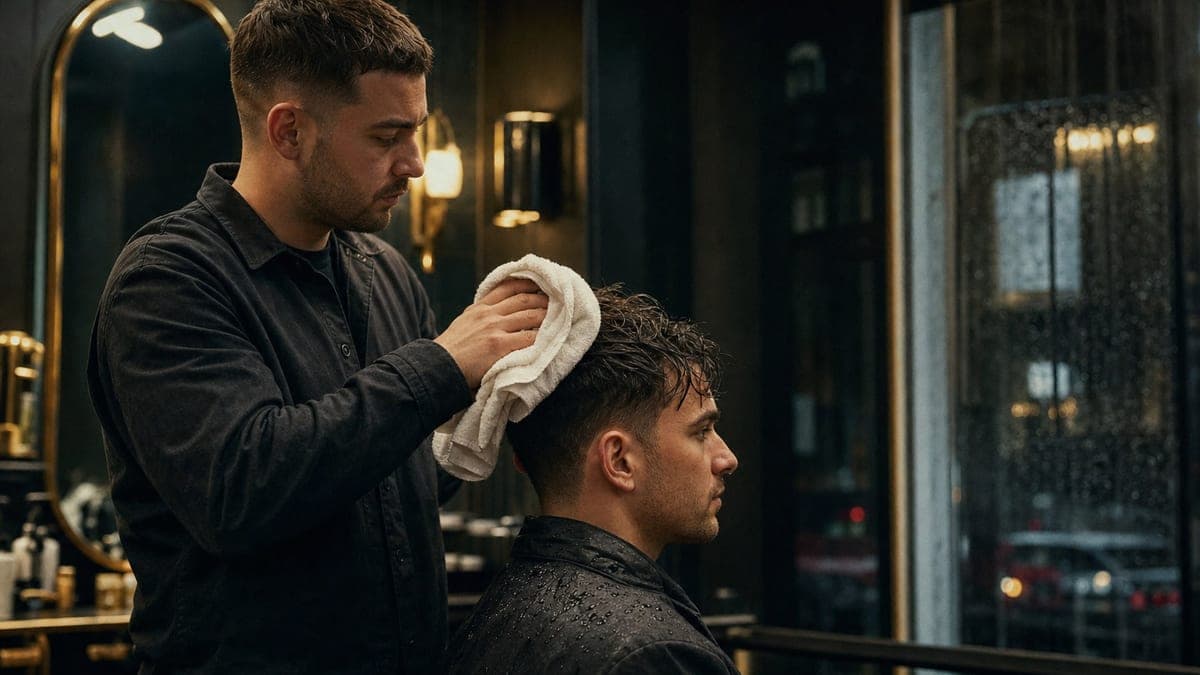
- Press the water out. Squeeze and blot with a towel, never rub. Rubbing is a lot of friction against a cuticle that is already lifted and soft, and it is one of the more reliable ways to turn damp hair into frizzy hair.
- Even it up. If only the top layer went, run damp fingers through the whole of the top so all of it is equally wet. This is the step everybody skips and it is the one that decides the result, because the bonds re-form in whatever shape the hair is in as it dries. Half-damp hair re-forms into two shapes at once, and that is where you started.
- Dry it with some intent. Fingers into the roots, air moving, pushing the hair the way you want it to sit. Thirty seconds of that is worth five minutes of patting at it. No dryer to hand is fine, your hands and a bit of time will do it, as long as step 2 happened first.
- Product last, on dry hair. Less of it than usual.
If it is the front that has gone, the same order works, it just matters more. The hairline is where your shortest hairs are, and short hair has no weight to pull it back down once it lifts. Pushing it off your forehead with a wet palm on the walk in is usually what started it.
Hoods, caps and the walk itself
An umbrella is the only one of the three that leaves your hair alone, which is the argument for carrying one.
A hood keeps the water off and then does something else instead. It holds the top and sides flat against your head while the hair is damp, and damp hair held flat for a quarter of an hour dries flat. You arrive with a dent rather than frizz. Better than frizz, but the style has still gone.
A cap does the same and adds a hard line across the forehead.
None of that means do not wear them. It means doing what the autumn advice on this site already says about beanies: style it when you arrive, not before you leave. Carry the tin instead of wearing it out of the door. Ninety seconds in a work toilet with hair that has dried off will beat anything you built at half seven and then squashed under nylon for twenty minutes.
If you are walking to us, it is about ten minutes on foot from Westbourne Park and twelve from Warwick Avenue, and there is not a lot of shelter on either route. The towpath has none at all. We have plenty of towels, and we would far rather you turned up wet than rescheduled.
Weight is what actually decides it
Product is the last five per cent of this. What really governs how your hair behaves in the wet is how much weight is sitting in it, and how much of your style is propped up by volume rather than by the cut.
Weight is the problem. A heavy top holds more water, and the wetter it gets the heavier it gets, and the further it drops from wherever you put it. Take that weight out with texturising and the same length carries less water and springs back instead of going over. It is scissor work inside the cut you are already paying for, so it costs nothing extra. You have to ask for it.
The sides matter for a different reason. When the top does give up, short sides mean the shape of your head still reads as deliberate rather than accidental, and you can push the top back and get away with it. A taper is the sensible version of that through a wet month.
The product side of this is a genuinely different problem, and we answered it separately: what to use when the air is damp goes through matte clay, salt spray and why glycerin works against you on a muggy day. Damp air and actual rain are not the same problem, but the products that survive one tend to survive the other.
Half an hour and £15 covers a haircut with that scissor work in it. Forty minutes and £17 covers a taper fade.
One honest caveat
No cut and no product makes hair waterproof. Anyone selling you that is selling you something. What the right cut buys you is a style that goes over in the rain and comes back in two minutes, rather than one that is finished for the rest of the day.
If yours gives up every time it spits, book a haircut and tell us that while we are still settling on the length. It changes how much comes out of the top, and where from.
Common questions
- Why does my hair go frizzy in light rain but not heavy rain?
- Because drizzle only wets the outer layer. The surface hairs break their set and lift while the hair underneath stays put, and that mismatch is what frizz looks like. Heavy rain wets everything evenly, so the style is gone rather than fighting itself.
- Why does the front of my hair frizz first?
- The hairline carries your shortest and finest hairs, it is the part facing the weather, and it is the part you push off your forehead with a wet hand. Short hairs have no weight to hold them down, so once the set breaks they stand straight up. Keep your hands off it, damp it evenly with the rest of the top, then dry it pushed the way it grows.
- Does wearing a hood stop rain frizz?
- It stops the frizz and gives you a flat dent instead. Damp hair held against your head for fifteen minutes dries in that shape. Wear the hood, then restyle when you arrive rather than before you leave.
- Should I put product in before walking out into the rain?
- It will not protect the style, and wax or clay on hair that then gets damp goes gummy. Carry it and put it in when you get there, on hair that is dry again.
- Is rain actually damaging my hair?
- The water is not. What does the wear is everything around it: rubbing a towel over a soaked head, and wetting and drying the same hair over and over through a wet month. Blot instead of rub and you have dealt with most of it.
- What haircut handles rain best?
- Anything with weight taken out of the top and the sides kept short. Weight is what holds water and drags a style down. A taper with texture through the top recovers in a couple of minutes where a heavy longer cut is finished for the day.
Read next
Products
The Best Men's Hair Products for Humidity
The best hair products for humid weather, the ones that fail by lunchtime, and what to leave on the shelf. Honest advice from our Harrow Road chairs.
6 min
How To
How to Protect Hair While Sleeping
What happens to your hair overnight, how to protect hair while sleeping, and the twenty-second morning fix. From the barbers on Harrow Road.
6 min

Trend
Autumn Hair Trends for Men in 2026
The autumn hair trends men are asking us for: length coming back on top, tapers over skin fades, and how to grow it out without the bad six weeks.
7 min