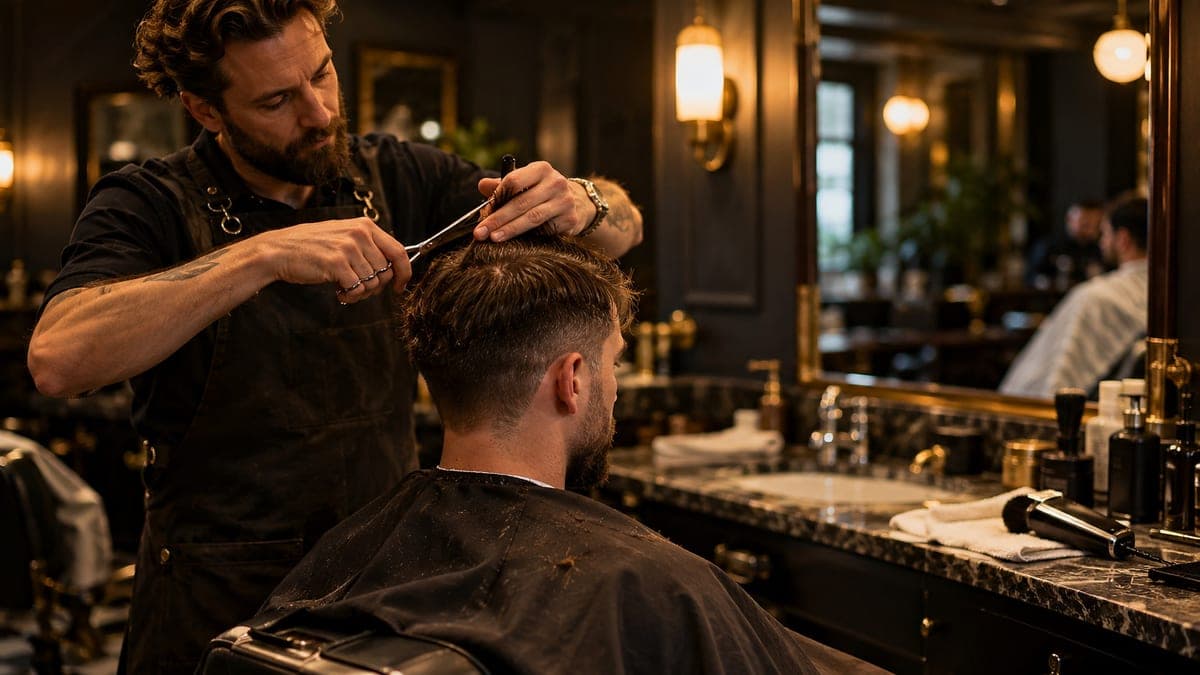
A gentleman's haircut is a short, classic cut worn with a side parting. The back and sides are tapered with scissors or a longer clipper guard and never taken to skin, and the top is left long enough to comb, usually five to eight centimetres at the front. You will not find it on a barber's price list, ours included. The name tells us the finish you are after. It does not tell us the lengths.
What Barbers Mean by a Gentleman's Haircut
A gentleman's haircut is a finish, not a set of lengths. What the name settles, the three things it leaves open, and the sentence that gets you the right one.
6 min readGolden Scissors, Maida Vale, London
The short version
- It is a finish: soft tapered sides, a parting, nothing shaved, nothing standing up.
- The name leaves three things open: how short the sides go, how long the top stays, and whether it is combed across or back.
- Say those three and you get your cut. Say only "a gentleman's cut" and you get the barber's guess.
What a gentleman's haircut always has
Ask ten barbers and the lengths will differ. These parts will not.
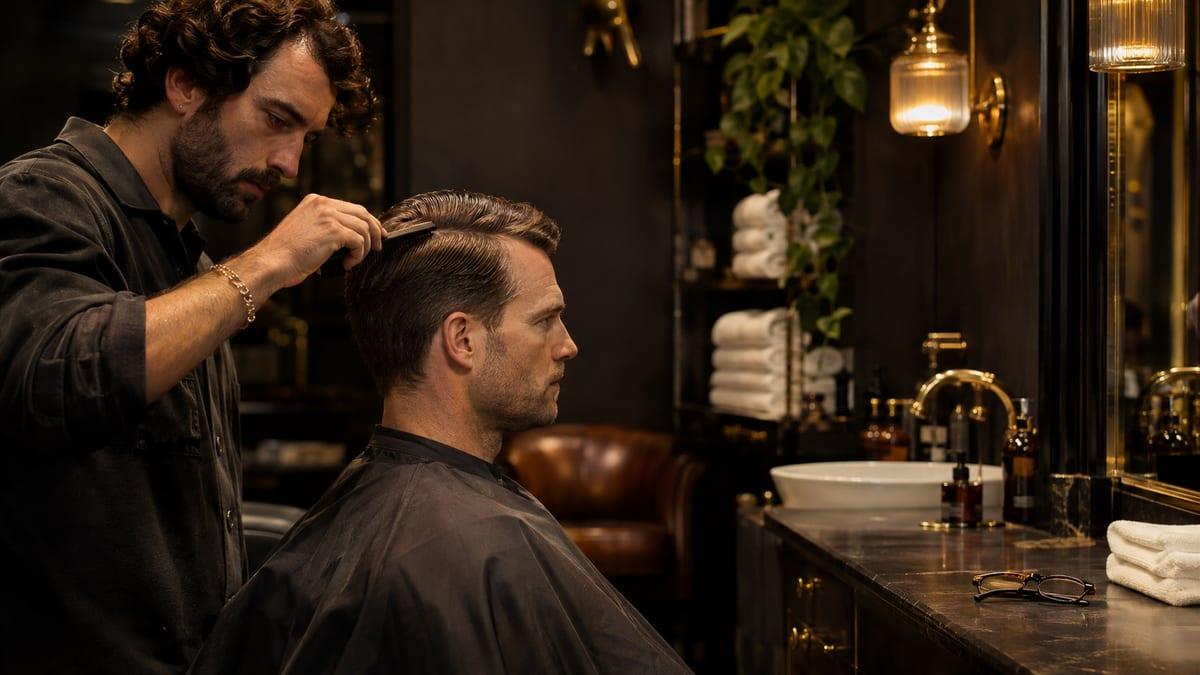
- A taper, not a fade. The sides get gradually shorter towards the ear and the neck, and at the shortest point there is still hair. No skin, no shadow, no line where the clipper stopped.
- Ears and collar clear. The hair is cut around the ear, not left to sit on it, and it stops short of a shirt collar.
- A natural neckline. Tapered away to nothing, not squared off. A square neckline belongs to a sharper cut and grows a shelf by week three.
- A top that connects to the sides. No step, no overhang, no disconnection. Run a comb up the side of the head and it should travel into the top without catching on a ledge.
- A parting. On the side, where your hair already splits, and combed in rather than shaved in. A razored line is a different haircut.
The effect is a cut nobody comments on. That is the point of it, and it is also why the name gets used for so many things. Search it and the top results are galleries of eighteen or twenty-odd "gentleman" styles under the one heading, which shows how far the name gets stretched. If a photo has bare skin above the ear or four inches of height at the front, it is a fine haircut, but it is not this one.
Three things the name leaves open
How short the sides go. The quiet version is scissor-over-comb all the way round, which leaves around two centimetres and no clipper marks anywhere. The tidier version is a clipper at a three or a four, tapered down to a two at the ear and the neck. Both count. The scissor side looks softer and grows out for longer. The clipper side looks cleaner for the first three weeks. We set out what each tool does in scissors against clippers.
How long the top stays. Five centimetres at the front gives you a parting and not much else. Eight gives you something to sweep, and something to manage. Either way the top gets shorter towards the crown, so the weight sits at the front where the parting is. Take the front below about four centimetres and you have an Ivy League, which is the shortest cut that still takes a parting.
Across or back. Combed across from the parting is the standard. Combed back off the forehead with the parting still showing is the dressier version, and it needs the longer top to stay there. Tell us which you wear day to day, because the front is cut differently for each: slightly longer at the fringe for across, more even for back.
The hair it suits, and the hair it fights
Straight and slightly wavy hair take this cut with no argument. It lies where the comb puts it.
Thick hair needs weight taken out from underneath on the parting side, or the top pushes the parting open by mid-afternoon and you spend the day flattening it with your hand. That is thinning-scissor work and it adds a couple of minutes, not a different price.
Fine hair wants the shorter end of the range. At eight centimetres it separates into strands and shows the scalp through the parting. At five it sits as one shape.
Tight curls will not lie in a combed parting without a lot of product. The same outline works, with tapered sides, a natural neck and the top left to its own pattern and pushed to one side. We would call that a taper with a curly top and not pretend it is the same cut.
A strong cowlick at the front hairline decides the parting for you. Part on the side the cowlick pushes away from and it helps hold the front up. Part against it and nothing in a tin will win.
Living with it
Two minutes in the morning. Towel the hair until it is damp, comb the parting in, comb the top across, and leave it. On most hair that is the whole routine.
If it has fallen flat by lunch, work a small amount of matte cream in from the crown forward before you comb. Shine is what makes this cut look like a period costume. The comb over fade guide has the ten-second test for finding where your hair naturally parts, if you have never been sure which side is yours.
It is one of the slowest cuts to go off. Hair grows about a centimetre a month, and there is no sharp edge here for that centimetre to blur. With clippered sides, book every four to five weeks. With scissor sides, five to six is normal, and at seven it has become a longer haircut, not a scruffy one.
The sentence that gets you the right one
On our list this is the Haircut, £15 for 30 minutes: scissors and clippers, cut to the head. It is not the £14 Short Back & Sides, which is a quicker clipper cut with a tidy on top and will come out shorter and squarer than you had in mind.
Then give us the three decisions in one go. Something like: "Gentleman's cut. Scissors on the sides, keep about two inches on top, parting on the left, combed across. Natural neckline."
Swap in your own answers. If you do not know one of them, say so, and we will look at how your hair grows and suggest it. What we cannot do is work out from the name alone whether you meant two centimetres on the sides or a grade three.
One last thing, if you wear glasses. Put them back on before we finish around the ears. The arms sit exactly where the taper is, and hair that looks clear of the ear without them gets pushed outwards the moment they go on. It takes ten seconds to correct in the chair and a month to stop noticing if nobody does.
Common questions
- Can a gentleman's cut have a fade?
- A low taper at the ear and neck, yes, and most of the ones we cut have it. Once the sides go to skin it has become a comb over fade. That is a good cut, but it is a louder one and it needs doing twice as often.
- Does a gentleman's cut work if my hair is thinning?
- At the temples, yes: part on the side that has gone back further, so the parting sits in the higher corner and the comb carries the front across the other one. At the crown it is harder, because the cut is worn flat and combed, which shows the scalp. Going shorter on top with a little texture usually covers better.
- Is it an old man's haircut?
- No. It reads as older when the top is left flat and heavy and set with something shiny. Cut with a little movement in the top and finished matte, it suits a man of twenty-five as well as it suits one of sixty.
Read next
Style Guide
Ivy League Haircut: What to Ask the Barber
The Ivy League haircut zone by zone in millimetres, why the crown decides whether it works, and how long it takes to grow into one from a crew cut or buzz.
6 min
Style Guide
Professional Haircuts for Men: Office Guide
Which professional haircuts suit men who work in an office, how long each one holds its shape, and the words to use in the chair to get it right.
6 min
Barbershop FAQ
Scissor Cut vs Clipper Cut: Which Is Better?
Scissor cut vs clipper cut: which tool suits your hair length, how each one grows out, and why most good haircuts use both. From the barbers on Harrow Road.
6 min