
Some hair loss at 25 is completely normal. A teenage hairline sits low and straight across the forehead, and for most young men it moves up half an inch or so at the corners through their early twenties before settling into an adult shape. That is a hairline maturing, not going bald. What is not normal is a hairline still moving well into your mid-twenties, a thinning patch on the crown, or a bald spot with a clean, defined edge. Here is how we tell the two apart from behind the chair.
Hair Loss at 25: Normal or Not?
What's ordinary hairline change for young men in their twenties, what points to something more, and when it's worth talking to someone about it.
5 min readGolden Scissors, Maida Vale, London

What normal hair loss looks like at 25
Everyone sheds hair as part of the ordinary growth cycle. You do not usually see it, because it happens a few strands at a time and gets replaced without you noticing. A few more coming out around the plughole after a wash, or on the pillow some mornings and not others, is not a sign of anything on its own. Nor is finding a few in the lining of a winter beanie, which is the same shedding on a darker background. We went through what hats really do to your hair separately.
The hairline itself changes shape too, and this is the part men mistake for balding most often. A teenage hairline runs almost dead straight across. As you move through your late teens and early twenties, the two front corners soften and recede a little, while the centre holds roughly where it was. The result is an adult hairline with two gentle points instead of a straight edge, and it is the shape nearly every grown man has. Once it settles, it settles, usually by the mid-twenties.
Some men keep a straighter line with a slight peak in the centre, others end up with a more obvious M-shape where the corners have gone back further than the middle. Both are normal adult hairlines. Neither one is a sign that anything is wrong, and neither one is better or worse to cut around. We see both shapes every week and there is nothing in either that tells us a hairline is about to keep moving.
What points to something more
A few things separate ordinary maturing from hair loss that is actually progressing.
It keeps moving. A maturing hairline stops. If yours is still receding at 25 or 26, particularly if it is moving faster than it did the year before, that is worth paying attention to rather than dismissing.
The crown thins too. Corners softening at the front is normal. Hair thinning on the crown at the same time, so the two patches start reading as one, is the pattern of hair loss actually progressing rather than a hairline settling.
It runs in the family. Pattern hair loss is hereditary, and it tends to start earlier in men whose fathers or grandfathers went thin young. If that describes your family, it is worth knowing now rather than piecing it together from old photos later.
A smooth patch with a clean edge is different again. That is not the gradual thinning above. It can appear quickly, sometimes overnight, and it is a dermatologist question, not something to wait out.
What we notice from behind the chair
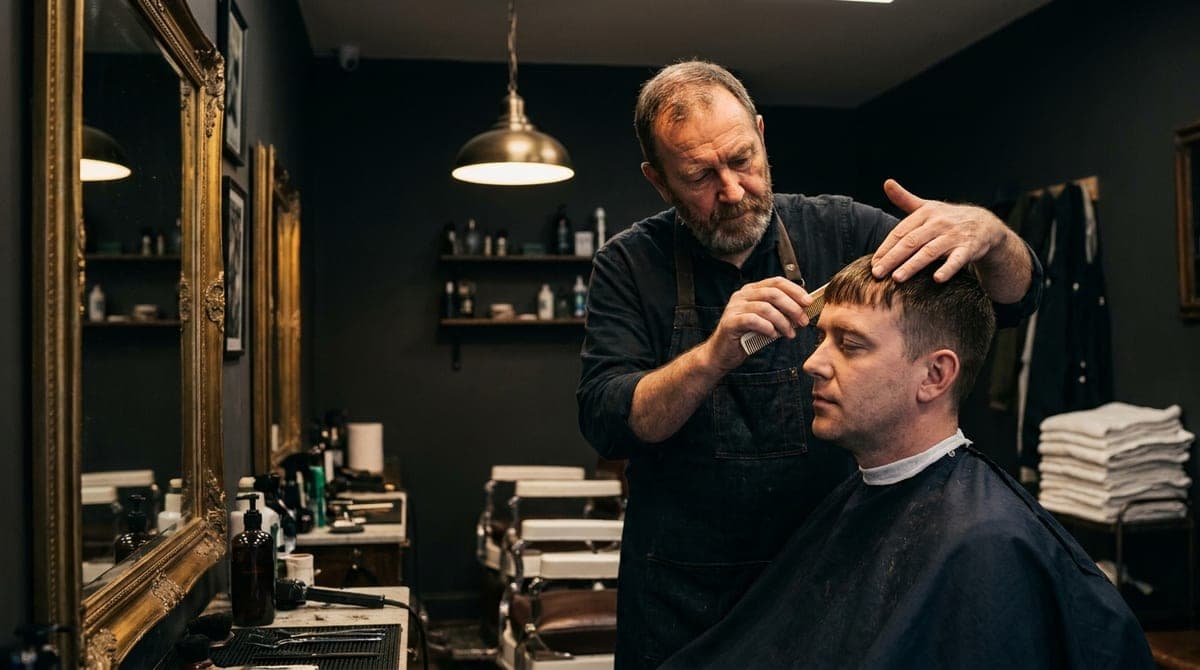
If you come in every three to four weeks, we are one of the few people who sees the same few inches of your head on a schedule. Most men check their hairline in a bathroom mirror they are three inches from, under one light, at an angle they have used for years without meaning to. We see the top of your head under proper light with a comb parted straight through it, and we see it again next month, and the month after that.
That comparison over time is worth more than any single look in a mirror at home. If nothing has changed since your last visit, we will tell you that plainly. If something has, we will say that too, and it is not a sales pitch either way. We are not the ones who can tell you why it is happening, only that it is.
We also see the thing men cannot check themselves at all, which is the crown. Nobody has a natural view of the back of their own head, so a patch thinning there can go unnoticed for a year or more, right up until a photo from behind catches it. A comb parted through it at the basin shows it straight away.
Haircuts that work while you decide what to do
None of this needs solving before your next haircut. Keeping the sides shorter and even, rather than long and heavy, takes weight off the top and stops the contrast between thinning and full hair from standing out. A taper fade kept low, away from the temple, does this well without drawing a hard line next to a corner that is already moving. Going shorter all over, rather than fighting to keep length, often looks better sooner than men expect, because there is nothing left for the eye to compare.
We have a full guide to haircuts for a receding hairline that goes through this properly, cut by cut. None of it changes what is happening underneath. It changes what people notice.
When to talk to someone else
A haircut can only do so much. If your hairline is still moving in your mid-twenties, if the crown is thinning alongside it, or if there is a bald patch with a defined edge, that is worth a conversation with a GP or a dermatologist rather than something to manage from the chair. We will tell you honestly when we think that is the next step, the same way we would tell you a cut is not going to fix it.
If you just want an honest look at where things stand, book a haircut and we will check your hairline and crown properly, under decent light, and tell you what we actually see rather than what you are afraid of.
Common questions
- Is it normal to lose hair at 25?
- Some change is. A teenage hairline is low and straight, and it usually moves up at the corners through your early twenties before settling into an adult shape. That is maturing, not balding. A crown that is visibly thinning, or a hairline still moving in your mid-twenties, is a different thing.
- How do I tell a maturing hairline from early hair loss?
- Shape and speed. A maturing hairline softens at the two corners while the middle holds its position, and it stops moving once it settles. Hair loss usually keeps going, often shows up on the crown as well as the front, and tends to run in families.
- Does hair loss run in families?
- Pattern hair loss is hereditary, and it commonly starts earlier in men whose fathers or grandfathers went thin young. If that is your family, it is worth knowing earlier rather than working it out from a photo five years from now.
- Can a haircut hide early hair loss?
- Yes, to a point. Keeping length low and even, and avoiding anything that puts a hard line near a thinning corner, takes the contrast away. It will not stop what is happening underneath. Our guide to haircuts for a receding hairline goes through the options.
- When should I actually see someone about it?
- If there is a smooth bald patch with a clean edge, if it is coming out in clumps rather than gradually, or if a thinning crown is bothering you enough that you are reading about it at midnight, that is a GP or a dermatologist, not a barber.
Read next
Hair Health
Best Haircuts for Receding Hairline
The haircuts that hide a receding hairline without exposing more scalp, and the ones that make it worse. Straight advice from a Maida Vale barbershop.
5 min

Hair Health
Uneven Hairline: What a Barber Can Do
An uneven hairline is usually normal, sometimes a line-up gone too far and occasionally a GP question. How we tell which, and what to ask for in the chair.
7 min
Barbershop FAQ
How Often Should Men Get a Haircut?
How often should men get a haircut? Every two to six weeks depending on the cut. The honest timetable we give customers on Harrow Road, cut by cut.
5 min