
An uneven hairline is usually nothing more than your face being a face. Nobody's hairline is symmetrical. We look at them all day and a dead-straight one is rarer than a cowlick. The three causes that matter are the direction your hair grows at the front, a line-up that went too far, and two temples receding at different speeds. A haircut can hide the first two almost completely and take the eye off the third. What it cannot do is move the line, and the barber who offers to is about to make it worse.
Uneven Hairline: What a Barber Can Do
An uneven hairline is usually normal, sometimes a line-up gone too far and occasionally a GP question. How we tell which, and what to ask for in the chair.
7 min readGolden Scissors, Maida Vale, London
Why your hairline looks uneven
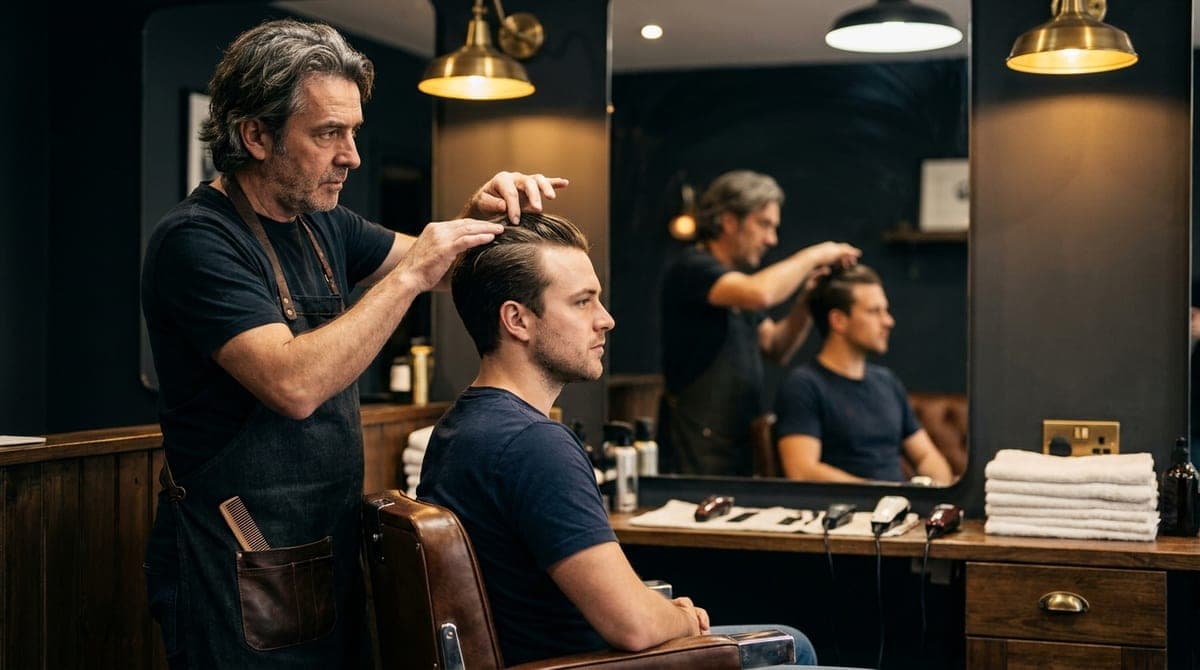
Start with the mirror, because a photo is often what started this. A mirror flips you. A photo does not. You have spent your whole life looking at the mirrored version and your brain has quietly corrected for the corner that sits higher. Then someone takes a picture from the other side and there it is. Nothing changed on your head. The angle did.
Beyond that, the real causes are these, and they call for different answers.
Growth direction. Hair at the front does not all grow forward. Plenty of men have a whorl at one temple, or a patch that grows sideways, and hair that lies flat reads as a lower hairline while hair that stands up reads as a higher one. This is the easiest version to deal with, because it is a cutting problem, not a hair loss problem.
A line-up that went too far. More on this below, because it is the one we actually cause.
The temples going at different speeds. Hairlines that recede usually start at the corners, and the two corners almost never move together. One goes first and the other catches up, or does not. You want to know if that is what is happening, because the cut that hides it is different from the cut that hides a cowlick. Thirty years on Harrow Road means we have cut a lot of men through every stage of this.
A scar. A childhood knock at the front edge leaves a spot where nothing grows, and a short cut with a hard edge puts it back on show.
One thing we do not do is diagnose. If a corner is moving fast, or there is a patch of smooth skin with no hair in it, or the hair is coming away in your hands, that is a GP or a dermatologist, not a haircut question. We will say if we think it is worth asking them, and cut around it in the meantime.
The line-up that makes it worse
A line-up is the hard edge some men want drawn across the front hairline and down the temples with trimmers, or a razor. Done properly it takes off the fine stray hairs that grow below your natural line and leaves the line itself where it was. Done badly it is the quickest way to manufacture an uneven hairline out of a normal one.
Here is how it goes wrong. The right corner sits a few millimetres higher than the left, as corners do. To draw a straight edge, the trimmer has to take the left corner back to match the right. The line is straight for about four days. Then the left side grows in as stubble while the right, which was barely touched, grows in as hair, and the whole front looks patchy. So next time the edge goes back a little further, and a month later someone is chasing a straight line across a forehead that has moved a centimetre up and still is not straight.
We call it chasing the corner, and we undo a lot of it.
So when someone with an uneven hairline asks for a line-up, the honest answer is a soft one. We clean off the fluff below the natural line with the trimmer held flat, square the corners only where there is enough hair to square, and leave the line where it grows. Less dramatic on the day. Still a haircut in three weeks, which a hard edge on an uneven hairline never is.
What a barber can do about an uneven hairline
Everything we can do comes down to where the eye goes, and the eye goes to contrast and to edges. Remove those and a hairline that is out by half a centimetre stops registering.
Bring the front forward. Hair that sits down onto the forehead covers the corners, so nobody can see where they are. A textured crop does this well, and the French crop with a blunt fringe does it outright. If your hair grows back from the front it takes some persuading, so say so in the chair rather than fighting it at home for a month.
Part it on the right side. If one corner is higher, the parting goes on that side, so the heavier section sweeps across the other way and drops weight over the low corner. Swapping sides is free and takes a week to get used to.
Keep the fade low. A high fade climbs through the temple, which is exactly where the unevenness lives, and turns a vague difference into a sharp one you can measure. A low taper finishes under the temple and leaves hair there to soften the corner. On a man whose hairline is going at the front we nearly always suggest low, and we say so before the clippers are on.
Leave a little more on the weak side. A few millimetres of extra length over the higher corner, blended so nobody can see the join, does more than any product. This is the bit that needs a barber rather than a guard number.
Go shorter everywhere. If one temple is properly going and a fringe is not going to cover it, the answer is often the opposite direction: a crew cut or a close buzz. Short hair drops the contrast between where there is coverage and where there is not, so the eye has nothing to measure. Our crew cut is £10 and twenty minutes, and it is a better answer for a receding corner than it sounds.
None of that moves your hairline. It stops anyone noticing it, which is the job.
Growing out a line-up that went too far
If the line has been pushed back and you want it where it was, the only fix is time, and the first fortnight is the ugly part. Hair grows a little over a centimetre a month, so an edge taken back a centimetre needs four to six weeks before it looks like an edge again. In between it is stubble on one side and fluff on the other, and every instinct will tell you to tidy it.
Do not. Every trim restarts the clock.
What we can do in the meantime is keep the rest of the haircut tidy so the front is the only thing changing, cut the top forward to cover it, and leave the front edge completely alone. The same rules apply as for growing out any other bad haircut: keep the bits that are fine, ignore the bit that is not.
What to ask for
You do not need to explain the theory. Four phrases cover it.
"Natural hairline, just take the stragglers off." That is the soft line-up, and it is what nearly everyone with an uneven hairline actually wants.
"Soft corners, don't push the line back." It is the one instruction that stops the chase.
"Keep the fade low and leave the front heavy." The shape that hides a receding corner.
"I'm growing the line-up out, leave the front." So nobody tidies away six weeks of progress out of habit.
If you are not sure which applies to you, that is what the first few minutes of a haircut here are for. We look at the front of your head from where we stand, which is not where you stand, and tell you honestly whether it is growth, a past line-up or something for the GP. The rest of what to say in the chair is in its own guide. A haircut is £15 and takes half an hour, and the looking is part of it.
Common questions
- Is it normal for a hairline to be uneven?
- Yes. Nobody's hairline is symmetrical, and the same goes for eyebrows, ears and jaws. A dead-straight hairline is rarer than a cowlick. It only looks wrong because you are the one staring at it.
- Can a barber fix an uneven hairline?
- We can hide it and we can stop making it worse. Forward length, the right parting and a low blend take the eye off it. What we cannot do is move where hair grows, and anyone who shaves the line back to even it up is moving it the wrong way.
- Should I get a line-up if my hairline is uneven?
- Only a soft one that follows your natural line and takes off the stray hairs below it. A hard straight edge cut into an uneven hairline has to go back to the higher corner to be straight, and then it grows out patchy.
- One temple is receding faster than the other. Is that normal?
- The two corners rarely move at the same speed, so on its own that is common. If it is moving fast, or there is a smooth patch with no hair in it at all, that is a GP or dermatologist question rather than a haircut one.
- How long does an over-cut hairline take to grow back?
- Hair grows a little over a centimetre a month, so a line that was pushed back a centimetre needs four to six weeks before the edge looks like an edge again. Leave it alone in the meantime.
Read next
Style Guide
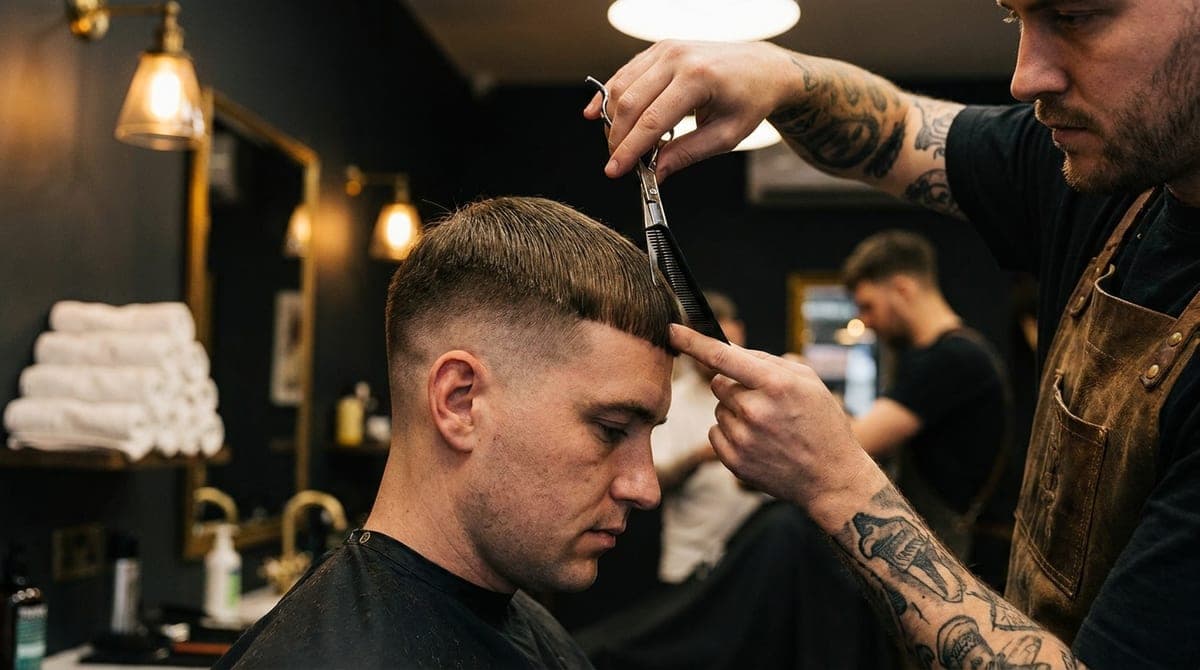
What Is a French Crop Haircut?
What a French crop haircut is, whose hairline it rescues, what to ask for in the chair, and how long it holds before it needs doing again.
6 min
Style Guide
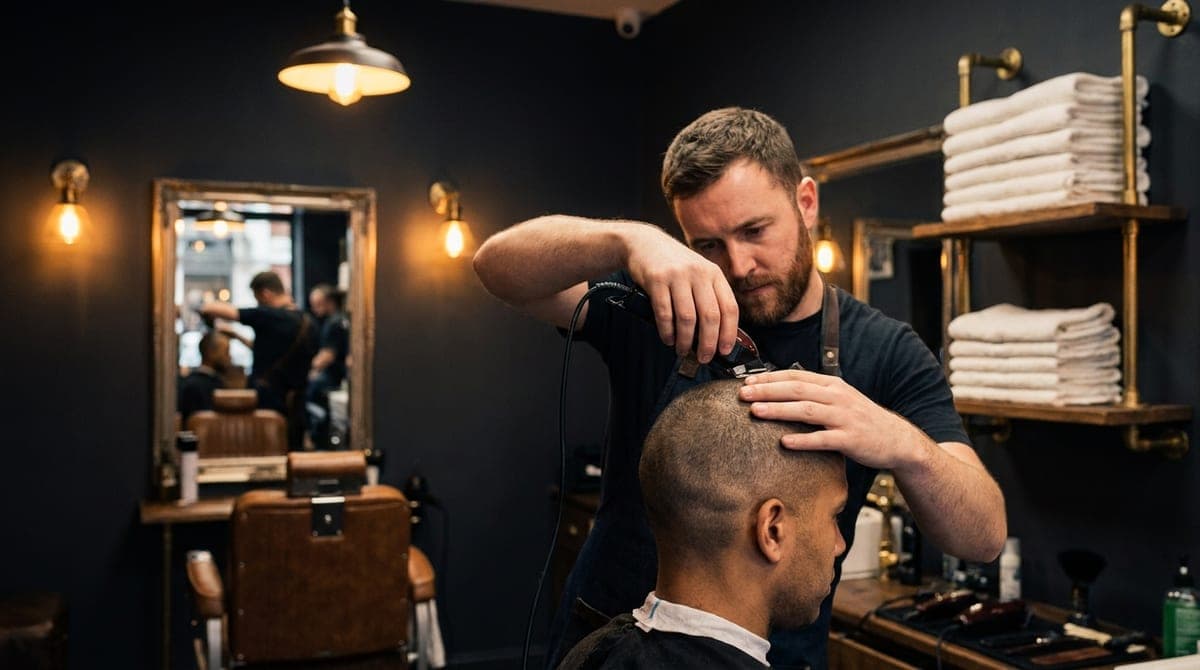
Buzz Cut Lengths: Every Grade Explained
What each clipper grade actually leaves on your head, which buzz cut lengths suit which hair, and what to ask for. From the barbers on Harrow Road.
6 min
Barbershop FAQ
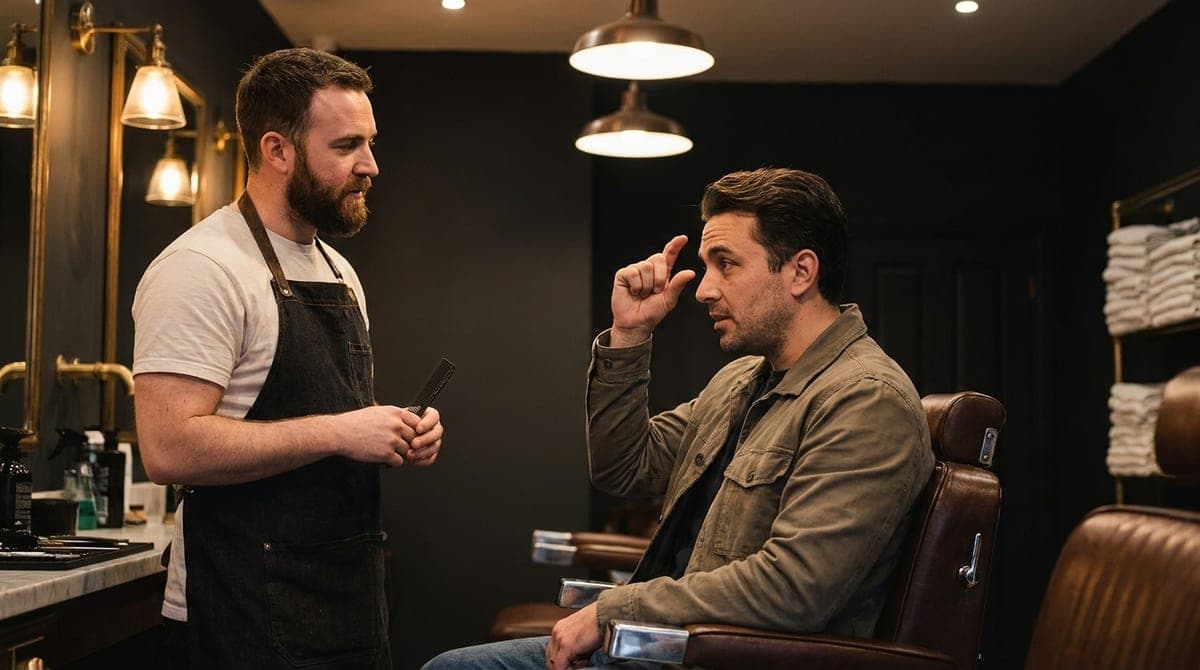
How to Ask for a Haircut: What to Say
How to ask for a haircut in words a barber can cut to: the four decisions, what a photo is actually for, and the one sentence that saves ten minutes.
7 min