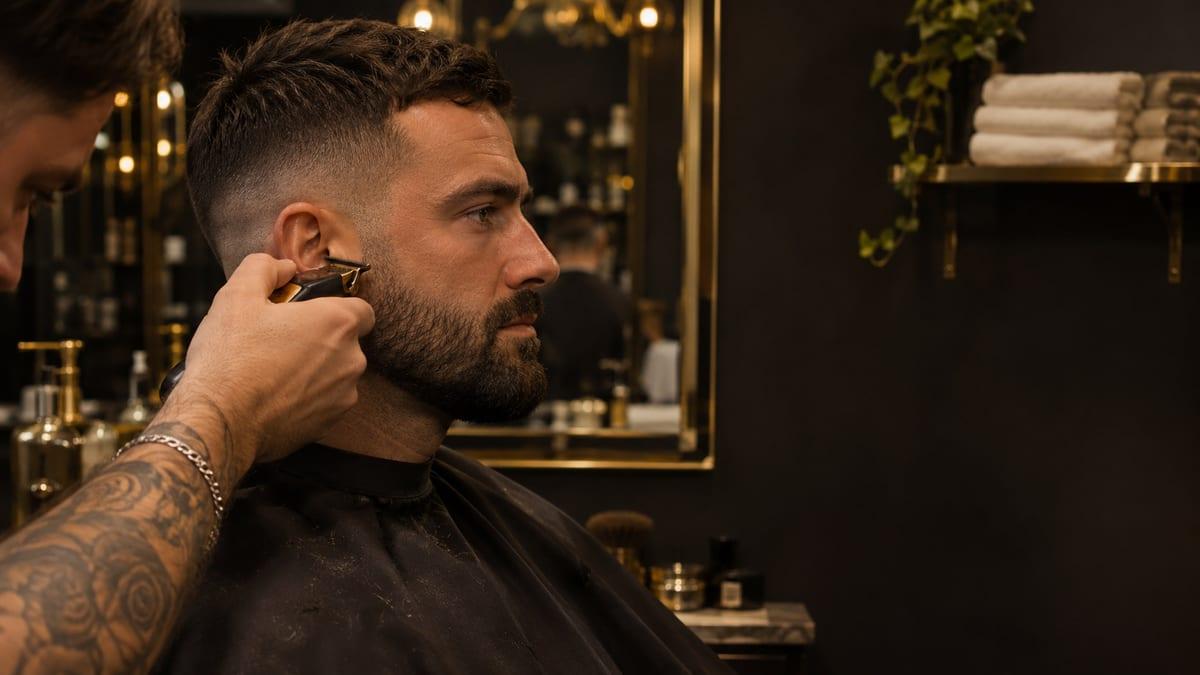
A skin fade with beard works when the two are joined on purpose. The fade takes your sideburn down to bare skin, so the beard can no longer run up into your hair the way it used to. It has to be faded as well, from its full length at the jaw down to nothing beside the ear. Get those few centimetres right and the pair reads as one cut. Leave them alone and you have a full beard stopping dead against bare skin, like a shelf.
Skin Fade With Beard: Getting the Join Right
A skin fade with beard stands or falls on the few centimetres beside your ear. How the blend is cut for each beard length, and when a taper is better.
6 min readGolden Scissors, Maida Vale, London
The short version
- Any skin fade removes the sideburn, so the beard needs its own fade to meet it.
- The longer the beard, the more room that blend needs, and the lower the fade should sit.
- The join is the first part to grow out. If you cannot get back in a fortnight, pair the beard with a taper instead.
Why a skin fade with beard is decided at the sideburn
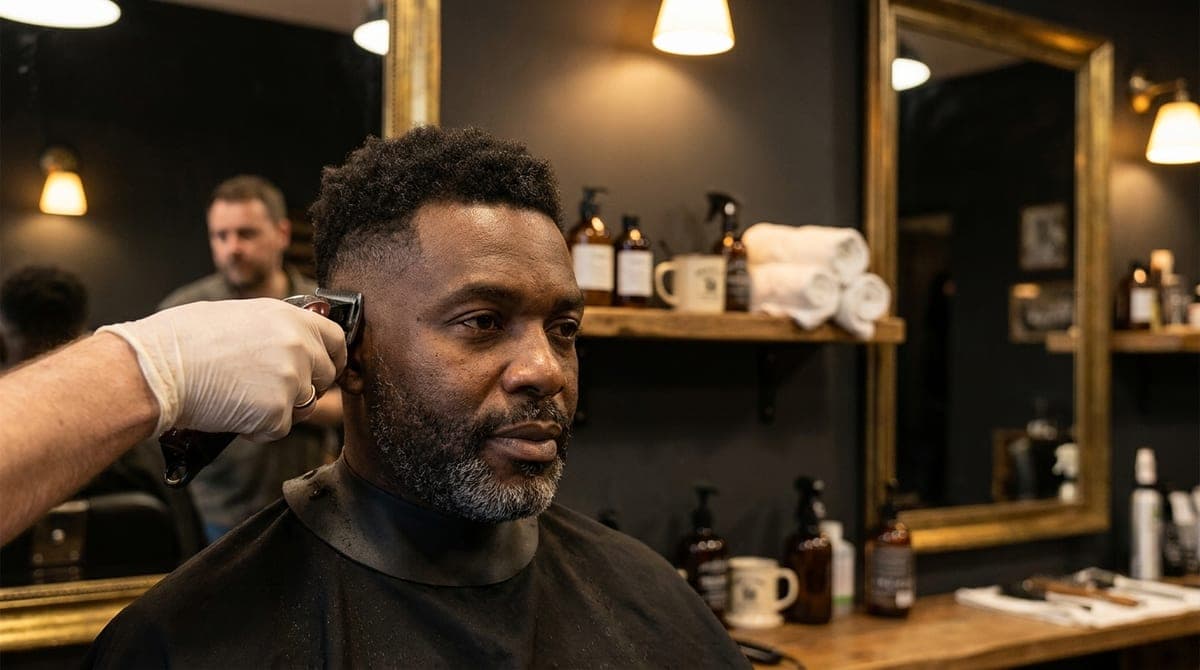
Low, mid or high only changes how far up the bare skin goes. It does not change what happens at the ear. On every skin fade the sideburn is gone, which leaves three bands down the side of your head: hair, skin, beard.
That is the look, and it is a good one. The strip of skin frames the beard and makes it look denser than it is. But it means the top of the beard is now an edge that everyone can see, and there are only two honest ways to finish it.
Blended. The beard is stepped down through the guards as it climbs, so it thins out into the skin with no line. This is what we cut unless you ask otherwise. It grows out quietly.
Hard line. The beard keeps its length right to the top and is cut off square with the trimmer, level with the middle of the ear. It is sharp on the day and for about three days after. Then stubble comes through above the line and it looks like a blend somebody forgot to finish.
A taper is a different case, because it never goes to skin. The sideburn survives and the beard simply carries on from it, which is one reason we point some bearded men towards a taper rather than a skin fade.
How much room the blend needs
A beard at a grade one has three millimetres to lose on its way to skin. A beard you could get a fist round has several centimetres. The second one cannot do that in the width of a thumb without looking chopped, so the length of the beard decides where its fade begins.
| Beard | Length | Where its fade starts | What to watch |
|---|---|---|---|
| Heavy stubble | Grade 0.5 to 1, up to 3mm | Barely needs one. A centimetre below the skin | The gap fills with new stubble in days, so the contrast is short-lived |
| Short boxed beard | Grade 2 to 3, 6 to 9.5mm | Around the middle of the ear | The easiest pairing to wear and to keep |
| Full beard | Grade 4 and up, 13mm or more | The bottom of the ear | Keep the sides flatter than the chin, or the jaw goes wide |
| Long beard | Scissor length | The corner of the jaw, climbing the whole ear | Needs a low fade. A high one leaves the beard hanging off a bare head |
Read the last column before you choose a fade height. A long beard under a high skin fade puts all the weight at the bottom of the face and none at the sides of the head. On a round face that helps. On a long, narrow one it adds length you did not want. If your top is shaved or clipped short all over, a high fade into a full beard is still one of the kindest things you can do, because the beard takes over the job the hair has stopped doing.
Two things the blend quietly fixes
Plenty of beards are thin at the corner under the ear, where the jaw meets the sideburn. Worn full, that reads as a bald patch. Faded, the hair there is meant to be short, so nobody can tell thin growth from clipper work. If that corner is your weak spot, this is a better answer than most of the fixes for a patchy beard, because it costs you nothing.
It also helps when your beard has come through a different colour from your hair. With a sideburn, brown turns to red or grey on one line. With a band of skin between them, the two never touch.
When the combination is the wrong call
It is a good pairing. It is not one that works on everybody.
The join ages faster than anything else on your head. Bare skin is stubble again within three or four days, and that stubble comes up exactly where the beard was faded out, so the gradient fills in from the top. At ten days the fade is still decent and the beard still has its shape, but the space between them has gone soft. At three weeks it is a beard and a haircut that happen to be near each other.
So this is a two-week cut. If a month is your real interval, have the taper.
Fine hair on top is the other problem. Take the sides to skin and put a dense beard underneath, and the top looks thinner than it did when you walked in. Either keep the beard short so it does not outweigh the hair, or go short all over and let the beard lead.
What you can do at home, and where to stop
You can keep the beard's length down with your own trimmer, clear the cheeks above the cheek line and shave the neck below the beard.
Stop the trimmer at the bottom of your ear. The blend above that point is three or four different lengths in a couple of centimetres, and one pass with a single guard turns all of them into the same length. That is how a faded beard becomes a shelf between visits, and it cannot be put back until the hair has grown.
Three things to say before the clippers start
Book the two together. On our price list the Skin Fade is £17 and the Beard Trim £11, with £2 off the beard when it is added to a haircut, so the pair comes to £26 and about 45 minutes. The join belongs to both jobs, and it can only be finished once the fade is in and the beard is at its final length.
Then tell us:
- The beard length you want to walk out with. A guard number if you know it, or "keep the length, just shape it".
- Blended or a hard line at the top of the beard.
- How high the skin goes. If you are not sure, say what the beard is doing and we will set the fade to suit it.
Before you get up, look at yourself face-on, not side-on. Both blends should start at the same height. Ears are not always level, so we match the two sides to each other and not to each ear, and face-on is the only angle where you can check it.
Read next
Style Guide
Skin Fade vs Taper Fade: The Difference
A skin fade goes to bare skin, a taper fade keeps a little length. Which one suits your hair, your head shape and how often you can get back to the chair.
5 min
Beard & Shave
Beard Trim Styles: Shape, Length, Neckline
The beard trim styles we cut most on Harrow Road, what guard number to ask for, where a neckline actually belongs and when to leave the cheek line alone.
6 min
Barbershop FAQ
How Long Does a Skin Fade Last?
How long does a skin fade last? Sharp for about ten days, tidy for three weeks. What decides your number, and how to buy yourself an extra week.
6 min