The widow's peak hairstyles for men that work are the ones that move hair away from the point or lift it up off it: a slick back, a quiff, a side part set at the edge of the V, or anything short enough that the line stops mattering. The cut that works against it is a blunt, straight fringe pushed down onto the forehead, because the hair at the point rarely wants to lie that way and the fringe splits there by lunchtime. Pick a direction first, show it or soften it, and the cut follows from that.
Widow's Peak Hairstyles for Men That Work
Widow's peak hairstyles for men, sorted by whether they show the point or hide it, plus the two cuts that fight it and why the fringe keeps splitting.
6 min readGolden Scissors, Maida Vale, London
Why a fringe splits on a widow's peak
The V itself is not the problem. The problem is what the hair does at the bottom of it.
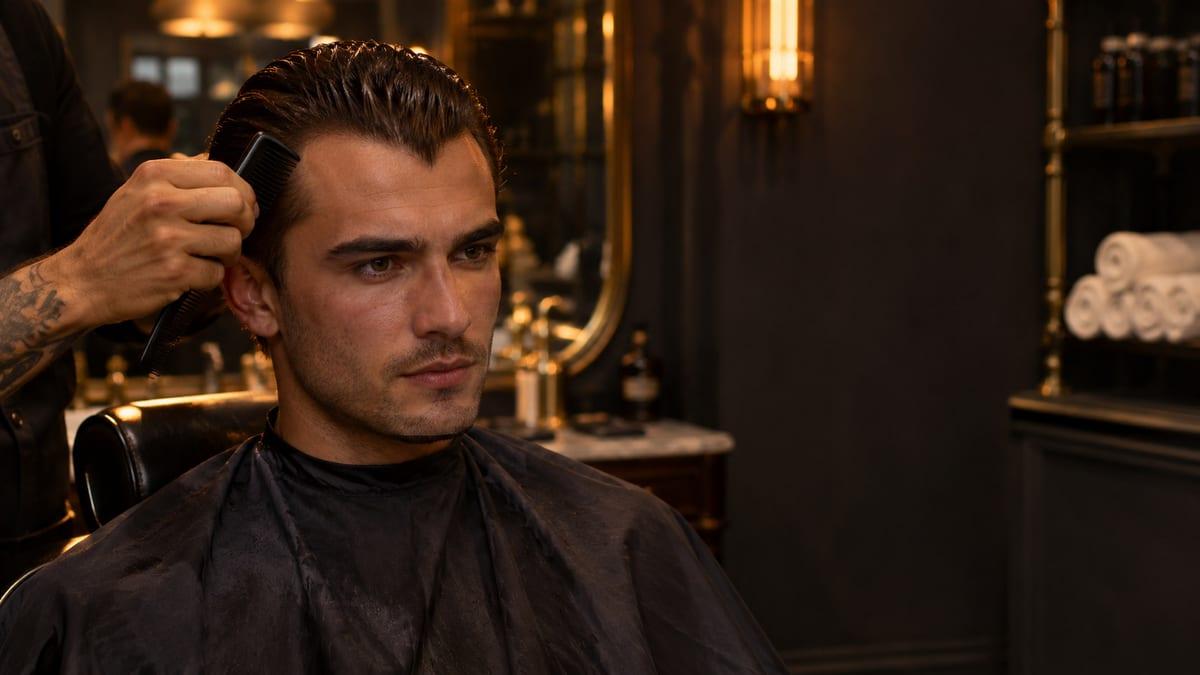
On a lot of peaks, the hair at the point grows forward or straight down, while the hair either side of it angles away towards the temples. Comb it all forward, cut it straight across, and it looks fine while it is wet. Once it dries, each side goes its own way and you get a gap or a little upturned tuft right at the centre of the fringe. Men tend to blame the barber, or the product, or the weather. It is the growth pattern, and no amount of cutting will change where it points.
So the first thing we do with a widow's peak is comb the front down while it is damp and watch where it falls apart. That split is the natural edge of a parting, or the place a quiff wants to turn up, and the cut gets built around it rather than across it.
Two other things are worth knowing before you choose:
A peak that was always there is just your hairline. It is the shape you grew, and it does not mean anything is going.
A peak that turns up in your late twenties or thirties usually is not a peak. It is the corners moving back and leaving the centre where it was. That changes the advice, because the cuts that show off a true widow's peak also put the temples on show. If that sounds like you, our guide to haircuts for a receding hairline is the better place to start, and anything moving fast is a GP question rather than a haircut one.
Widow's peak hairstyles for men, from showing it to hiding it
| Style | What it does with the peak | Length on top | Comes back to the chair |
|---|---|---|---|
| Slick back | Shows it fully, frames the face symmetrically | 8 to 12 cm | Every 4 to 5 weeks |
| Quiff or pompadour | Lifts the hair up and away from the point | 6 to 10 cm at the front | Every 3 to 4 weeks |
| Side part at the edge of the V | Uses the natural split as the parting | 5 to 8 cm | Every 3 to 4 weeks |
| Buzz or crew cut | Shows it, but the short length makes it read as a clean line | Grade 2 to 4, or under 3 cm | Every 2 to 3 weeks |
| Textured crop, choppy fringe | Softens it without fighting the split | 3 to 6 cm | Every 3 to 4 weeks |
| Long, swept to one side | Hides it under length | 10 cm and over | Every 6 to 8 weeks |
Slick back. The widow's peak's best friend, and we will happily say so. Everything is going back off the face anyway, so the hair at the point has no say in it, and the V ends up as the centre of a symmetrical frame. It needs length and a product with some hold, and the sides can be anything from a scissor cut to a taper. Our slick back guide covers the lengths and the product.
Quiff or pompadour. Same principle with more height. The front is blow-dried up and back, so the split at the point becomes the lift. If your peak has a strong forward cowlick in it, this is often easier than a slick back, because you are pushing the hair in a direction it half wants to go.
Side part at the edge of the V. This is the one men overlook. A parting drawn straight down from the arch of one eyebrow will usually land somewhere near one side of the peak, and that is where the hair already divides. Put the parting there and the hair falls on its own every morning. Put it a centimetre either way and you are fighting it with a comb for the life of the cut. We find the line by combing the front back damp and letting it drop.
Buzz or crew cut. Short enough that no hair has a direction worth arguing with. The peak shows, but as a crisp, even line, and on most men that looks deliberate. A crew cut here is £10 and twenty minutes.
Textured crop with a choppy fringe. If you like hair coming forward, this is the version that survives a widow's peak. The fringe is point-cut and left uneven on purpose, so when the centre splits, it looks like texture rather than a mistake. A blunt French crop fringe is the opposite: it shows every millimetre of the split.
Long and swept. At ten centimetres and over, the hair is heavy enough to lie where you put it and the peak disappears under it. Fine if you want the length. A lot of upkeep if the only reason is hiding the hairline.
The two cuts that fight it
A blunt fringe straight across. Covered above. Wet, it lies flat. Dry, it parts at the point and spends the day being pressed back down.
A dead-centre part on short hair. On long curtains, a centre part can sit nicely on a widow's peak, because the length carries each side away. Cut short, the two halves are not heavy enough to hold a line, and the hair at the point sticks up between them.
Please do not let anyone shave it out
This is the request we push back on hardest. A widow's peak can be cut out with trimmers to leave a straight line across the forehead, and it looks tidy for about a week. Then the point grows back in as stubble while the rest of the front is hair, and you have a stubbly notch at the centre of your forehead for the next month. Push the line back to straighten it and the whole front sits higher than it did, permanently, in the sense that you will keep having to match it.
The opposite move does no favours either. Sharpening the V with a razor to make it more dramatic is a line-up decision, and it has the same grow-out problem in reverse. Our line up guide explains why we follow the natural line and only clean the fluff below it. A widow's peak is exactly the hairline that rule is for.
Before you sit down
Come with your hair washed and dry, the way you normally wear it, and do not flatten the front with product that morning. That gives us the best read of where the point splits, which is worth more than any photo you bring. Then tell us one thing: whether you want the peak seen or not. Everything else, the parting, the fringe, how much length stays on top, comes out of that answer, and it takes about two minutes in the chair before the clippers go on. If you are not sure, start with the side part on the natural split. It is the easiest of the lot to change your mind from at the next booking.
Read next
Hair Health
Uneven Hairline: What a Barber Can Do
An uneven hairline is usually normal, sometimes a line-up gone too far and occasionally a GP question. How we tell which, and what to ask for in the chair.
7 min
Hair Health
Best Haircuts for Receding Hairline
The haircuts that hide a receding hairline without exposing more scalp, and the ones that make it worse. Straight advice from a Maida Vale barbershop.
5 min
Style Guide
Slick Back Hair for Men: The Length It Needs
How long hair has to be before it will slick back and stay there, what to do with the sides while it grows, and why it falls forward by lunchtime.
6 min