A modern mullet is not the 80s one grown back out. The length at the back is the same idea, but the sides get tapered or faded properly instead of being left to grow with everything else, so there is no flat step at the ear, just short at the sides and longer at the back. Ask for that in this shop and you will get the current version, not your dad's.
Modern Mullet: What It Looks Like in 2026
A modern mullet in 2026 tapers the sides instead of growing them out flat. What we actually cut, who it suits and what to say in the chair.
5 min readGolden Scissors, Maida Vale, London
What makes it modern, not just a mullet
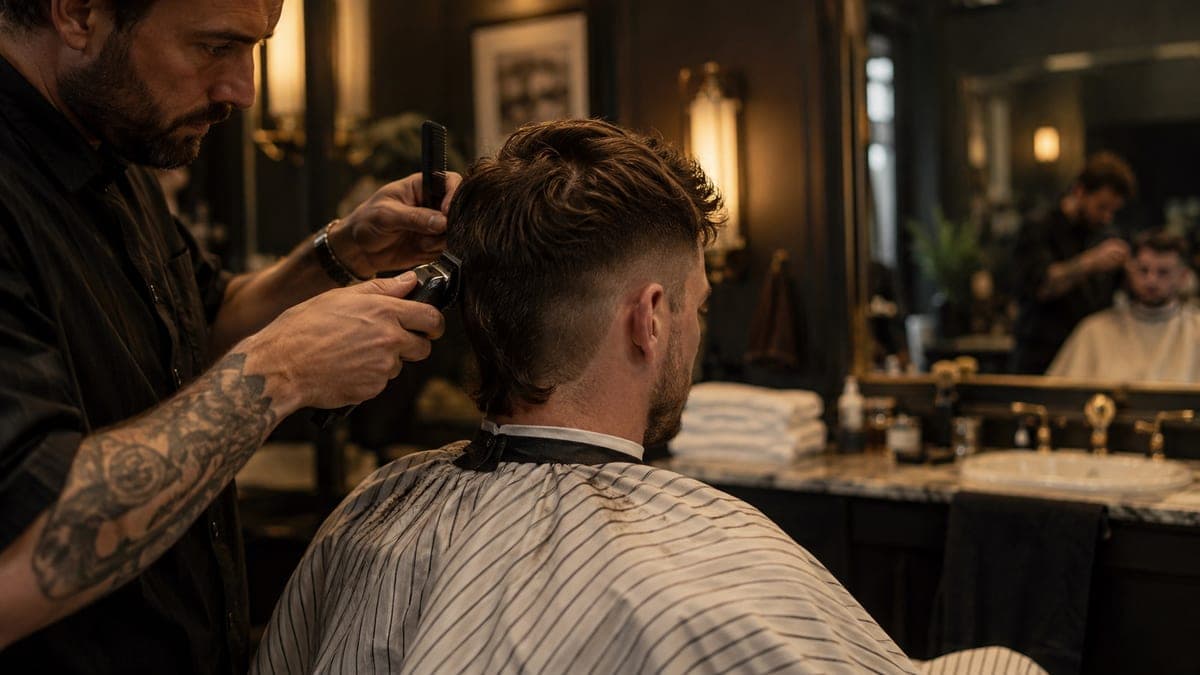
Take the sides down with a guard and a taper the way we would on any other cut, and the hard line an 80s mullet had at the ear disappears. What is left is a haircut that is short over the ears and gradually longer moving back and down, rather than one length everywhere with a single break in it.
The back is the other half of the decision. Some men want it squared straight across at the nape, which reads as more deliberate and suits thicker hair that holds a straight edge. Others want it left to a soft point, which moves more and hides a cowlick better. Neither is more "modern" than the other. What makes either one look current rather than borrowed from 1986 is that the sides were cut with the same care as the back, not just left alone until someone said stop.
We do not have footfall numbers broken down by haircut, and nobody selling you a percentage for 2026 has real ones either, whatever the article says. All we have to go on is our own six chairs, and on those, it is the tapered version walking out the door, not the flat-sided original.
The hair and the head it actually suits
Thick or coarse hair holds a straight nape line without help, which is why a squared-off back tends to go to the men who have it. Fine hair drops rather than sits, so a pointed, less defined back edge hides the gap better than a hard line will.
Curl works in this cut's favour rather than against it, which is not true of most cuts on this list. Curl already lifts and shapes at the back on its own, so a curly mullet needs less raw length than a straight one before it stops looking like an overdue haircut and starts looking chosen. If what actually appeals is the length and the movement rather than the short-long contrast, the layered wolf cut is the other cut worth knowing about, though it wants the sides grown too, not just the back.
The one honest caution is not about hair at all. A defined length change back there shows up from behind in a way a fade or a crop never does, in a mirror, on a video call, walking away from someone. If your work has an unwritten dress code, ask yourself whether this is the cut to test it on before you book, not after.
Getting the back long enough
Nothing about this cut asks you to grow the whole head out. The sides stay maintained on their normal cycle, and the only thing doing the growing is the back. A rough rate to work from is a centimetre a month, so getting past the collar, where the length starts reading as a shape rather than an overdue trim, takes an ordinary short back and sides three to four months. Not a fortnight of "just leave it".
Book the sides in every few weeks during that stretch and say why, so the taper stays clean while the back does nothing. The line between "getting a bit long" and "growing a mullet" comes down entirely to whether the sides are kept up, and that is the one part of this most men get wrong without meaning to.
What to say when you book it
Three things cover it. How short the sides go, either a guard number or "as short as a normal fade" works if you have never had one before. Whether you want the sides tapered, which fades out gradually and grows out kinder, or faded closer to skin, which is sharper for longer between visits and grows out faster. And how the back should finish, squared straight across or taken to a soft point.
On the till that is a taper fade or a skin fade at £17 for 40 minutes if the sides are properly blended, or the ordinary £15 haircut, done in half an hour, if clippers with no graduated fade suit you better. The back adds no separate charge either way, since it is scissor work on hair that is already there. Say all three when you book a chair and there is nothing left to work out once you sit down.
Keeping the shape between visits
The sides go first, same as a taper or fade worn on its own: three or four weeks in, the blend has softened even though the back has not moved an inch. Come in for the sides on that cycle and leave the back out of it.
The back only needs attention every couple of months, and what it needs is not length taken off but the edge redefined, since a squared nape grows soft at the corners and a pointed one grows wide. Say which shape you started with when you come back for it. We would rather ask than guess and square off an edge you meant to keep pointed.
If you decide against it later, the grow-out is the part to plan for. The back has to either grow long enough to blend into a longer cut all over or get cut back down to meet the sides, and the second one is a bigger single cut than most men expect from something that grew in slowly.
Common questions
- Is a modern mullet the same as an 80s mullet?
- No. The 80s version let the sides grow out with the rest of the head, so the join by the ear was a flat step in raw, uncut length. The version we cut now tapers or fades the sides properly, the way any other cut here does, so the length only changes at the back. The sides never get the chance to look like an accident.
- How long does the back need to be?
- Past the collar before it reads as a shape rather than a bad grow-out, which from an ordinary short back and sides is three to four months. Hair grows roughly a centimetre a month and nobody is cutting the back during that stretch, only tidying the sides, so the length arrives on its own.
- Does a mullet work on curly hair?
- Often better than straight hair does. Curl adds its own lift and shape at the back, so you need less raw length before it looks like something rather than just longer hair. Straight hair has to get further down the neck before it holds a shape on its own.
- How often does a modern mullet need cutting?
- The sides every three to four weeks, same as any taper or fade. The back gets left alone far longer, usually just a shape tidy every couple of months to square off or round the nape, and the two parts of the cut are booked and thought about separately.
Read next
Trend
Wolf Cut for Men: Is It Still In for 2026?
The wolf cut men ask for in 2026 is softer than the 2021 one: what it is, who it suits, what to ask for and how long you need to grow first.
7 min
Style Guide
Low Taper Fade: The Complete Guide for 2026
What a low taper fade actually is, who it suits, exactly what to ask for in the chair and how often it needs tidying. From the barbers on Harrow Road.
6 min
Style Guide
Mid Fade Haircut: 20 Styles to Try
A mid fade sits between a low and a high fade, and it works under almost anything on top. Nineteen combinations to show your barber, and how to ask for them.
6 min