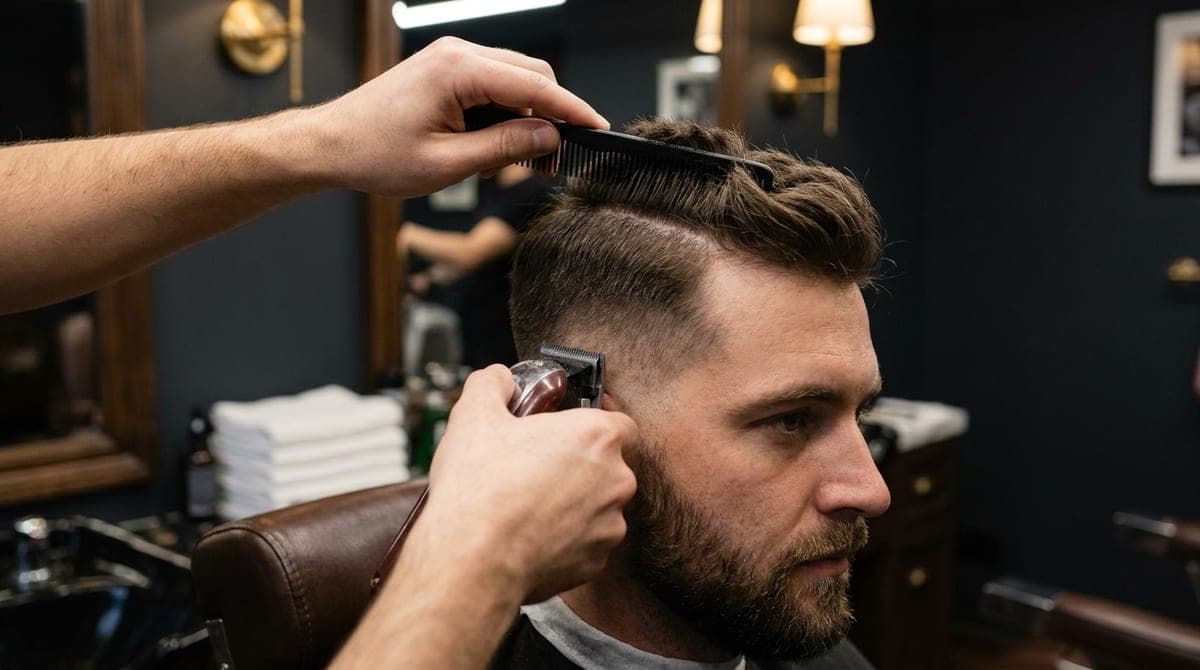
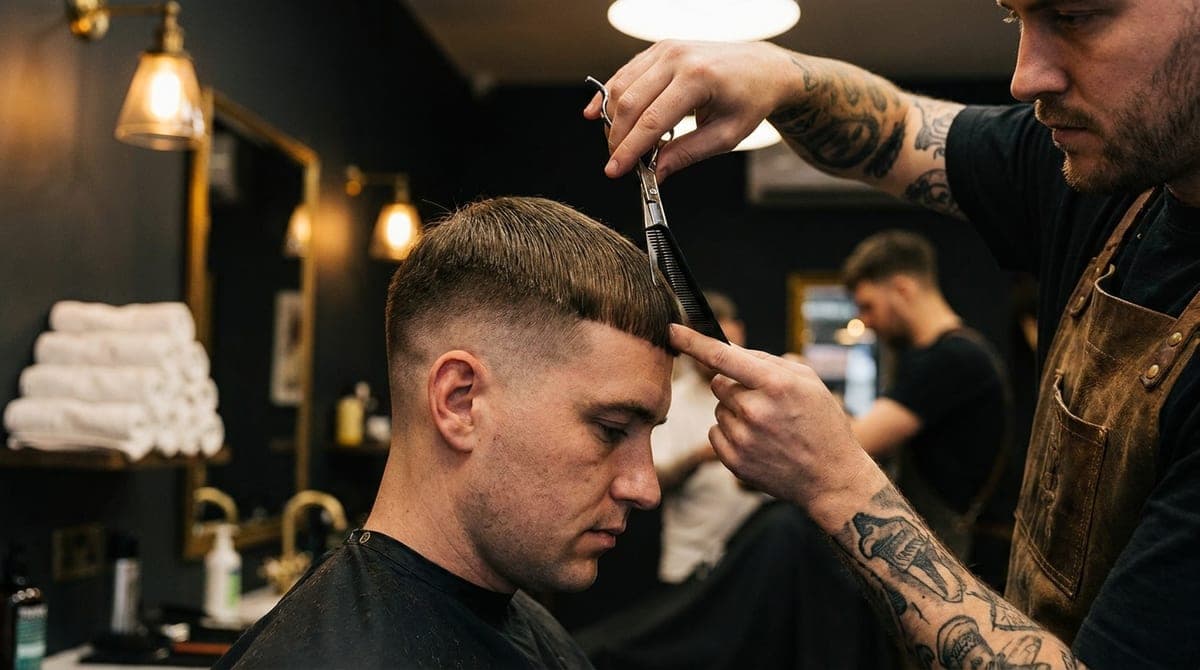
A mid fade haircut starts the blend roughly midway between your ear and your temple, higher than a low fade and lower than a high fade. It is the most forgiving height because it works with almost any head shape, whether you keep length on top or cut it short. You will also hear it called a medium fade or a middle fade. Same cut, same height. Below is how it compares with the other two heights, what to say in the chair, and nineteen tops it sits under.
The Mid Fade Haircut and 19 Ways to Wear It
Where a mid fade starts, how it compares with a low and high fade in one table, the sentence to say in the chair, and 19 tops it suits. From Harrow Road.
Updated 7 min readGolden Scissors, Maida Vale, London
What "mid fade" actually means
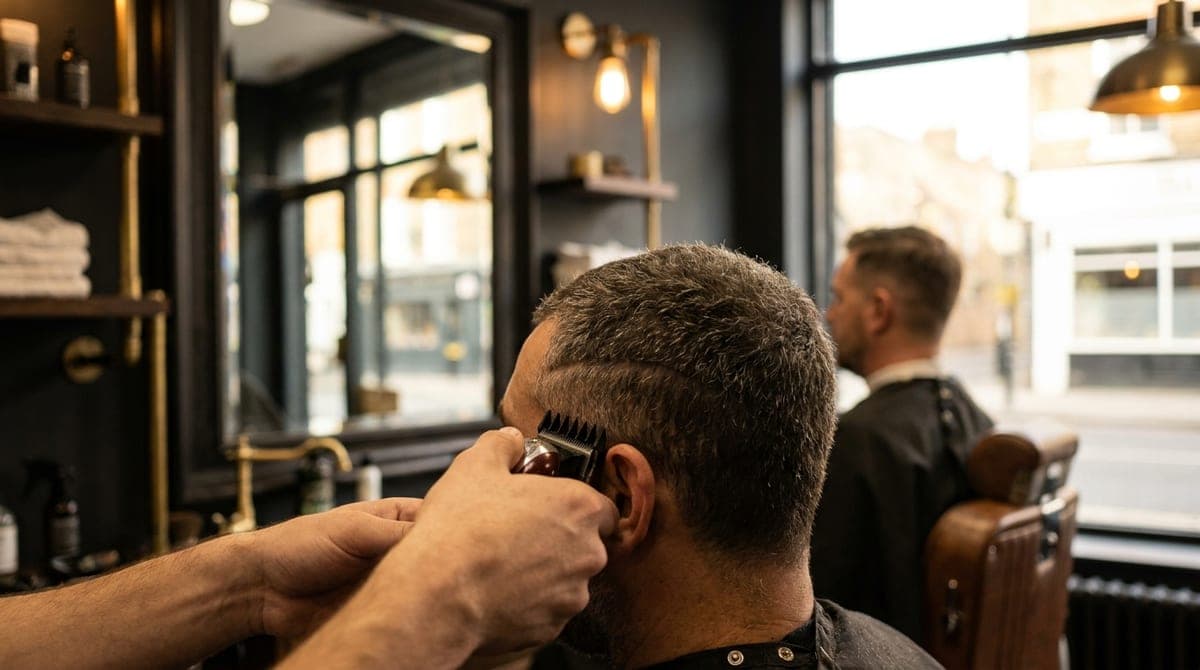
Low, mid and high describe where the fade starts, not how short the sides finish. A low fade begins just above the ear. A high fade climbs up near the temple and can look severe on some face shapes. A mid fade sits in the middle, which is why a barber reaches for it by default when nobody has a strong opinion either way. If you do have an opinion and it is about the two ends, high fade vs low fade goes through which face each one suits.
| Low fade | Mid fade | High fade | |
|---|---|---|---|
| Where the blend starts | The bottom inch, just over the ear | Roughly halfway between ear and temple | Up at the temple corner |
| How much of the side goes short | Very little | About half | Most of it |
| How long it stays sharp | Around three weeks, then it drifts gently | Two to three weeks | About a fortnight |
| A sensible pick if | Your face is long, or you want it subtle | You have no strong feeling either way | Your face is round or broad and you are back every two weeks |
The line runs level all the way round, from one temple, across the back of your head, to the other. If you have seen a fade that dips down behind the ear and climbs again towards the nape, that is a drop fade, and it needs asking for by name, because a barber will cut it level unless you say otherwise.
Height is a separate decision from finish. A mid fade can go all the way to skin, or it can taper to stubble and stop there. We wrote about that choice on its own in skin fade vs taper fade, because most men who ask for "a mid fade" are actually asking two questions at once without realising it. In our booking system both are priced the same way, as a Skin Fade or a Taper Fade, £17 whichever finish you pick. The height gets decided in the chair, not on the price list.
A fair few men who ask for a mid fade actually mean a disconnected undercut: long on top, sides taken straight down with no graduated blend at all. It is a different cut with a different look, and we cover the difference properly in taper fade vs undercut.
Length on top
Textured crop. Short, choppy layers with a fringe pushed forward. The mid fade keeps the sides quiet so the texture on top does the work. Ask for scissor-over-comb through the crown rather than clippers, or it loses the texture that makes it worth having.
Quiff. Length swept up and back off the forehead, with enough product to hold the lift. A mid fade under a quiff reads smarter than a low fade under the same top, because the sides sit higher and frame the face.
Comb over. A side part with the length combed across rather than back. Ask for a defined part line if you want it crisp, or a soft, undefined one if you would rather it looked less deliberate. The comb over fade guide covers that choice in more detail.
Slicked back. Length on top combed straight back with a wet-look product. This one works better with a mid fade than a high fade, because a high fade next to a slicked crown can look severe rather than sharp.
Ivy league. The tidier cousin of the crew cut, kept slightly longer on top and combed to one side without much product. A mid fade keeps it looking put together for work without any daily styling.
Texture, parting and a hard edge
Hard part. A shaved line cut into the side, separating the top from the fade. It needs redoing every couple of weeks as the line grows out, so only ask for it if you are back in the chair often.
Pompadour. More height and more product than a quiff, swept back off the forehead rather than up. Our pompadour guide covers the length it needs. The mid fade gives it a clean base without competing with the volume on top.
Faux hawk. Short at the sides with a raised strip through the centre. The mid fade is what stops it looking like a full mohawk, because there is enough taper at the sides that it still reads as a haircut. How much length the strip needs, and how to push it up in the morning, is in our post on what a faux hawk is.
French crop. Short, textured fringe cut fairly straight across, sides faded up to meet it. We wrote a full guide to this one, the French crop, because there is more to the fringe than one paragraph can hold.
Mullet. Short and faded at the sides and front, left long at the back. A mid fade keeps the front tidy enough that the length at the back reads as a choice rather than an accident. That tapered-sides version is what a modern mullet is, as opposed to the 80s one.
Short on top, low maintenance
Buzz cut top. One guard length all over, blended into the fade rather than left as a hard line. A number two or three on top fading down to skin or stubble at the sides, whichever finish you picked.
Crew cut. Slightly longer than a buzz on top, short enough to need no product, and it grows out better than almost anything else on this list. A mid fade under a crew cut is the cut most men leave with when they say "just tidy it up, nothing fancy".
Flat top. The top cut level and squared off rather than left natural, which needs a fair bit of hair to work with and a comb to keep the edge flat while cutting. It is the boldest thing on this list and it earns a second look.
Spiky crop. Short on top with just enough length to push up and forward with a little wax. Similar to a textured crop but shorter and less styled.
Caesar crop. Short fringe combed forward, no parting. Low effort in the morning, and the mid fade underneath does most of the visual work.
Curls, coils and thicker hair
A mid fade holds up on every hair type, but curly and coily hair change how it reads.
Curly fringe. Length left on top in its natural curl pattern, faded sides so the whole head does not read as one shape. Ask your barber not to over-thin the top, because curls need weight to hold their shape rather than fly up.
Afro top. Full natural texture kept long on top, faded close at the sides. The contrast between the density on top and the fade underneath is the whole point of this one.
Twists. Two-strand twists or finger coils on top, faded sides underneath. The twists need redoing on their own schedule regardless of the fade, so factor that into how often you are actually back in the chair.
Waves. Short hair brushed and trained into a spiral pattern between visits. A mid fade at the sides gives the waves somewhere clean to run into, rather than fading into stubble that hides the pattern.
What to say in the chair
The fastest way to leave with what you actually wanted is to say two things before you sit down: the height (low, mid or high) and the finish (skin or taper). "Mid fade, skin at the bottom, keep two inches on top" tells a barber everything in one sentence. Come in without deciding and we will still get there, just with a couple of extra questions first.
One more pairing worth planning for. If you want a beard trimmed at the same time as a mid fade, book both together rather than adding the beard once you are already in the chair. Getting the fade height and the beard line level with each other is easier when both are planned as one appointment rather than two separate jobs weeks apart.
Common questions
- Is a medium fade the same as a mid fade?
- Yes. Medium fade, middle fade and midfade are all names for the same height, a blend that starts roughly halfway between the ear and the temple. Say any of them and you will get the same cut.
- Is a mid fade the same as a skin fade?
- No. Skin fade and taper fade describe how close to bare skin the bottom of the fade gets. Low, mid and high describe where it starts. A mid fade can be cut with either finish.
- Does a mid fade go all the way round the back?
- Yes, by default it holds the same height from one temple, round the back of the head, to the other. If you want the line to curve down behind the ear instead, that is a drop fade, and you need to ask for it.
- How much is a mid fade at Golden Scissors?
- It is priced as a Skin Fade or a Taper Fade depending on the finish you choose, both £17, in 30 and 40 minute slots.
- How often does a mid fade need cutting?
- Every two to three weeks if you want the line sharp, the same as most fades. It softens faster than a low fade because more of the head is exposed to regrowth.
Read next
Style Guide
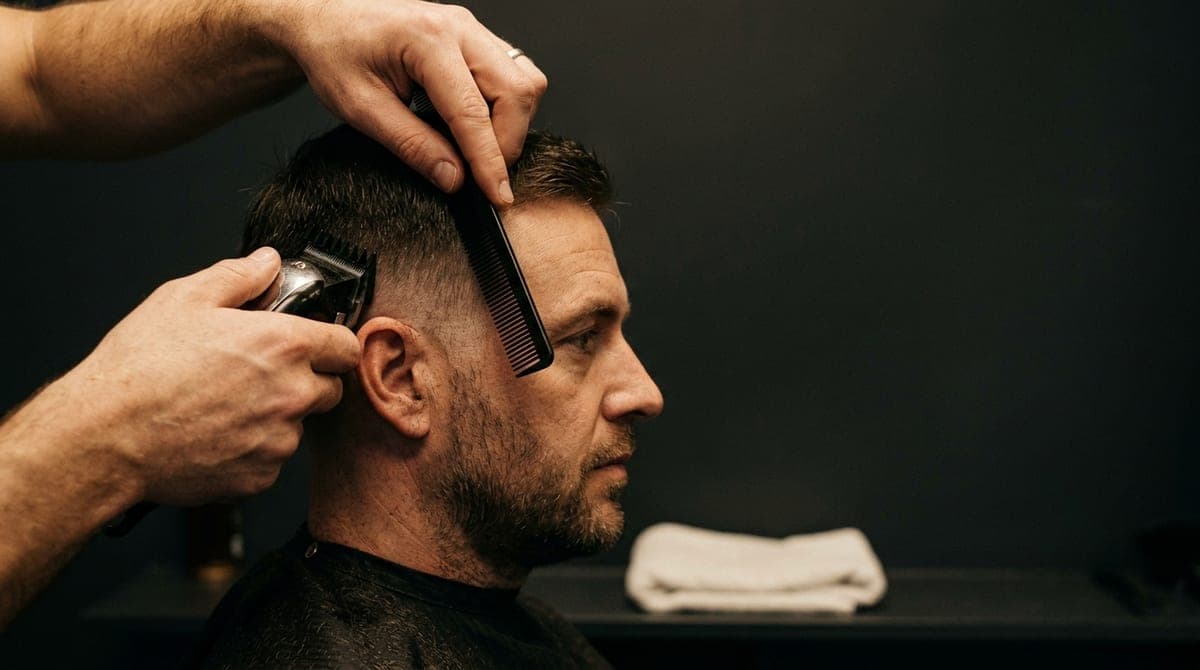
Skin Fade vs Taper Fade: The Difference
A skin fade goes to bare skin, a taper fade keeps a little length. Which one suits your hair, your head shape and how often you can get back to the chair.
5 min
Style Guide
Taper Fade vs Undercut: Which Suits You?
Taper fade vs undercut: one blends all the way down, the other leaves a hard step, and your hairline and your morning routine decide which one you want.
6 min
Style Guide
What Is a French Crop Haircut?
What a French crop haircut is, whose hairline it rescues, what to ask for in the chair, and how long it holds before it needs doing again.
6 min