How to get 360 waves comes down to three things, and the haircut is the smallest of them: hair with some curl in it, a short even cut on top (usually a 1.5 or a 2, so 4.5 to 6mm), and weeks of brushing outwards from your crown, every day, with a durag on at night. The cut gives you an even length to work with. The brushing trains the curl to lie in a ripple. Most of the work is yours, and it is slower than the videos suggest.
How to Get 360 Waves, and the Cut They Need
How to get 360 waves: the guard to start on in mm, the brushing pattern from the crown, when to wolf, and why the clippers must go with the grain.
7 min readGolden Scissors, Maida Vale, London
Will your hair actually wave?
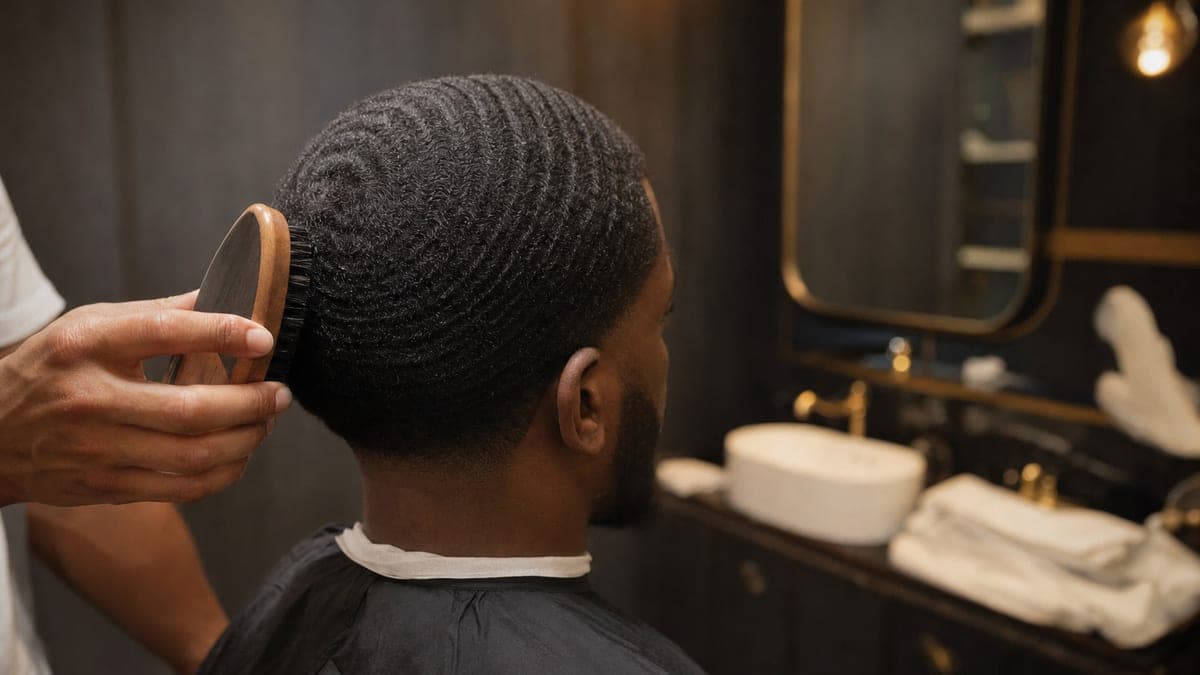
Waves are curl that has been brushed flat until it lines up. So the first question is whether there is curl there to line up.
Afro-textured and tight curly hair is what waves are made from. Loose curls wave fastest, because they lie down without much argument. Very tight coils wave too, they just need a little more length and a lot more brushing before the pattern stops springing back.
Straight hair will not do it. Brushing straight hair flat makes it flat. If your hair is wavy rather than curly, you may get a soft ripple across the top, but not the full ring round the head, and we would rather tell you that now than take your money for a cut that cannot do what you want.
One more thing we check before anything else: where your crown is. The 360 is built outwards from it, so if your whorl sits off to one side, or you have two, the pattern will centre there and not in the middle of your head. That is fine. It just means the brushing has to follow your head, not a diagram.
The haircut that starts it
Waves are not cut in. Nobody can clip a wave pattern into your head, whatever a photo of a fresh cut might suggest. What the cut does is leave the top at one even length so every hair is starting the race from the same line.
| Where you are | Guard on top | Roughly | Why |
|---|---|---|---|
| Starting from scratch, looser curl | 1.5 | 4.5mm | Enough length to lie down, short enough to look neat while you wait |
| Starting from scratch, tight coils | 2 | 6mm | Tight curl needs the extra length to bend into a ripple |
| Pattern already showing | 1.5 | 4.5mm | Sharpens the waves you have without cutting them away |
| Pattern deep and connected | 1 | 3mm | Only once the waves are set; too short before that and they vanish |
Those mm figures assume the clippers go with the grain, which is the one thing about a waves cut that really matters. More on that below. The full set of guard numbers, if you want them, is in our clipper guard lengths guide.
The sides are your choice. Same guard all round keeps the ripple running unbroken down to the ears, which is the classic look. A low taper underneath sharpens it. A high skin fade cuts most of the side waves off, so leave that until the top is where you want it.
How to get 360 waves, step by step
This is the daily routine. Missing a day does not undo anything. Missing a week does.
- Start with damp hair. Wet it, or brush straight after a shower. Curl moves more easily when it is damp.
- Put a little wave pomade or cream on your palms and work it through. A pea-sized amount. Too much and the hair clumps and goes greasy.
- Find your crown with your fingers, the point where the hair swirls.
- Brush the top forward from the crown down to your hairline, in short strokes. A medium brush to begin with; a hard one can irritate the scalp before you are used to it.
- Brush the sides down and slightly forward, from the crown towards your ears and your jaw.
- Brush the back straight down from the crown to the nape. This is the slowest part to come through, and the part most men skip because they cannot see it.
- Durag on, snug, while the hair is still damp. Leave it on for at least half an hour, and overnight if you can.
- Brush again two or three times through the day, a few minutes each, always the same directions.
The direction never changes. Brushing back towards the crown one day and away from it the next is how you end up with a top that waves and a back that frizzes.
How long it takes depends on your hair, and anyone giving you a number of weeks has not seen your head. Expect the first ripple at the front within a few weeks. Expect the back to lag behind the top by a long way. A pattern that connects all the way round is months, not days.
Wolfing, and what a haircut does to it
Wolfing means going without a cut so the hair gets longer and the waves get deeper. Each wave is a bend in the hair, and longer hair has more room to bend.
The catch is the edges. Three weeks into a wolf the waves are deeper, but the hairline has gone soft and the neck has grown in, so the whole head looks scruffy even though the top is working. That is when most men give up and ask for a short cut, and lose the depth they spent a month building.
The answer is to cut the outside without touching the inside. When you come in mid-wolf, tell us before we pick up the clippers: edges and neck only, top stays. We line up the front, clean the neck and the bits round the ears, and the waves you have built go home with you. There is no separate line-up price on our list, so book the Crew Cut and say "don't touch the top" when you sit down.
When you do come out of a wolf, cut the top back to the guard you started on, with the grain, and the pattern underneath should still be there.
Why the clippers have to go with the grain
This is where a haircut can wreck waves, and it is the part most wave guides skip.
Clipping against the grain, from the neck upwards, cuts closer than the guard number says, because it lifts the hair off the scalp before cutting it. That is how most short cuts are done and it is fine for a crew cut. On a waves head it does two kinds of damage. It takes the top shorter than you asked for, and it stands every hair up against the direction you have spent weeks brushing it, so the pattern comes out looking broken.
So on waves we go with the grain: the clippers follow the same directions as your brush, forward on top, down at the sides and back. The guard leaves the length it is supposed to, and the hair is cut lying the way it already lies. Expect the result to look a little longer than a normal 1.5 or 2. That is the point.
If you book in, the sentence that does it is: "I'm growing waves. A 1.5 on top with the grain, same on the sides, line the front but follow my hairline." If the hairline part matters to you, our post on the afro taper fade explains why redrawing the edge every fortnight moves it back over time.
Bring the brush
Come in with the brush you use at home and your hair brushed the way you brush it. We will see which way the pattern is already running, which patches are behind, and where your crown is, and cut to that. A barber looking at freshly brushed waves cuts a better waves cut than one guessing from hair that has been under a hat all morning.
If your waves are not coming through at the back, that is usually the brushing, not the cut. Turn the mirror round and check you are actually reaching your nape. The rest of your night-time routine, durag and pillowcase, is in our guide to protecting your hair while you sleep.
Common questions
- Should I wash my hair while I am growing waves?
- Yes, but gently and not every day. A sulphate-free shampoo once or twice a week, conditioner every time, and brush the pattern back in while the hair is still damp, then put the durag on. Hair that is dry and brittle will not hold a wave.
- Durag or wave cap?
- Either does the job of pressing the pattern flat overnight. A durag ties tighter and covers the back of the neck, which is where waves are slowest to come through, so that is what we would pick if you only buy one.
- How much is a waves cut at Golden Scissors?
- One guard over the top and sides is our Crew Cut, £10 for 20 minutes. If you want the sides faded under the waves, that is the Skin Fade or the Taper Fade, both £17.
Read next
Style Guide
What Is a Caesar Cut? Two Cuts, One Name
A Caesar cut means two different haircuts, depending on who is asking. How to tell them apart, the words that get you yours, and what each one costs.
5 min
Curly & Afro
Afro Taper Fade Types and What to Ask For
Every afro taper fade side by side, temple to burst, what a soft taper and a round afro mean, and the exact words to use so you leave with the right one.
8 min
How To
How to Protect Hair While Sleeping
What happens to your hair overnight, how to protect hair while sleeping, and the twenty-second morning fix. From the barbers on Harrow Road.
6 min