A taper fade is a gradient. The hair gets shorter as it drops down the side, with no line anywhere in it. An undercut is a step: the sides go to one length all the way up, the top stays long, and the two are deliberately not blended. That is taper fade vs undercut in a sentence. Which one you should get depends less on the picture you brought in and more on how much length you have on top, and how much time you will give it every morning.
Taper Fade vs Undercut: Which Suits You?
Taper fade vs undercut: one blends all the way down, the other leaves a hard step, and your hairline and your morning routine decide which one you want.
6 min readGolden Scissors, Maida Vale, London
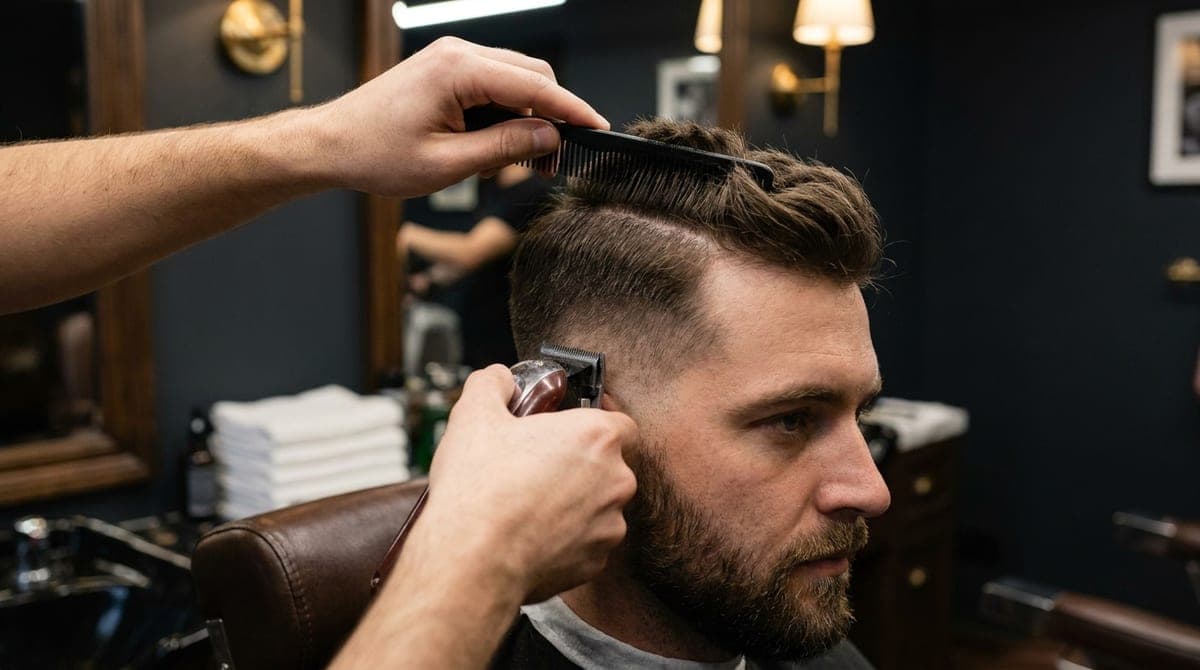
Taper fade vs undercut, in the mirror
Taper fade. We start short at the bottom, usually a half or a one, and work up through the guards so each change disappears into the one above it. Done properly you cannot point at the spot where one length becomes another. The sides get gradually longer until they meet whatever is on top, and there is no edge in it.
Undercut. One guard, one pass, the same length from the neck up to a line we agree on, usually around the temple or just above the ear. Above that line nothing is touched. The top keeps its full length and sits over the short sides with a visible step where the two meet. The step is not a mistake. It is the entire cut.
The taper hides how it was built. The undercut shows it off. Look at the back of your head with a hand mirror and a taper looks like the hair is growing shorter on its own, while an undercut looks like two haircuts stacked on each other. That is what people mean when they say disconnected. The Korean take on the same idea, with the line run as a horseshoe over the back of the head, is the two block haircut.
You need real length on top for an undercut
This is where most undercuts go wrong, and it is almost always a length problem rather than a barbering one.
An undercut needs something on top heavy enough to fall over the short sides. Three or four inches is the working minimum and longer is easier. If you have two inches up there and you take the sides down to a two, the top has no weight to sweep back, so it sits out sideways and you have got yourself a very short bowl. Nobody asks for that. Plenty of men accidentally book it.
A taper does not care. It works at any length on top, from a crop to something you can tie back, because the sides are graduated into whatever is already there. If you are growing your hair out and you want it kept tidy on the way, the taper is the cut that carries you through the awkward months. The undercut is the one you get once you have arrived.
Worth knowing before you sit down: what each guard number actually leaves is the difference between an undercut that reads sharp and one that reads severe. A one and a three are both "short back and sides" to most people, and they are not the same haircut.
How they grow out
A taper fade holds its shape for about three weeks and still looks deliberate at four. There was never a hard edge in it, so there is nothing to go blurry. It just becomes a slightly longer version of itself.
The undercut is stranger, because the line is the part that ages. For the first fortnight it stays crisp. After that the sides grow up into the line and it goes soft, so instead of a clean step you get a fuzzy shelf, and the sides start adding bulk in exactly the place you wanted none. At five or six weeks, a heavy top over grown-out sides is the mushroom. It is why the undercut has a reputation for looking bad on some men and excellent on others. The ones it looks excellent on are the ones getting the sides redone every three weeks.
Neither is low maintenance in the way men hope. The taper needs the chair more often than it looks like it should. The undercut needs product and five minutes every morning, because the whole shape depends on the top being put somewhere on purpose. If you towel dry and walk out of the door, take the taper.
Your hairline, your head and your job
A receding hairline. The taper is kinder. The gradient at the temple gives the eye something to travel along, so the corners go quietly. An undercut takes everything off around the temple and then stops, which frames the recession and lights it. If your hairline has moved and you would rather not advertise it, that is the deciding factor, and we will say so in the chair rather than let you find out at home.
Fine hair. The undercut is better than you would expect. Taking the sides down removes bulk from the one place fine hair looks thin anyway, and the top keeps every millimetre of length it has, so it reads denser. Compare that with a skin fade set against a taper, where going to bare skin can make fine hair on top look sparser by contrast.
Thick or curly hair. Both work. Curls over an undercut are one of the better looks going, although the step will vanish under the curl pattern unless the line is cut high enough to be seen.
Face shape. Height on top from an undercut lengthens a round face. On a long, narrow face it adds to length you already have, and the taper is the safer bet. That is a two minute conversation at the start of the appointment, not something to work out from a photo on your phone.
Where you work. A taper is invisible in any room. An undercut is a statement, and a hard disconnect over a very short side is a louder one than the reference picture usually suggests.
What to ask for, and what it costs here
For a taper: "Taper the sides, no skin, down to a one at the bottom, keep the length on top." Then say square or natural for the neckline, because that one word decides what the back of your head looks like for the next month.
For an undercut: "Undercut, a two on the sides, line just above the temple, leave the top long and disconnected." Say whether you want the line following the shape of your head or sitting level the whole way round. They look quite different from behind.
A taper fade is £17 in a 40 minute slot, and the extra ten minutes over a standard cut is the blend, which is the part you cannot rush. The undercut is not its own line on the price list. Book the £15 haircut and ask for it when you sit down, because it is scissor work on top and one clipper pass on the sides, and it fits inside the 30 minutes.
If you cannot decide, have the taper first. You find out how you like the sides short without committing the length on top to anything, and if you want the disconnect next time we can take it there in a single appointment. Going the other way, growing a top out to cover an undercut you regret, is a three month job. Book a chair and bring the photo anyway. It tells us more about what you actually like than the words usually do.
Common questions
- Is an undercut the same as a fade?
- No. A fade is graduated, so the length changes as it drops and no line is visible. An undercut is one length on the sides with a deliberate step where it meets the top.
- How long does my hair need to be on top for an undercut?
- Three or four inches is the working minimum. Less than that and the top has no weight to sit back over the short sides, so it stands out sideways instead.
- Can I have an undercut and a taper at the same time?
- Yes, and we cut it often. Disconnected on the sides, tapered into the neckline at the back, so the shape stays sharp from behind without softening the step at the temple.
- Which one needs cutting more often?
- The undercut, if you want the line crisp. It holds about a fortnight against three weeks for a taper, though the taper is still tidy at four.
- What do they cost at Golden Scissors?
- A taper fade is £17 in a 40 minute slot. An undercut is not a separate line on our list, so book the £15 haircut and ask for it in the chair.
Read next
Style Guide
Skin Fade vs Taper Fade: The Difference
A skin fade goes to bare skin, a taper fade keeps a little length. Which one suits your hair, your head shape and how often you can get back to the chair.
5 min
Style Guide
Low Taper Fade: The Complete Guide for 2026
What a low taper fade actually is, who it suits, exactly what to ask for in the chair and how often it needs tidying. From the barbers on Harrow Road.
6 min
Barbershop FAQ
Clipper Guard Lengths: 1 to 4 Explained
Clipper guard lengths in plain millimetres: what a number 1, 2, 3 or 4 actually leaves, which one your sides want, and how to ask for it.
5 min