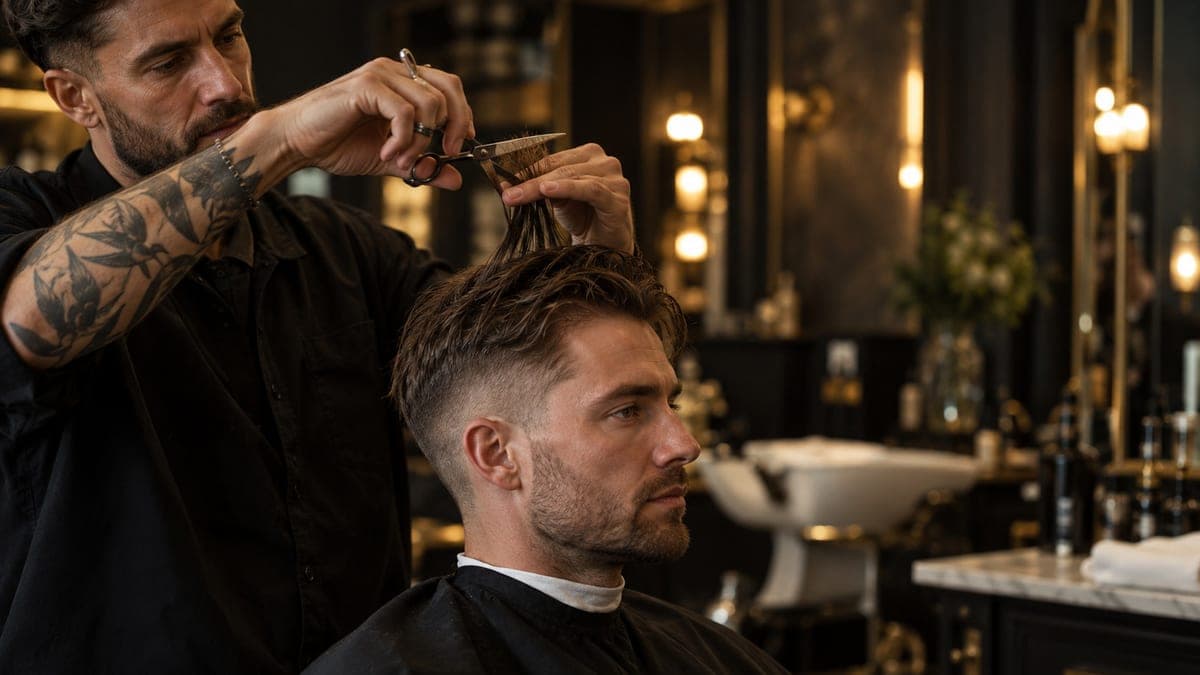
A warrior cut is length left on top, cut into choppy separated pieces, sitting over sides taken short enough that the contrast is the point. Two to four inches up top, a taper or a fade at the sides, and the tips of the scissors driven into the ends so the top never reads as one solid block. The finish is matte and deliberately unfinished. That is the whole cut.
Warrior Cut: What It Is and Who It Suits
What a warrior cut actually is, how the choppy top gets cut, which hair holds it and what to ask for in the chair, from the barbers on Harrow Road.
7 min readGolden Scissors, Maida Vale, London
What a warrior cut actually is
Strip the name off it and you have three decisions.
The first is length on top. Enough that the hair falls forward and moves when you turn your head, which in practice means two inches at the absolute minimum and three to four for the version most men have seen a photo of.
The second is what happens to the ends. They get point cut, which means the scissors go into the hair vertically and take small wedges out of the ends rather than cutting straight across them. A blunt cut end sits next to its neighbour and the hair behaves as a sheet. A pointed end has nothing to line up with, so the hair breaks into pieces on its own. That separation is what people are actually responding to in the photos, more than the length.
The third is the sides, and this is where the cut is won or lost. The top only looks long because the sides are short. Take a 1 or a 2 up the sides, taper it, and the shape has structure holding it up. Leave the sides at three weeks of growth and the same top just looks like you need a haircut.
Some barbers cut it disconnected, with a hard step between the short sides and the long top and nothing blending the two. Others taper it so the length arrives gradually. Disconnected is the stronger look and it is less forgiving, because the step sits wherever it was put and you live with it for a month.
Worth separating this from the other shaggy cut men come in asking about. The wolf cut is layered the whole way through and needs real length before it does anything, sides included. This one keeps the sides short on purpose. If the movement appeals but the better part of a year of growing it does not, this one starts working at two inches where the wolf cut wants four, which is two or three months from a short back and sides rather than seven or eight.
The name is new, the haircut is not
This is a 1990s cut with a 2020s name on it. The reference everyone lands on eventually is Brad Pitt as Tyler Durden in Fight Club, which came out in 1999: short at the sides, spiked and uneven on top, nothing about it looking arranged. Grunge had already been doing a scruffier version of the same idea for most of that decade.
We would rather say that plainly than pretend a new cut has been invented. Nobody publishes reliable figures on what men are asking barbers for, and any shop quoting you a percentage has made it up or copied it from somebody who did. Our side of it is narrower and more useful: what the cut is, what it needs, and who walks out happy with it.
The honest value in the name is that it gives you something to say. "Warrior cut" gets you closer to the right cut than "a bit longer on top, messy" does, because most barbers have now seen the same photos you have.
The hair it actually works on
Thick or medium hair with a bit of natural movement. This is the hair the cut was designed around. The strands carry enough weight to stay apart, and enough bend that they do not all fall the same way. If your hair already does something slightly annoying of its own accord, this cut turns that into the feature.
Fine straight hair. The hard one. Point cutting makes fine hair look fuller for about two hours, then gravity wins and the top lies flat. Clay buys you a few more hours and no more than that. We would steer you to a textured crop instead, which is shorter, keeps its shape without holding anything up, and flatters fine hair rather than exposing it.
Tight curls. The choppy layers are invisible in a curl pattern that is already doing its own thing, so you pay for texture you cannot see. A shape-up with length left on top gets you the same silhouette.
On face shape, height on top lengthens a face. If yours is already long and narrow, ask for the length kept forward and down rather than pushed up, or you will add an inch to your reflection. Rounder and squarer faces get the most out of it, because the height is doing something useful.
One caution worth saying out loud. If your hairline is going at the temples, a disconnected top pulled back and up puts a spotlight directly on it. The forward-falling version is fine. The swept-back version is not, and no amount of clay fixes that.
Saying it out loud so you get it
Say the length, the sides and the disconnection, in that order.
"Leave three inches on top, point cut through the ends so it separates, take the sides to a 1 and taper it up, and blend the top in rather than leaving a step." Ten seconds of talking, and nothing is left to guess at.
Two things worth adding if they apply. Say if you want to be able to push it forward onto your forehead, because that changes how much length stays at the front. And say how often you realistically get a haircut, because that decides between a fade and a taper. A taper grows out clean and a skin fade does not, and this cut leans on its sides more than most.
Photos help. Two of them help more, especially when they do not quite agree, because the difference between them is usually the thing you actually care about.
Getting it to sit right without it looking done
Start damp, not wet and not dry. Towel it off until it has stopped dripping.
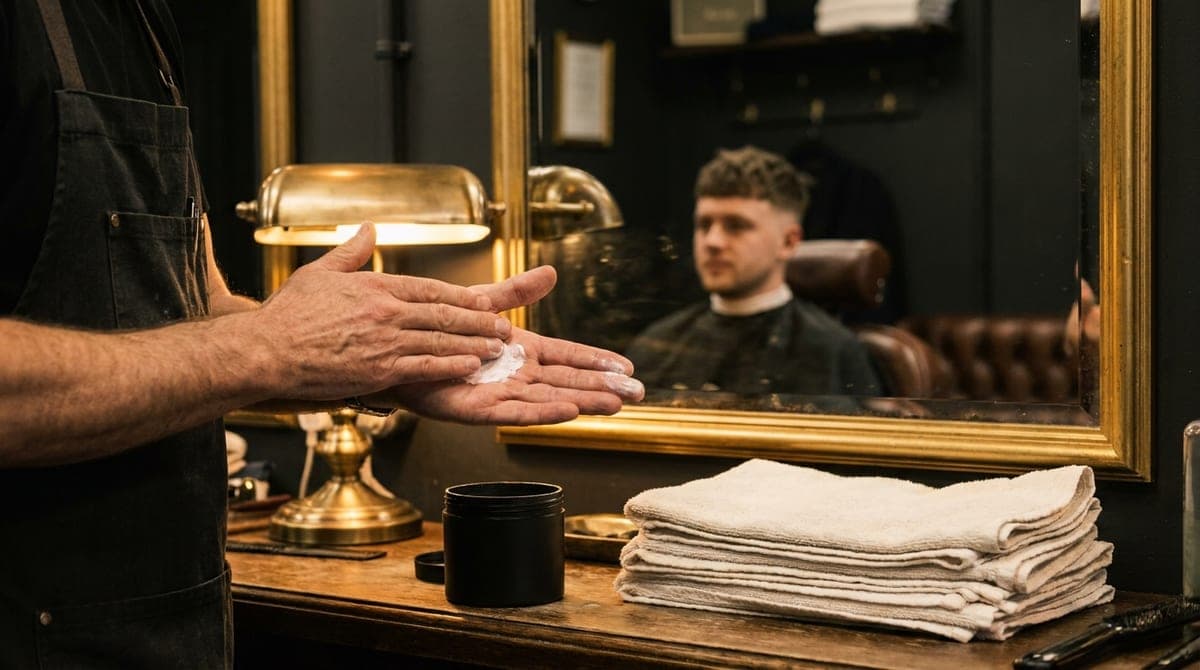
Use a matte clay, about a five pence coin's worth, worked through your hands until you cannot see it any more. It should never land on your head as a lump. Clay is the right product here because it absorbs oil, scatters light instead of bouncing it, and swells the strand slightly, which is exactly the set of things this cut is asking for. If you want the longer version, we have written about which product does what.
Then use your fingers and nothing else. A comb puts every piece in the same direction and undoes the separation you paid for. Push the hair roughly where you want it, break the front up with your fingertips, and stop. The most common way this cut goes wrong is a man styling it for four minutes when it needed forty seconds.
No hairdryer unless your hair is genuinely flat at the root, and if you do use one, rough-dry it upside down and finish cool.
What it costs to keep
The sides drift before the top does. Three to four weeks in, the contrast has softened and the cut stops reading as a cut, even though nothing is wrong with the length on top. Come in on that cycle and ask for the sides tightened and the top left alone, and you will only need the ends re-pointed every second visit.
On our menu that is the £15 haircut, booked at 30 minutes, rising to £17 and 40 minutes when the sides want a proper fade instead of a clipper and a taper. The four-week tidy is short enough that most men take it as a walk-in rather than planning an appointment around it.
Growing into it from a short back and sides has one bad stretch, months two and three, when there is enough length on top to flop about but not enough for the ends to break apart. Keep the sides tight through it. The cut is contrast, and contrast is the part you can still have while the top catches up.
Common questions
- Is a warrior cut the same as a wolf cut?
- No. A wolf cut is layered all the way through and wants four inches or more, so the length changes gradually and the sides are cut into rather than cut off. A warrior cut is built on contrast: a short back and sides underneath a top that is left long and broken up.
- How long does my hair need to be on top?
- About two inches before there is enough to separate, and three to four is where it looks like the photos. Hair moves roughly a centimetre a month and a short back and sides only starts you two or three centimetres in, so two inches is two or three months of growing and the photo version is more like five to eight.
- Does a warrior cut work on fine hair?
- It is the hardest hair to do it on. Fine straight hair has no weight to hold the pieces apart, so by lunchtime the top has laid down flat and the cut has gone. A textured crop does the same job on fine hair and does it better.
- How often does a warrior cut need cutting?
- The sides go first. Three to four weeks and the contrast that makes the cut has softened, even though the top is still fine. Most men here end up on a four week cycle with the top only tidied every second visit.
- How much is a warrior cut at Golden Scissors?
- It is priced by what the sides need. Scissor or clipper sides with the top cut in is an ordinary haircut, £15 for 30 minutes. If you want the sides faded properly underneath it, that is a taper fade at £17 for 40 minutes.
Read next
Trend
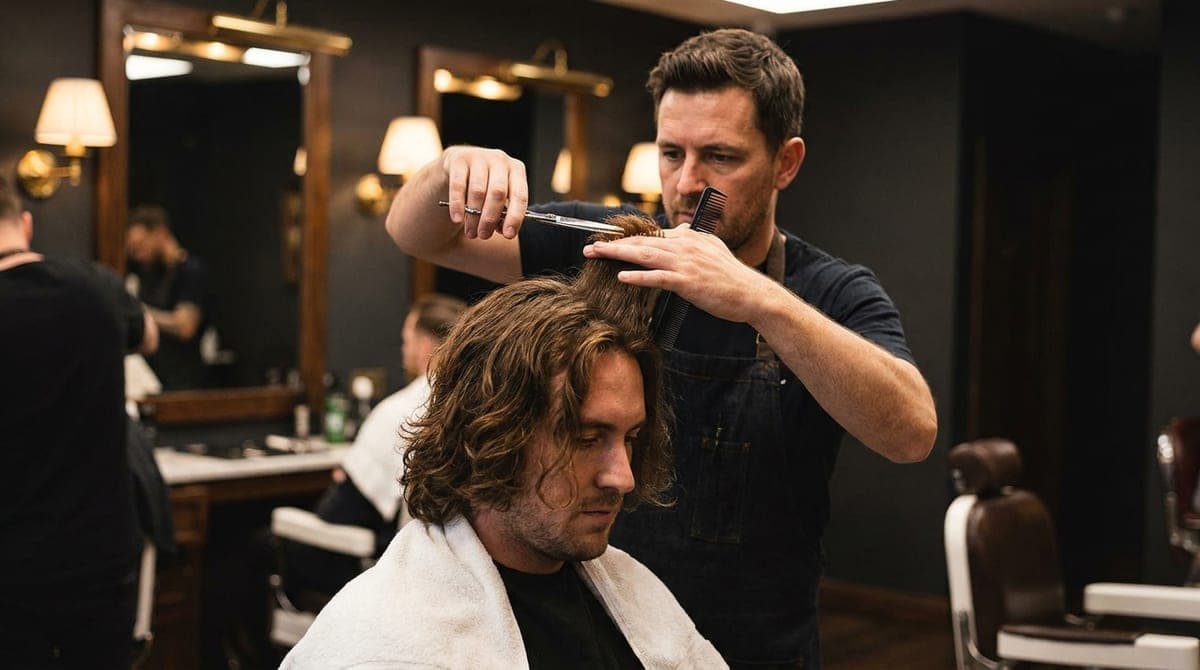
Wolf Cut for Men: Is It Still In for 2026?
The wolf cut men ask for in 2026 is softer than the 2021 one: what it is, who it suits, what to ask for and how long you need to grow first.
7 min
Trend
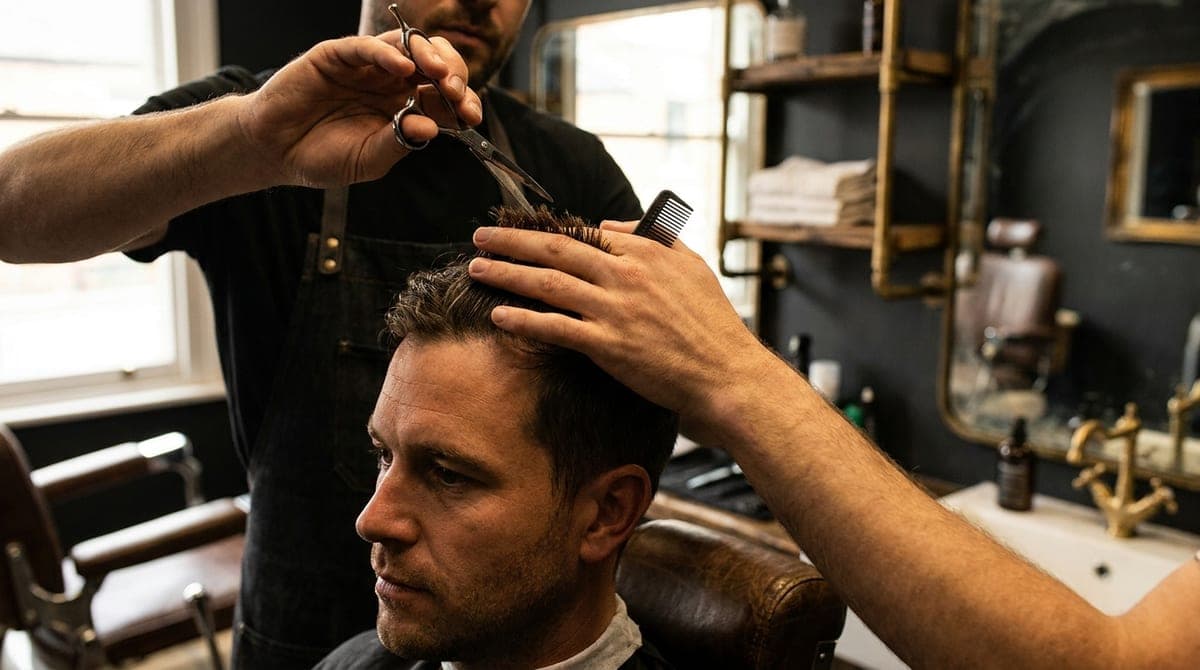
What Is a Textured Crop?
What a textured crop actually is, how the texture gets cut into the top, and which hair types it flatters, from the barbers on Harrow Road.
5 min
Products
Clay vs Pomade vs Wax: Which Do You Need?
Clay vs pomade vs wax explained by barbers who see the results three weeks later: what each one does, which suits your cut, and how to wash it out.
5 min